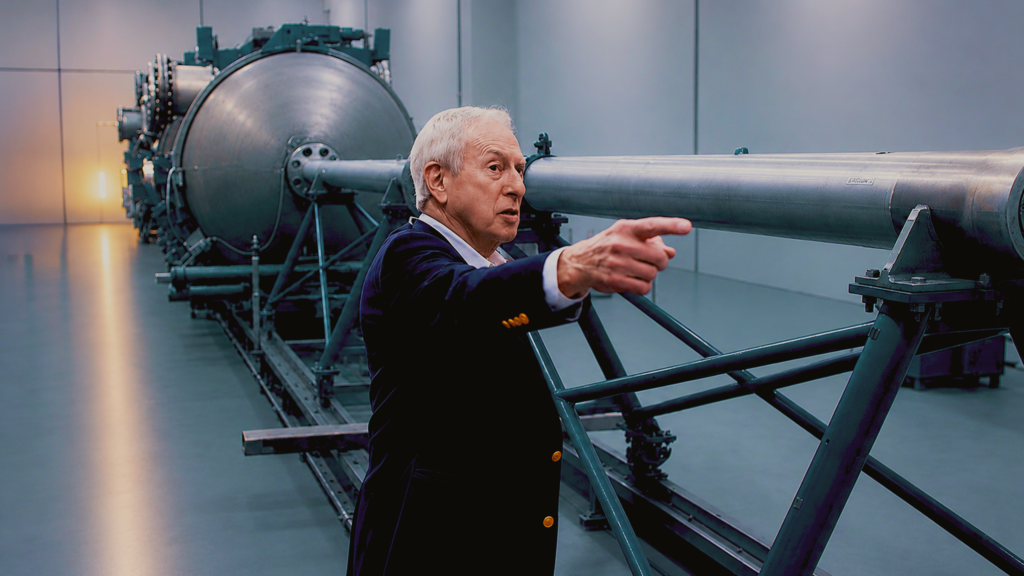
We asked John Serafini, who has spent two decades building and backing national security companies.
John is a West Point grad and former Army infantry officer (Airborne Ranger-qualified) who served with the 82nd Airborne and on the Korean DMZ. After the Army, he studied at Harvard Business School and the Kennedy School, then moved into venture. At Allied Minds, he helped form and fund a string of dual-use companies, including Federated Wireless, BridgeSat, Percipient Networks, and HawkEye 360. John has led HawkEye as cofounder and CEO since 2016, and he’s also a partner at Shield Capital, the dual-use fund led by Raj Shah and Philip Bilden.
Based in Herndon, Virginia, HawkEye uses satellites to detect and geolocate radio signals, and it went public on the NYSE in May (with a most excellent ticker: $HAWK). It’s a familiar name in Per Aspera‘s pages: we wrote about its IPO (#047), its launch of three satellites on SpaceX’s Bandwagon-5 (#067), and more. (Jeff co-led HawkEye’s Series D back in 2021.)
So why do so many veterans end up building hard tech? Here’s John’s answer.
I have had an enjoyable two-decade career as a defense tech venture investor and company builder. When I left the U.S. Army infantry in 2004, then graduate school in 2007, the idea of defense tech as a stand-alone venture capital investment thesis was still years away. Funds that I was blessed to have worked with at the time were forward thinking in their approach to dual-use technologies and recognizing that material venture returns could be achieved with what we now associate as the C4ISR technology commercialization paradigm.
Over the past twenty years in this sector, I’ve seen investment ideas come and go, different administrations evolve their approaches to commercial, and government customers slowly build an appreciation for what the “Silicon Valley” community can contribute to our national defense. And, of course, I’ve witnessed many wonderful dual-use companies appear, grow (or didn’t), mature, and eventually exit.
Not surprisingly, what’s been constant throughout those 20 years and what has propelled so many of our industry’s winning companies has been exceptional management teams. And while I won’t generalize by saying veterans make up the majority of these founders and managers in defense tech, so many of them have been veterans.
The traits that define a great founder and C-suite team player—absolute resilience, a compelling vision, the selflessness to put “we” before “me,” and the willingness to wake up every morning ready to run through walls to accomplish the mission—are often the very characteristics forged in uniform, leading American soldiers under far more demanding circumstances with exponentially greater stakes. In that environment, success is not simply measured by achieving an objective, but by protecting the lives of those entrusted to your leadership and making consequential decisions with imperfect information. Today, my top goal is ensuring Warfighters have the timely, accurate, and trusted information they need to execute their missions and return home safely. That unwavering commitment to mission success and accountability to the constituents who depend upon you is precisely what makes military leadership experience so powerful in the entrepreneurial arena.
For the veteran, you never get the need to serve out of your heart, out of your blood. It is always there whether in uniform or not. Those who have served know this. It’s constantly in the back of your mind, the voice asking, “am I still contributing?”. And so, I’ve come to appreciate that defense tech as an industry provides not just the opportunity to deliver critical functionality to our Warfighters, better, faster, and cheaper than ever before; moreover, it is also a pathway for thousands of veterans, across the continuum of our military forces, to continue with great pride and effectiveness their lifetime of service to our Nation.
Generations before, that lifetime of service ended on a person’s ETS date, separation, or retirement. Now, with the acceleration of the defense tech industry a veteran’s time in uniform is just one component- just one phase- of their personal contribution to America. The mission continues.
And so, when I see a veteran leading or contributing to a defense tech company, I thank them. Not just for their service in the military and what they invested of themselves for our country in days gone by, but for what these Americans continue to do today and tomorrow to make our military more capable and our Nation better protected.