The World Leader
Fun fact: the most nuclear-powered country on Earth is about to be Slovakia. Five reactors already supply 60%+ of its electricity, and a sixth, Mochovce 4, reached the grid on Oct. 15. At full power it covers another ~13% of national consumption, which pushes Slovakia past France.
It is a slow, expensive way to take the crown: Mochovce 4 is half of a two-reactor completion job that was budgeted at €2.8B when work restarted in 2008 and finished at ~€6.7B, a 139% overrun, and that was to finish units whose foundations were poured in the 1980s. The unit took 18 years from that restart to first electricity, and nearly four decades from the day construction began, when the country putting in shovels was still Czechoslovakia.
And yet, by recent Western standards, Slovakia got a good deal.
- Looking West, France’s Flamanville 3 took 17 years and €23.7B with financing (~€14.5K/kW). Vogtle 3/4, America’s only new build this century, took 11 years from first concrete and ~$35B (north of $15K/kW).
- Looking East, South Korea’s first APR1400s came in around $2.4K/kW overnight, and China’s Sanmen AP1000s finished at ~$3.2K/kW all-in, by Beijing’s count.
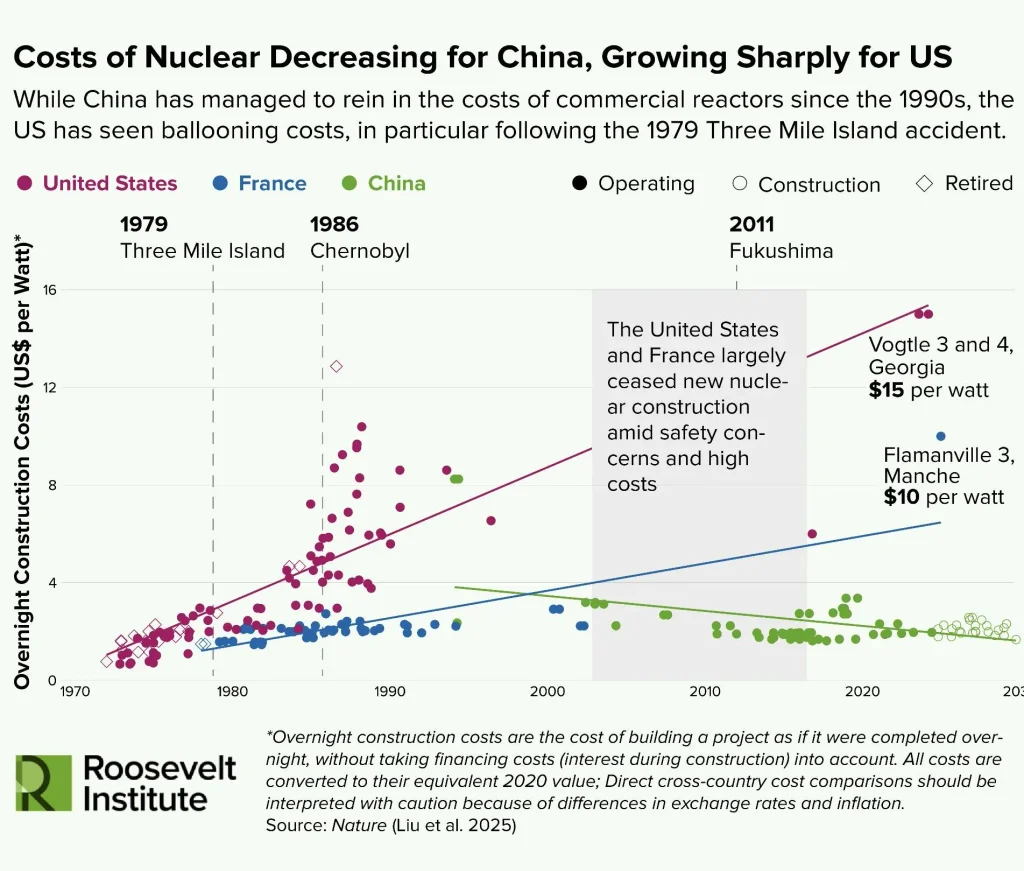
The cleanest comparison would be Sanmen, where China built the same Westinghouse AP1000 that Georgia built, starting four years earlier. All four Chinese units were running before Vogtle 3. China then localized the design as the CAP1000 and currently has a dozen under construction. The furthest along, Haiyang 3, should connect by year-end, four and a half years after first concrete.
All Eyes on the AP1000
For all of the excitement about new nuclear form factors (SMRs!), Washington and its allies are very keen to build the proven design (AP1000) again, at fleet scale, and brute-force our way back down the learning curve. Over the last year the pieces have fallen into place:
- The $$$: A year ago, the government agreed to arrange financing for at least $80B of Westinghouse reactors. Japan earmarked up to $100B more, tucked inside its $550B investment pledge. On Oct. 1, Korea committed up to $120B for six AP1000s and two APR1400s on federal sites, with a $10B advance due by year-end.
- The parts: Vessels and steam generators take years to forge, and no press in North America is big enough for the largest pieces. In June, DOE put up $17.5B in loans to order long-lead parts for up to 10 units.
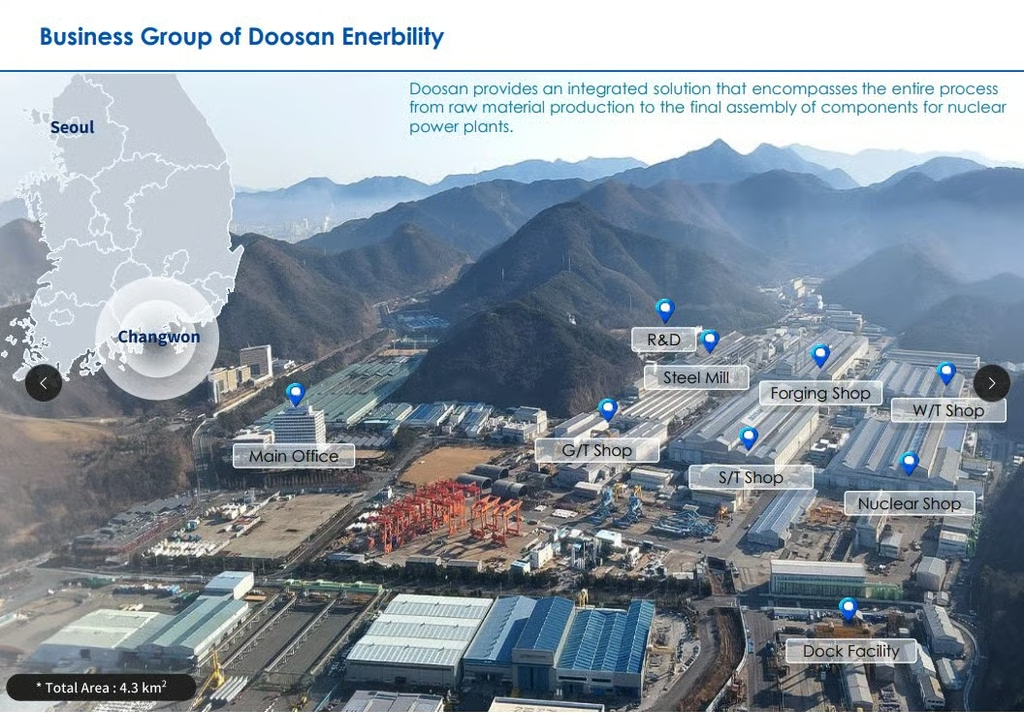
- The builders: Korean industry makes those parts and builds these plants. Doosan Enerbility forged Vogtle’s steam generators and Sanmen’s reactor vessels at its works in Changwon (see above), and Korea, which has put eight APR1400s into service since 2016, will build up to two of its own on a federal site, with ~$2B a unit flowing back to Westinghouse.
- The paperwork: On Oct. 14, the NRC renewed the AP1000 certification to 2066 with 180+ amendments folded in.
THE GREAT HOPE is that Vogtle was a one-off penalty: the price of dusting off the boots after 30 years, relearning the tribal knowledge we’d lost, and stop-starting a few times along the way. The government has called for 10 large reactors under construction by 2030, so the clock is ticking.
A CODA IN CARRS BOTTOM, KY: Last Wednesday, The Nuclear Company proposed Prosperity One, a site with up to six AP1000s on the Ohio River in Lewis County. At 6.6 GW, it would be the largest nuclear plant in America. Phase One calls for two units, with construction targeted for 2028. It has no cost estimate, no offtaker, no NRC application, and no PJM interconnection filing yet. What it does have: an Eclipse-led $51M Series A, a JV with Brookfield (which is also running the V.C. Summer 2 and 3 restart), and a chief nuclear officer, Joe Klecha, who spent the Vogtle construction years on site. And, hey, we like big swings!
Ryan Duffy is the Editor-in-Chief of Per Aspera.