Cheers to Pursuing Endless Frontiers.
A few weeks ago, I was invited by my dear friend Jordan Blashek (investor, veteran and true mover of the movement) to give a talk at Endless Frontiers. To speak on “10 Challenges” that the country needs to address together over the next century.
As I started writing out my speech for you all, I decided perhaps one (old) man attempting this exercise may be a bit presumptuous — so I’ve decided to skip the polished prose and give you all a snippet into my thinking process.
My request: if you have something to add, write in to team@peraspera.us.
1. Scaled manufacturing (duh!)
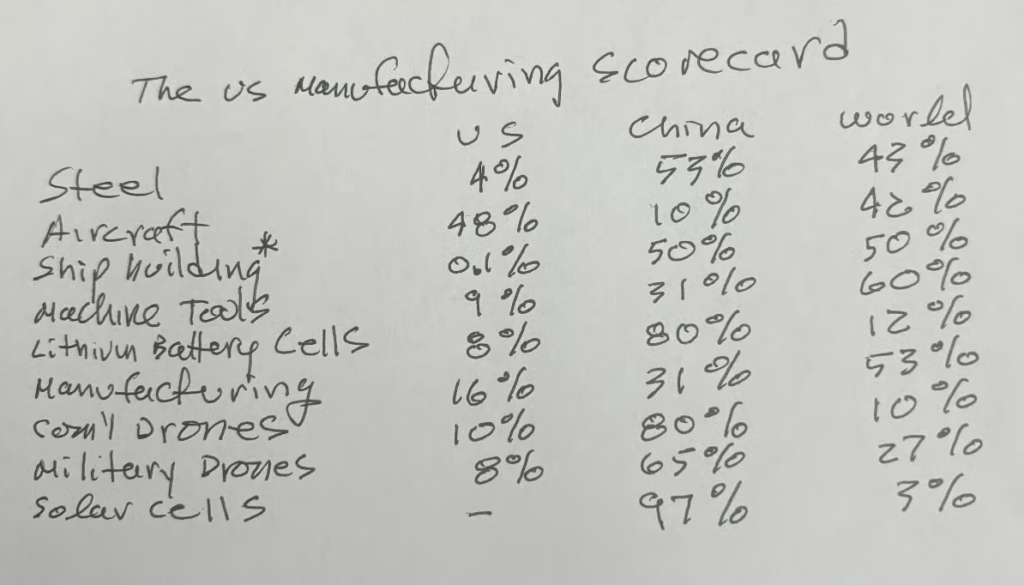
Let’s start with a simple one: we need to scale manufacturing with new tools and common sense to get our economies of scale back.
2. Shipbuilding.
In 1950, Admiral Hyman Rickover set out to build the first nuclear submarine. Four years later he had the Nautilus. Over the next 13 years, we built 41 ballistic-missile subs and 1,092 Polaris missiles for ~$124B in today’s dollars. Columbia’s scorecard: 12 subs, 192 Trident D5 missiles, ~15 years, and $130B+. Rickover did it on drafting boards with no computers. We have AI, exaflops, every digital design tool ever made — and we’re slower. How in the hell. Time to go FBC.
3. Humanoid Robots.
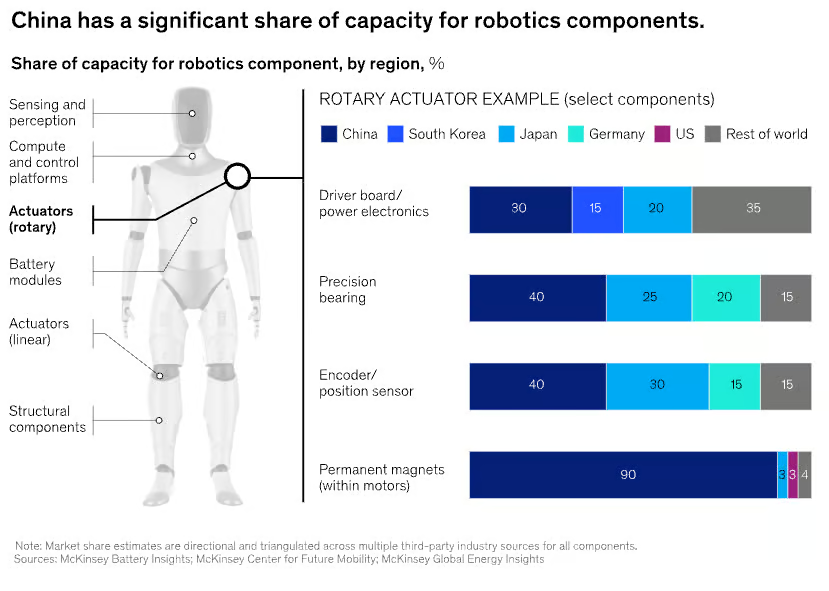
China is building them by the 100,000s; America by ones and twos. Boston Dynamics is magnificent and not replicable. Our leading humanoid developers — the ones actually trying to commercialize — have learned the hard way that you have to fully vertically integrate, design to deployment, to control your destiny. We need more upstream suppliers. We need the Actuator Manufacturing Corporation Of America. Those on Team Specialist will agree: we need our industry working on all of this!
4. Fusion (& Fission).
We want fusion on spacecraft, and we want it — plus fission — for our terrestrial power-hungry tenants down here too.
- ITER has burned $24B+ of public money for first plasma in 2034 and a first plant in the 2040s. Meanwhile $15B of private capital has flowed into 50+ fusion startups targeting next decade. (More on fusion here.)
- On the proven track, every one of the last 38 reactors that broke ground globally used a Chinese or Russian design.
Pick your horse, there are plenty, but we need more clean, compact, safe power decoupled from hydrocarbons’ geopolitical shocks (e.g. Strait of Hormuz).
5. Hypersonics.
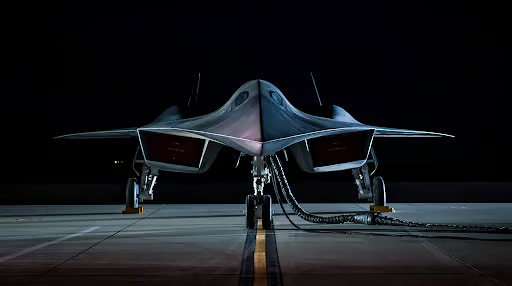
We invented the field, and we are not the leader anymore. Shame on us! China has wind tunnels, higher-temp materials (1,600°C hotter), and physics-informed neural nets simulating before flying, that we don’t have. A bright spot: Bryon Hargis and Castelion, shipping a $300K U.S.-built hypersonic, ~3yrs from a cold start.
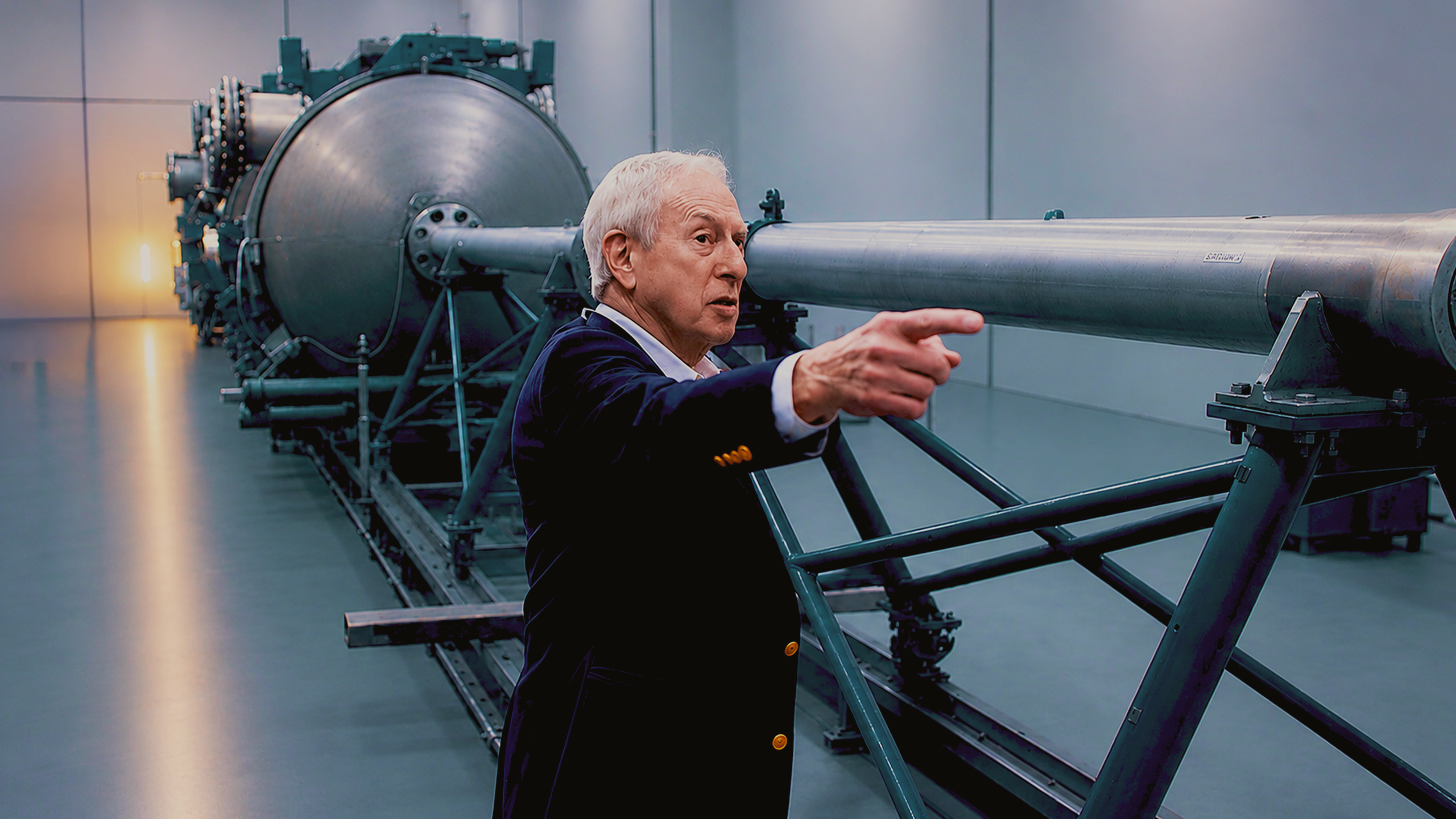
In 2004, my NASA team flew an air breathing hydrogen fueled scramjet at Mach 9.68 — very close to my goal of Mach 10, and still a world record today. It was my expectation at this point in history, my wife and I would be flying from LAX to Heathrow in 90 minutes, allowing time for taxi take-off and landing, for a birthday lunch with dear friends in London. After lunch, we would return to LA for my 90th birthday celebration with family in July 2030! Guess I’ll now have to wait for my 100th in 2040 with the optimism for a revived American spirit in making commercial hypersonic flight routine and available to humanity!
6. Technical Training.
It starts (or should start) in K-12. We need better, whole-of-society, soup-to-nuts (re)training. Every problem on this list has the same meta-problem: not enough welders, not enough machinists, not enough nuclear engineers. Skills compound, or decay, generationally. Our tribal knowledge is mid-decay. Apprenticeships and trades need what graduate-level applied research has: prestige.
7. Solid-State Batteries.
Today’s lithium cells run ~380 Wh/kg. Push the chemistry to solid-state and you get to 800, then 1,000+, with charging in 2-6 min… and a 1,000 mi car, drones that don’t come home, and — the one nobody talks about — cheaper subs. (The Japanese run lithium-ion through JS Ōryū.)
8. Energetics.
The unsexy… but essential stuff. We’ve lagged so badly that countries who also spooled their own energetics down can ramp back up much faster than we can (Germany just overtook the U.S. in ammo production capacity). Our upstream basic ingredients run on old chemistry, single-source dependencies, and political allergies near and around what few factories we do have.
9. Compute beyond CUDA.
The GPU is a miracle machine, and we’ve squeezed most of the juice out of it. Process node gains are diminishing and the von Neumann tax (memory ↔ compute round-tripping) is taking a bigger bite of the apple every cycle. Let’s look elsewhere: to analog computing, matrix operations on photons, in-memory designs, quantum compute and even GPU-quantum hybrid. Fortunately, more money and minds are flowing here.

10. Frontier Research.
It is time to revive, or reinvent, the universities. American frontier research is in decline at the very moment we need stunning technical leadership the most. We built and defended this country by leading on technology, not by fast-following, and the universities are now in an anemic financial posture (and deserve their fair share of blame for getting us here). China is out-publishing us on patents and out-citing us in the prestige journals across every critical industry. Federal research funding, meanwhile, is in retreat — and with $39T in national debt now exceeding our GDP, it has to be. Government can play a role but it can’t/shouldn’t be the senior partner. There are interesting private precedents (Bell Labs, IBM, Xerox PARC, RCA) that produced foundational science and IP that compensated their backers. Family wealth in America quadrupled from $52T to $199T between 1989 and 2022, with the top 10% now holding 60%. I’m no socialist, and this isn’t socialism. A socialist would say: make the government do it! This is the opposite. Those who got rich off the technology stack should step up, help fund the research system that built it, and earn IP returns for doing so!
🙏 Homework for you all: I’m a mere mortal. I’ve probably forgotten or overlooked things. Write in on what we’ve missed, what nuances should be addressed, what earnestly viable solutions you’ve come across thus far, and nominate your favorite players (founders, executives, govvies).