
The US Government and commercial spacecraft providers keep purchasing engineering instead of an outcome. The result: a single supplier, maxed-out launch ranges and a country rationing its own access to space.
America still shops for launch the way we “shopped” for the Space Shuttle: writing a magnum opus of requirements, anointing a contractor, and assuming the aging government operated range can easily accommodate you. Fifty years of that habit in effect is leaving us with one company that can actually fly — and a country waiting in line for access to the sky.
In the early 1970s, as the Space Shuttle was taking shape, my old boss at TRW, Gerry Elverum, proposed a rocket engine that dispensed with turbopumps altogether. It was a pressure-fed design that was simple enough to be built in a pipe factory, and it would have cost ~ $20,000 at a time when the Shuttle’s main engines ran to millions apiece and depended on turbomachinery so troublesome that many years later I had to direct a redesign of it as administrator. NASA declined. The objection was not that the engine wouldn’t work. The objection verbalized was the absolutely ridiculous response, “the design wasn’t sufficiently advanced”. That instinct still lives on in American space policy. We still tend to reach for the most sophisticated machine instead of the cheapest, most reliable path to orbit, and we are paying for the habit as we now look into the future of highly rationed access to space, at a moment the country could least afford it.
This isn’t penciling
In 2025 the United States flew 181 orbital launch attempts from its own territory, up from 145 the year before. The number was widely received as a triumph. But sized against inbound demand, it is better read as a warning: it’s not enough. The Department of War wants Golden Dome and myriad additional constellations of national security satellites, sensors, and interceptors. The intelligence community has its own plans. Then, there’s the commercial sector – terrestrial hyperscalers, the largest companies on Earth, talking seriously about putting data processing overhead. And commercial space operators today – the ones without their own rocket program – are queuing for launch capacity that does not exist.
The White House has written our national ambition into policy, calling for more than 1,000 American launches a year by 2030. Industry scenarios that fold in base-case orbital compute deployments drift toward 2,000 as a target. I think that 5,000-10,000 is plausible within a decade. We are not within shouting distance of where we need to be. We could be an order of magnitude short.
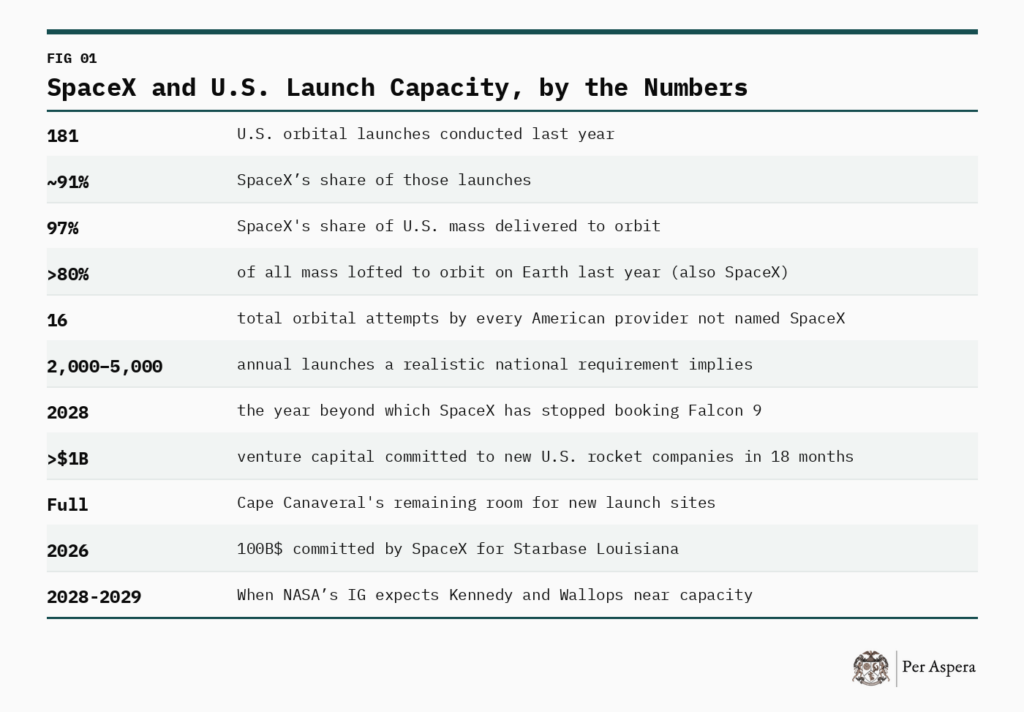
Worse, we’re going the wrong way. The workhorse that flies nine of every ten American launches will be wound down before the decade is out. SpaceX has closed the commercial Falcon 9 book past 2028, stopped taking future rideshare reservations, and – according to people who buy launches for a living – has ceased building some of the expendable Falcon hardware while lines are retooled for Starship. (That last part is how you know they’re serious!) Gwynne Shotwell has already said the quiet part out loud: “This year we’ll still launch a lot, but not as much. We launched 165 times last year. This year, maybe 140, 145-ish, yeah. And then we’ll tail off our launches as Starship is coming online.”
If you are a space system operator without a special relationship, you may already be discovering there is no seat for you. And if you’re any sized space operator without your own rocket program, you’re beginning to sweat even if you’re providing capabilities for national security space.
This is not Elon Musk’s fault
Let’s give Elon Musk his flowers, because he’s the one who got this right: SpaceX built a reliable, reusable vehicle, flew it at a cadence the rest of the industry insisted was impossible, and finished the argument with Starlink, where captive launch demand enabled a flywheel, and factory production of the satellite drove costs down toward $1M a pop. Elon earned his position and he is not running a charity, which is to say, it is not his responsibility to solve the nation’s capacity problem. SpaceX’s decision to reallocate capacity to their own next-gen vehicle is entirely rational. The failure falls on the rest of us – the United States – which collectively has not yet built a second act to follow in SpaceX’s footsteps.
Nowhere to fly from
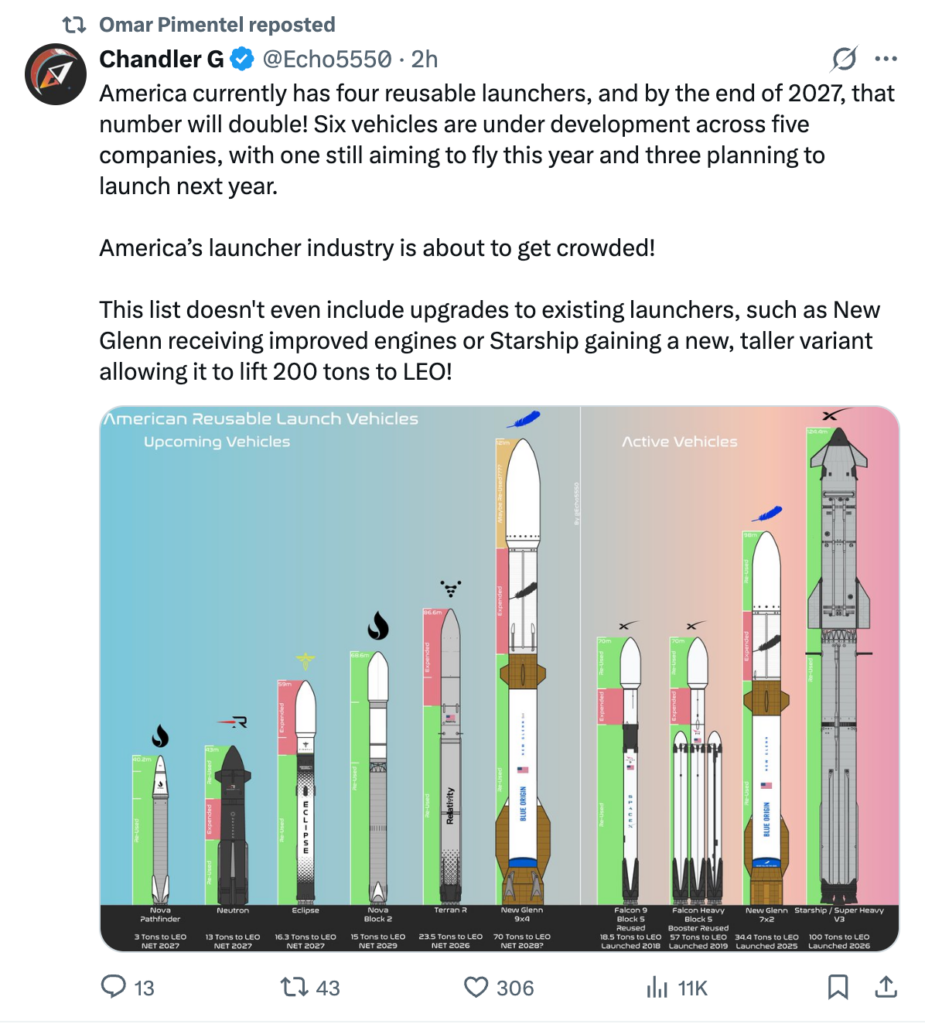
Venture capitalists have committed well over a billion dollars to new American rocket companies in the past eighteen months, and there are a lot of promising launch systems in development or nearing flight readiness, and it seems like a matter of when not if (especially with Relativity Space, Blue and New Glenn RTF, Stoke and Rocket Lab ). But the question I see very few executives, elected officials, regulators, or venture capitalists in our biz asking is this: where will any of these vehicles fly from?!?
On the Eastern Range, almost every pad that can take a serious rocket is already spoken for – with allocations for Relativity Space, SpaceX, ULA, Blue, Stoke, Firefly, and the rest leasing what little ground remains. As the Space Force leadership itself has admitted, the Cape is “very, very close to out of pads.” Cape Canaveral, simply put, has no more room.
And it’s already gotten tight at Vandy.
NASA faces the same constraint as commercial operators: pad access and range throughput were built for a handful of government shots a year, and the system is now being asked to carry a commercial flood.
In short, we are financing a yellow fleet of the future with nowhere to launch it, and the pad bottleneck is already starting to sting today, years before a lot of the hardware in question is ready.
Both blockages are of the government’s own making, because the government sits on every side of this market: the dominant customer, the only landlord, and the regulator in between. It has jammed the market from each seat.
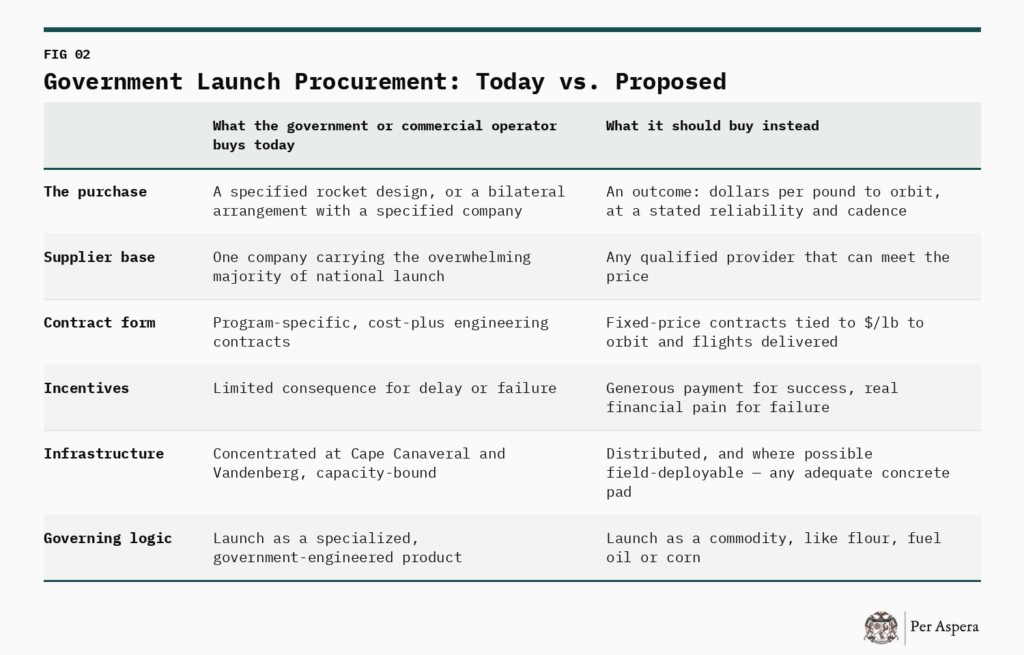
As a buyer, Uncle Sam still purchases space launch the old way: name the vehicle, pick the company, negotiate the marriage. Federal demand is most of the assured launch market, and every dollar of it flows through engineered contracts: a specified vehicle, a chosen company, a negotiated arrangement. (See Shuttle, EELV, SLS, and now the current round of bilateral deals.) Even the commercial-era successes (COTS, commercial crew, CLPS) picked partners first and paid for their development second. What the government is more reluctant to do – in fact, what it’s never done – is post a standing offer: this price per pound, specified reliability, this many flights, open to anyone who qualifies.
As the landlord and regulator, the government presently owns most of the ground that all rockets leave from and writes the rules for leaving it. Cape Canaveral and Vandenberg are military ranges, constructed initially to support a handful of government launches a year, and pad access is something the government doles out one negotiated agreement at a time. It’s never been something you could buy.
Unsurprisingly, our range infrastructure and its safety rules assume the slower, steadier cadence of an old era. This infrastructure, and permissive rulebooks, cannot be easily nor rapidly expanded (nor is the government known for being expedient). While Uncle Sam has gotten its fair share of my finger-pointing, I’ll turn it back around to us and say that we as a community have not done nearly enough at finding a solution to this bottleneck. Pads and qualified alternatives have not kept anything close to the pace of private funding for rockets.
Washington has responded to the crunch the only way it knows how: one company, then another, one negotiated arrangement at a time. The terms of each agreement may be defensible on their own. But collectively, this is no substitute for a working policy. You cannot assemble a redundant, reliable launch industry out of piecemeal bilateral deals, and every month spent trying is a month not spent building the market that would produce one.
Buy the outcome
The Pentagon does not design its own diesel fuel. It publishes a specification and a delivery schedule, refineries bid, and the low qualified bid wins. Nobody in the building could tell you how the winning refinery arranges its cracking towers, and nobody needs to.
Launch should be bought the same way. Here’s how it would work: the government or a large commercial operator announces that it will purchase X pounds delivered to orbit from any qualified American provider for Y dollars. That’s it! Of course, there are other details we’d need to sort out: reliability, heritage, cadence, orbital dynamics, etc. But, provided you can fly enough a year and you’re launching from the right spot, you can win the job. How you win is not the government’s business.
Under this system, a provider who misses a deadline eats a penalty spelled out in the contract. There will be no design review, no scoring of engine cycles, and no judgment about whether the vehicle is sufficiently advanced, because none of that is the government’s business once the criteria of price and reliability (and, of course, safety standards) are met.
I ran NASA for almost 10 years, and I know what a program office does when it is allowed to get into the architectural details: it picks the most impressive machine. That is how Gerry’s engine died in 1972, and it is how the cheaper, simpler (or faster, better, cheaper!) vehicles have died ever since. A procurement that only pays for pounds to orbit has no prejudice for bells and whistles.
Guaranteed volume is of equal importance to price. Because, remember: a few hundred committed flights a year will not close the gap to 2,000, but they give a serious company something that no American rocket startup has ever had – known revenue to finance a factory and a launch complex against.
The contracts should be fixed price, with the government carrying none of the development risk it has absorbed since Apollo.
If I was back in the government, my directive here could be stilled into just four lines:
- OPEN COMPETITION. Open the competition to anyone who can meet the price and prove the reliability, and disqualify no one for the crime of simplicity.
- GUARANTEED OFFTAKE. Guarantee the volume – a few hundred launches a year, ten years, signed sealed delivered – so a bank can finance a factory against it.
- FIXED-PRICE CONTRACTS. Specify the price per pound you’re willing to pay, and let any cost overruns be shouldered by the builder, not the taxpayer.
- ASYMMETRIC INCENTIVES. Pay generously on delivery, charge painfully for failure, and grant no waivers.
Limited access makes failure financially painful. Reliability improves when it is expensive to be unreliable.
This is the level of discipline that the leadership has been imposing at the Department of War, defining the outcome and leaving the method to industry. Launch is a good place to extend this system, since few outcomes in government are as easy to measure as mass delivered to orbit.
A country that depends on one supplier for access to orbit has accepted a deep strategic vulnerability by default. Another program, another study or another partnership announcement will not fix it. The correction is a buyer willing to name a price per pound and hold the market to it.
We are behaving as though there is time.
But on this one, our pants are on fire!