Toasts: American Agency
In December 2024, before we even launched Per Aspera formally, we decided we’d throw a party for those who are ushering the country into our Next Great Century. The theme was “Toasts: American Agency,” a toast to our rigorous culture of grit, leadership, and relentless capability to build what others deem impossible.
We convened at The Lodge at Torrey Pines in La Jolla (the San Diego area), which is a biotech and defense powerhouse. It’s also an area of the country that, frankly, most of you are still sleeping on.
We brought together leaders (seasoned and rising) who reflected the American spectrum across deep tech sectors, generations, and regions. Folks came with colleagues, spouses, and even children (the youngest person must have been in high school!).
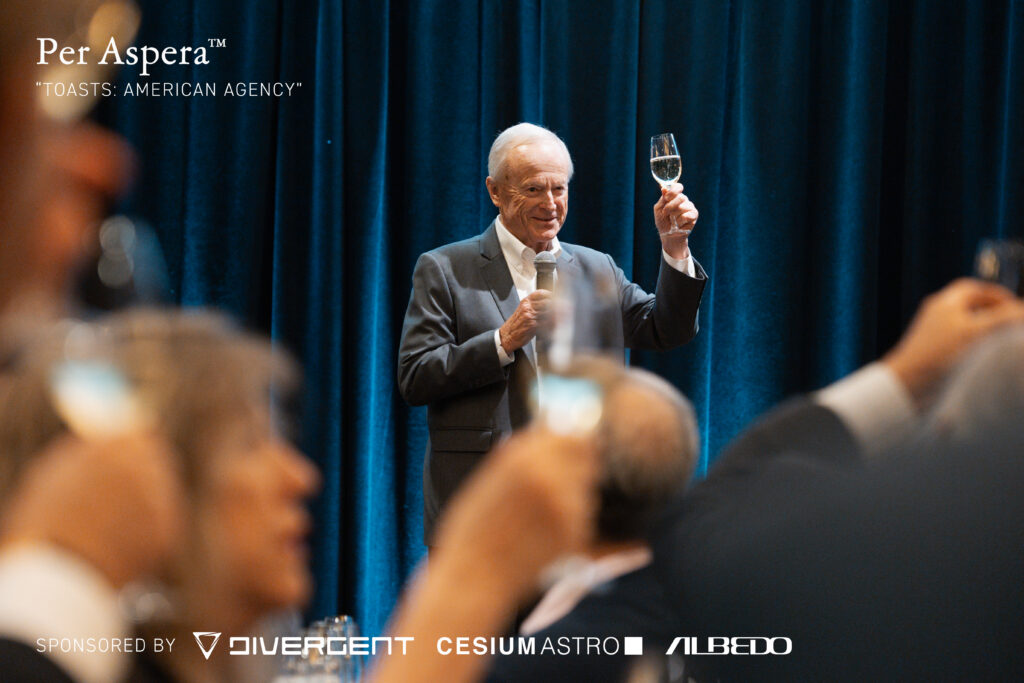
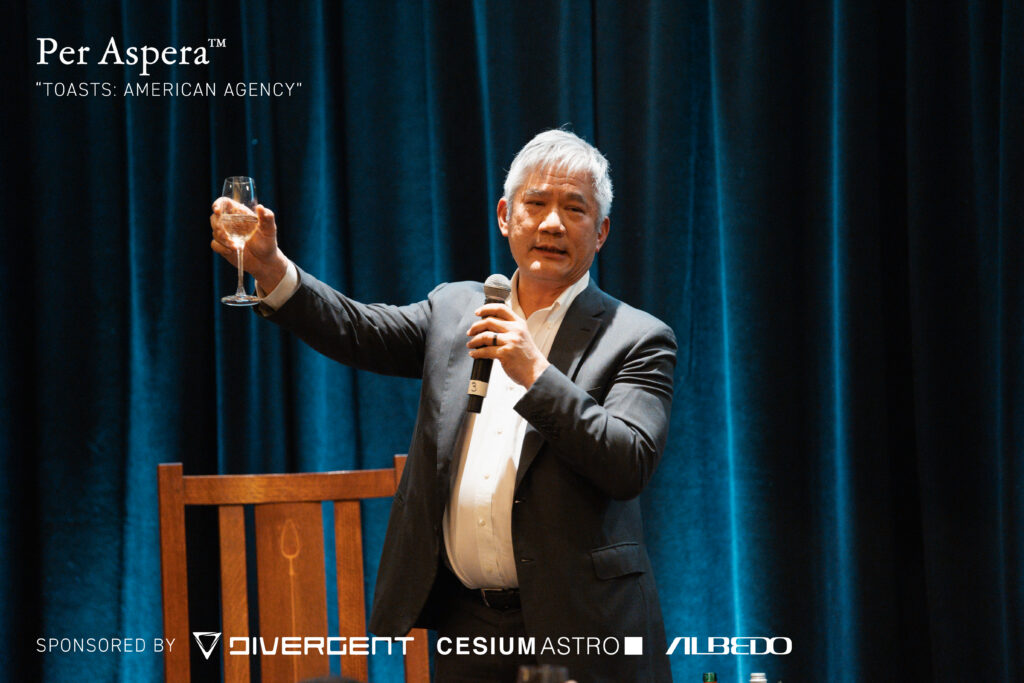
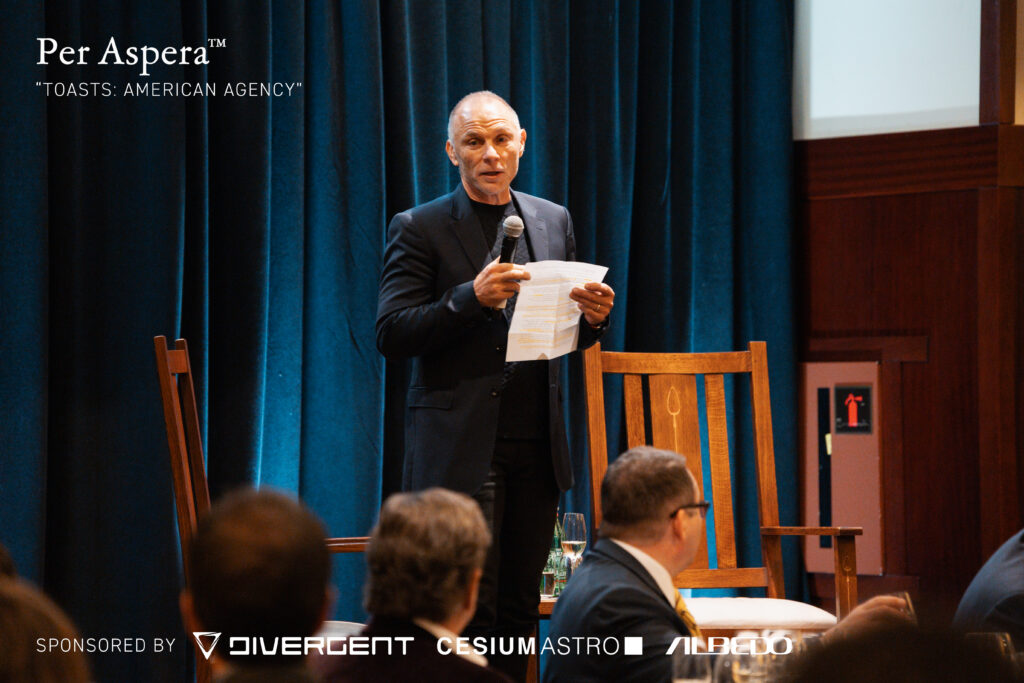
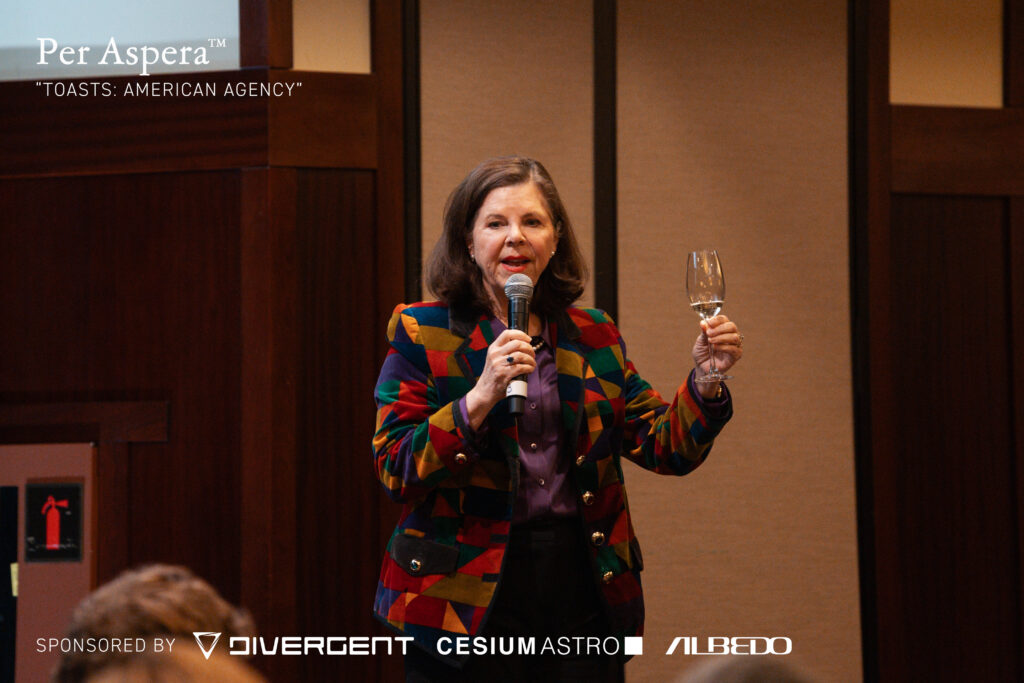
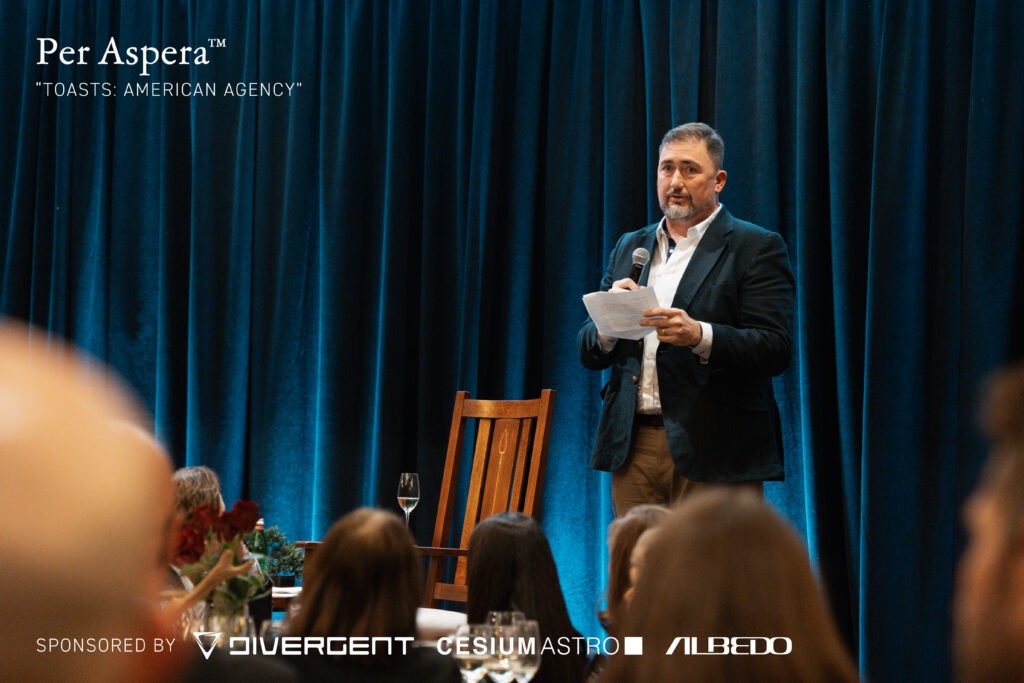

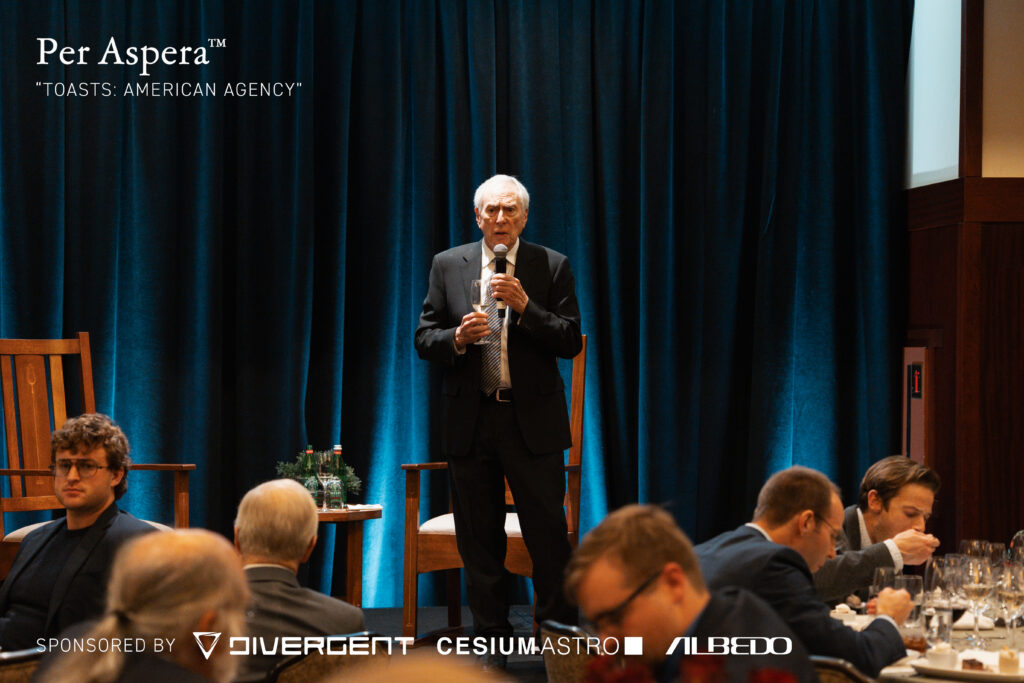
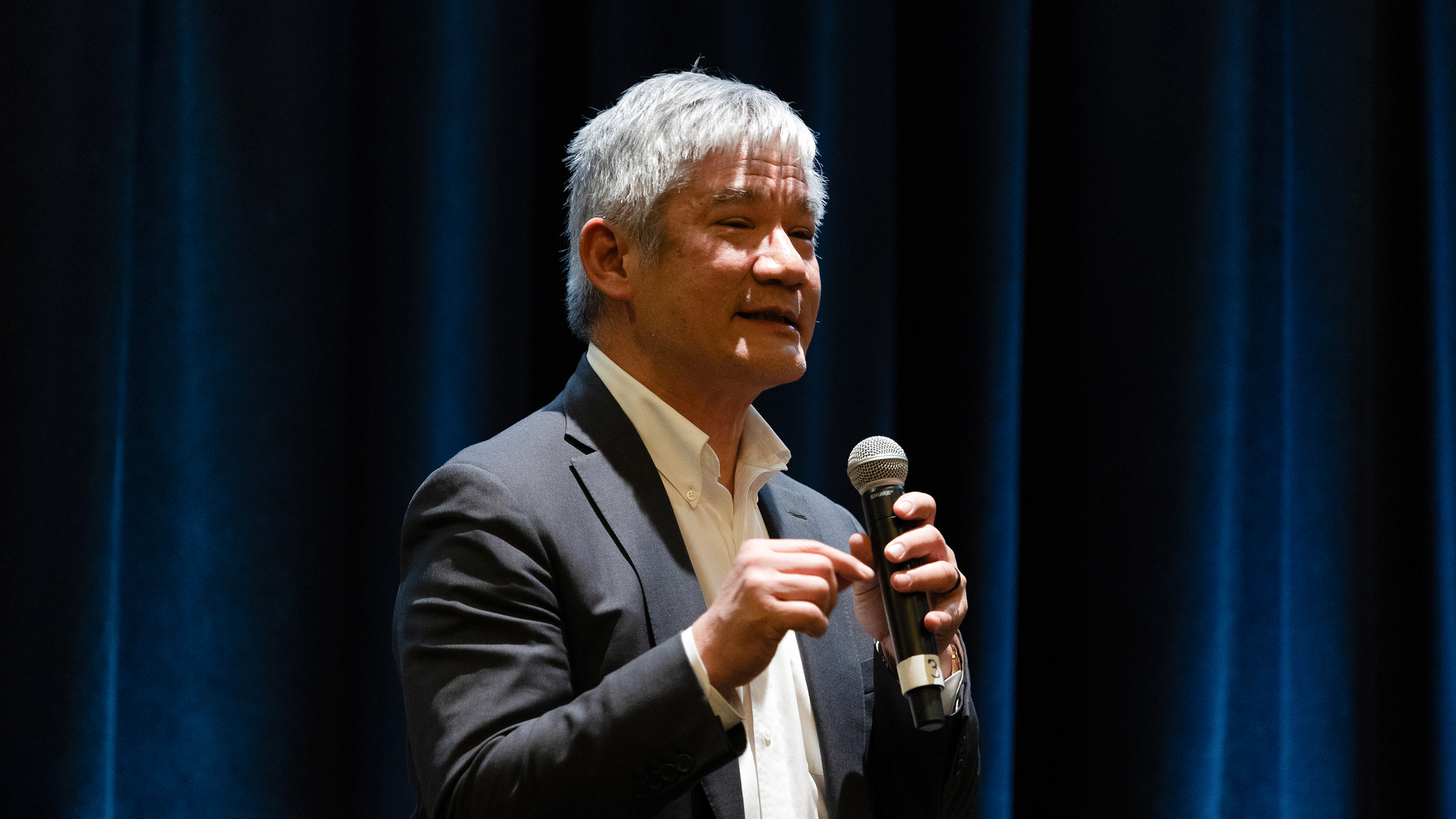
Below is the exclusive video and transcript from the event: a (very) rare fireside chat between Neal Blue — founder and CEO of General Atomics, the quiet San Diego powerhouse behind the Predator drone — and Per Aspera’s own Dan Goldin, followed by champagne toasts from some of the heaviest hitters in deep tech and the operators coming up behind them, all raised to American Agency. Enjoy!
Ryan Duffy: Good evening, everybody. Thank you. Thank you for joining us for this very special evening at Torrey Pines for what promises to be a very, very special night.
Good evening, everybody. If we haven’t met yet, my name is Ryan Duffy, and I will be your MC for the evening. I’ve gotten a few questions.
I’ve gotten a few questions. What’s the purpose? What are we doing here?
So I will answer those questions and set us up for a series of wonderful toasts tonight, and we’re looking forward to it. So the purpose of this event is to toast to American agency, which we’ll talk a little bit more about over the course of this evening, and to commemorate the kickoff of Per Aspera. So I’m going to tackle those in reverse order.
What is Per Aspera? Per Aspera is for the uninitiated, and 15 years ago, I invested four years of high school Latin for this moment to translate these two words for you. Per Aspera means through hardships, and it is commonly used alongside Ad Astra, which many of you may be familiar with.
And so it’s through hardships to the stars, or to the stars through hardships. So we thought that Per Aspera was a very special name, and by we, I’d like to give a call out to the co-conspirators on this Per Aspera project. First, to the mastermind himself, Dan Goldin.
Next, to Mr. Jeff Crusey. Give a little wave. The wave may not have been necessary.
It might not be necessary because Jeff is like 6’6″. And then lastly, last but not least, our operational mastermind, Joy Shin. So Jeff and Dan will share some thoughts with you later while Joy is overseeing all this and making sure it goes off without a hitch.
But I would like to share some of my own thoughts briefly, if you’ll indulge me, on American agency. I think to the four of us, American agency may mean something a little bit different. To me, I think of American agency as the capacity and courage to take hard actions and solve hard problems, not because it is easy, but because it is important.
And that necessitates, as I mentioned, courage, calculated risk-taking, and a little bit, a healthy amount of moxie, can-do attitude, and maybe a little bit of crazy. So we will be, over the course of tonight, we will be toasting to American agency. And you’ll hear from a half dozen very, very extraordinary, esteemed people.
But they are not the only extraordinary, esteemed people in this room. I think we have just about 120 people here who have all shown, in one way or another, that they are the card-carrying members and representation of American agency. And so what is Per Aspera actually about?
What are we doing here? Per Aspera aims to convene folks like yourself, and to celebrate and champion those who are already in the pursuit of hard things, and leading or at the forefront, in some way, shape, or form, of what you’ll hear us refer to as the deep-tech renaissance. But that is not the only goal of Per Aspera.
A secondary goal is to inspire new generations and many more to carry the torch forward and join us in this pursuit. Because if we want to accelerate this renaissance that I speak of, we need many, many more people. We need as many people as we can get.
So none of this is to say that any of this is going to be easy. That’s in our name. But tonight is the kickoff point for us.
And in terms of what to expect from us in the future, there will be conversations, dialogues, events like this, as well as a newsletter, and other publications, which some of you in this room are already contributing to. And we really want to serve as a kind of centralized place for folks who are already in this pursuit to share knowledge, to speak openly about their war stories, their insights, best practices, all of that. Because we think that just as this room is not from one industry, not everyone here is from space.
We, of course, have very healthy representation from space. We have healthy representation from the energy industry, from manufacturing, from local industries here in San Diego. It takes a village.
And no one type of persona or job function or industry is going to save us and help us tackle these hard problems that our country faces, including a diminished industrial base, a rising challenge on the world stage for technological competitiveness, a jeopardized supply chain, and many more. But I don’t want to use my power of the pulpit here to just talk about problems. We see a lot of solutions, and it starts with the people in this room.
And I would just like to reiterate that all of you are here for a reason. We spend a lot of time curating and selecting this list of people. And so many of you represent American Agency in very different ways.
There are many, many paths to agency here. There are builders. There are entrepreneurs.
There are also capital allocators. There are college students. There are artists.
There are communicators. And there are, of course, many, many, many industry veterans here, as well as actual veterans. So I think that, you know, I’m not alone when I say that almost everybody in this room could come up here and give a great toast.
So it’s a shame that we’re only going to be able to hear from a few folks. But just know that for everyone in this room, as well as the plus ones who we encourage folks to bring who are outside of the sort of traditional tech sphere, we think that you are going to carry the torch forward. And we are very, very, very happy you’re here.
Very important for me also to thank our partners in supporting us and making tonight possible. So first, I’d like to shout out Divergent. I would also like to shout out Cesium Astro and finally Albedo for partnering with us and help making tonight possible.
I also want to shout out the healthy representation for our partners, for our first round of partners of Native Texans or folks with Texas roots. So thank you. Thank you all.
Now, lastly, in terms of what to expect tonight, as I said, it’s going to be a series of toasts. We are going to keep things light. We’re going to keep things moving.
But I would ask for your undivided attention for the next hour or so here. I promise you it’ll be worth the patience and the quiet. We’re going to start with a conversation between two titans of industry, two heavyweights.
Mr. Neal Blue and Mr. Dan Goldin. I will introduce them separately and call them up to the stage here. But let’s start with the hometown hero, Mr. Blue. 40 or so years ago, Neal Blue acquired General Atomics and has since served as the CEO and has turned GA into one of, if not the nation’s premier national security and technological innovation powerhouses across a range of advanced sciences and technologies, critical technologies for our country. Not to be outdone, Dan is the, among many other things, served as the ninth and longest-tenured administrator of NASA, where he came to earn the reputation, which is, I didn’t approve this with you, but came in my mind to be known as the high priest of better, faster, cheaper, and pushing the agency to do more with less. Among Dan’s many, many accomplishments, we established a permanent presence or 24 years and counting presence in Earth orbit and sent many better, faster, cheaper probes to deep space.
So this is a very, very rare conversation, a rare conversation between two friends and two men who prove that it’s not just about a kind of shared business culture, but a shared reverence for critical technology and innovation and supporting our country. So without further ado, I would like to invite the two of you, Neal and Dan, to join me or replace me on stage up here.
Daniel Goldin: I wear boots, but I’m not from Texas. Just a little quick story before we get started, because it’s relevant. I was appointed, Joyce is really in charge.
I was appointed by George H.W. Bush, I think seven or eight months before the election of 1992, and when I got to NASA, they had distinguished themselves doing wonderful things scientifically, but they were consuming resources that were unacceptable. And when I arrived, there was a sense that there was going to be a national election, and why did we have to listen to this guy who just came in? He’s not from NASA, he worked in the defense industry, so what does he know?
And I found this problem to be dysfunctional. So I happened to be in Houston, Texas, and while I was there, there was a boot store. And I said, it would be interesting instead of my wingtip shoes if I showed up to the office in cowboy boots.
So I bought Tony Lama’s black ostrich boots some 30 years ago, and I rearranged my office so when the recalcitrant leaders of NASA came in, my sofa was two inches higher than the opposite sofa with a little bench in between, and I just crossed my legs and showed my boots, and I brought them under control. I’ll stop now.
Neal Blue: There was a discussion before this limited session here regarding what sort of decor one would wear, and in particular, the question was, would you wear a tie? And of course, we have a representative over here who demonstrates a certain generational affectation to and respect for proper dress. However, with the passage of time, conventions change.
And this then probably provides the basis for me to engage in a little bit of inquiry for your further response. Now, Dan, you have been not only head of NASA for the longest extended period of any one in memory, but also you’ve been involved in the Apollo program in particular at a time when it was challenging, hadn’t been done before, involved a massive bureaucracy, and so forth. We’ll discuss those details later, but first of all, I would post the question of how in the world was it that this kid from, we’re in California?
Daniel Goldin: No, from the South Bronx.
Neal Blue: From the Bronx, okay, good. Who emerged from the Bronx somehow with-
Daniel Goldin: It’s the Bronx, not the Bronx.
Neal Blue: The Bronx, okay. Emerged, indeed, with some kind of life experiences gained by association with different individuals and involving certain focused determination to achieve goals. And you might just elaborate a little bit on your early background without it going into extraordinary detail.
Daniel Goldin: I will limit it to just a few things. I’ll try real hard. I had a very interesting upbringing in a very worker-intensive environment.
We had carpenters on our street and we had people who worked with their hands, and especially my father. And when I was, I think, 11 or 12, we went to a junkyard and we couldn’t afford a car, so my father and I got this carcass of a 1946 Oldsmobile and then we went picking through the scraps, getting carburetors and getting transmissions, and we very carefully washed each part because we wanted to make sure it would work. So my father, who had so very little, gave me so much.
He taught me the basics of how to build things. And the other characteristic that helped me do the things I’ve done in my life is when I was born, I had something called progressive myopia, which meant as I went from one to two to three to four years old, I would get more and more nearsighted. And I remember I had, I’m going into, I’ll stop after this by the way.
There was a Dr. Jaffe who said to my mother, don’t let this child play contact sports because he’ll go blind and get a detached retina. They couldn’t fix it back then. So I was locked up in the house and I couldn’t do things and play sports.
So my father was amazing. He’d go to the library and bring books for me to read. So while everyone was playing football and basketball and baseball, I was in the house, so-called disadvantaged, but my father was an amazing man.
And the final thing that helped me, probably the most important thing that helped me is I was very shy. I was very introverted and I didn’t like to expose myself. So I was swimming in the pool in high school as a senior and Mr. McGarrity, the coach, said to me, why don’t you join the swim team?
And I said, no, I don’t want to do it. And he talked me into joining the swim team. And what I learned is when I stood on that damn starting block, I decided I’m not going to be the last person to get to the finish line.
And I drove myself to the point where it built my self-confidence. And I’ll talk about how that impacted later. Thank you.
Neal Blue: All right. So necessity may be the mother of invention.
Daniel Goldin: Yeah.
Neal Blue: And indeed, so that brings us to the subsequent career for which you became famous. And that is the NASA engagement. And therefore, you would have an abbreviated version of what you learned as the leader of a very, very large bureaucracy with massive amount of funding and significant difficulties in terms of actually achieving results for which the expenditures had been made available. Please.
Daniel Goldin: Oh, this is the joyous part. And I see one of my partners in crime, Dr. Mark Albrecht over there. We conspired for a number of years together.
I got to NASA. You cannot make this up. When I got there, President Reagan gave him billions of dollars to build space station freedom to compete with the Russians.
It was supposed to be completely deployed in space in 1992. There was nothing but parts and bushel baskets, but lots of big shots that went up to the Congress and convinced them there were jobs in their district. Then they had something called the Hubble Space Telescope, $5 billion.
It had an astigmatism and it couldn’t see. Then they had another spacecraft called Galileo on its way to Jupiter. It was $3.5 billion and its antenna didn’t deploy. And then they had something called, and I’ll get back to this later when you ask me another good question. They had something called the National Aerospace Plane. President Reagan stood in front of the American people and he said, America’s going to build the National Aerospace Plane in 1984 and in the ’90s it’s going to take off from San Francisco and it’s going to go to Tokyo in a few hours.
Well, I got there and I’ll start with the hypersonics. I said to the team in charge, and these are generals and chairman’s of the boards of aerospace companies. I said, “Answer two questions for me.”
One, the leading edge is going to get really hot. What material do you have to withstand that heat? And they said, “a lot of babble.”
So I said, “Oh, you have non-obtanium. I got it.” The next thing I said to them, “Has anyone seen water flowing in a stream and there’s a rock in the middle of the stream and you could see the lamina flow around?
Well, that’s how a wing works for God’s sakes. That’s why it has this nice shape because you get lamina flow over the wing and then you get a vacuum on top and you get pressure on the bottom and the plane doesn’t fall out of the sky. So I said to them, you can’t make this up.
Could you explain to me where the flow separation from lamina to turbulent occurs at the leading edge of the wing or the trailing edge?” They spent $1.6 billion and they couldn’t answer the question. So I said, “America’s in trouble.”
I went to the president and I said, “I want to cause fear in the streets at NASA.” So I — and this is during my confirmation process — so I said, “Here’s what I want to propose during my confirmation hearing.
That the NASA budget is scheduled to go from $14.3 billion to $25 billion over 10 years. So you integrate the increase in costs. That’s $55 billion.
And we’re going to cancel $55 billion worth of business that people have. And next I want to sign up to a budget that is not corrected for inflation because NASA has a bloated infrastructure and NASA has a workforce that’s much too big.”
But I don’t want to hurt people. So I said, “Mr. President, I want to be able to get a buyout program.” And I got a buyout program and you could see the records.
Check my record between 1992 and 2000, the end of 2001. I left just before 2002. The NASA budget was $14.3 billion a year. In one year we had a blip of $150 million. And people said, to get safety, you got to spend money. But I took money away from the shuttle.
And we flew almost 6 out of 10 of every person that went to low Earth orbit. That includes Russia and Elon Musk and it includes China. And not one of them got a scratch.
So I submit that the federal budget can be managed if you go in and have a plan and believe in yourself. Now, am I loved? No.
Am I respected? Yes.
Neal Blue: All right. Moving right along here.
Daniel Goldin: I’ll try and be more gentle on the next one.
Neal Blue: You have articulated some difficulty in terms of managing bloated bureaucracies. And you must have a view, therefore, as to where America stands today in respect of the so-called, I won’t say so-called, but the space race. That is to say, first question would be, what is your assessment of the U.S. in terms of its ability actually to win in a space race? And secondarily, what do you think would be needed or what is needed to encourage the productive elements of the culture to achieve that objective?
Daniel Goldin: Well, first, I think you cannot undertake a task without having a vision. And I’ll revert to Michelangelo. And if you go to the web, someone asked Michelangelo when he was alive, “How do you carve such beautiful angels in marble?”
And he’s quoted as saying, “I see the angel in the marble and I carve until I set it free.” And to me, this is the basic way you go about engineering, about any task. Instead of starting from the starting point and working to the end, you visualize the final solution and you work backwards.
And I don’t find that concept in government. I see it. There are a lot of, I know most of the people in this room and I ask most of them to come because they do what they say you’re going to do and you can’t do what you say you’re going to do unless you have a vision and you have an execution plan to get the vision.
So if America wants to lead again, it’s fine. Now there’s a Bhavya Lal. She was a chief technologist at NASA a few years ago.
And she told me a story. I went to Finland to a space meeting. And to my surprise, the people weren’t going to the Americans.
They were going to the Chinese. Now why are they going to the Chinese? Go to the web and you’ll see China has a vision for their space program to the end of the century.
You can’t find the vision for NASA to next year. So I’d say if NASA wants to have a competitive approach, they need to get their act together, have a vision, just like Michelangelo, and work backwards. And the Congress, and I’ll, again, I’m not going to, by the way, Chatham House rules, everybody, please.
You know, the Congress looks upon the NASA budget as a jobs program. And by the way, I was talking to Gilman. We were talking about how the defense budget works.
It’s not a jobs program. It’s about projecting American leadership in the world and then having a system that’s going to allow the American people to sleep at night. So I’m talking about NASA.
But I spent most of my life building weapons systems. So all I could say is, unless the Congress understands, they’re not there to get jobs in their district to get reelected. And the president needs to have the courage to tell these people in the House and the Senate, America comes first.
And if your constituents have a company that does the right kind of work and they contribute to the American people, then they get the business. But we don’t have 50% of the defense budget goes to programs 50 years or older. Now, I’ll stop.
Neal Blue: All right, well, finally, I would ask one more question. You’ve characterized multiple opportunities for improvement, let’s say. A few.
And among those opportunities, however, you may have an opinion as to what would be the most outstanding one around which you would focus your attention or advice as it relates to the most significant American interest to be addressed.
Daniel Goldin: Could I pick two?
Neal Blue: You can do whatever you want to.
Daniel Goldin: Thank you. There are two technologies that I think that are essential. Electricity, and I learned this from your brother Lyndon, one-seventh of the world economy goes to making electricity.
And we are delusional to think the renewable approach with its very diffuse energy density from wind and from solar is going to provide our nation and the people of the world clean, affordable energy. And I asked one person to join us tonight. Ed Moses, would you stand up, please?
All right. Sit down. This is an American hero.
This guy here led the National Ignition Facility at Lawrence Livermore. And he did the impossible. The President of the United States said we can’t test nuclear weapons anymore, but we need to do nuclear weapons effects tests.
And to do that, you need a controlled fusion reaction. And they, over a period, I don’t know, a decade or so, they were able to get net energy out. And it’s an amazing process.
And he walked away from the NIF, and he formed a company to build fusion power. He may even be working with your company, I think. There’s a rumor to that effect.
And this is absolutely essential. I know there are other competing approaches, and clearly you’ve got to look at them. But unless America gets serious about fusion energy, we’re delusional to think we could build, and I may be controversial here, small modular reactors in a world full of terrorism.
And then you get dirty bombs. And then you take a look at the cost efficiency. It’s not too high in the regulation.
The second technology is one that I talked about, hypersonics, the failed National Aerospace Plane. And I was so upset about it, it took a few years. There are three people in the room.
I forgot your names. It’s hard remembering names at my age. So I’m going to read them, but don’t take it that I forgot you, because these are, again, true American heroes.
And this happens when you get to be 84. I’m sorry about that. Call out your names.
Stand up. Tony. Castro Giovanni.
Kevin Bocott, over here. Kevin Boccott. There’s a third one.
Boyer, are you here? There he is. I challenged these three guys and their team somewheres about ’96.
And I said, the other guys got $12 billion. I’ll give you $3 billion. I want you to build a scramjet.
This is an engine that sucks in oxygen, so you don’t have to take oxygen tanks with you. And it’s an air-breathing engine. And I want you to get to Mach 10.
They got to Mach 9.68. And the Guinness Book of World Records, they did it in 2003, the Guinness Book of World Records is still holding them to that. And the United States Department of Defense has spent $10 billion, and they’re nowhere near that point. Could everyone celebrate these three people?
I know I talk a lot, Neal.
Neal Blue: Enough of that now. All right, then is there further commentary that you would like to share with us?
Daniel Goldin: I spoke my piece.
Neal Blue: You’ve spoken.
Daniel Goldin: Very good. Could I ask you some questions now?
Neal Blue: Go right ahead.
Daniel Goldin: As you have done with your brother, just an amazing job. You sit on top of one of the most important defense companies in the nation, if not the world. You do things that people say can’t be done, and you go do it.
And you keep on going. I’ll get to some more questions about it. But what were the things in your life, what were the people, what were the experiences that gave you the capacity to be able to do so much for our country?
Neal Blue: Well, that’s a judgmental assessment, of course. I want your assessment. However, I can refer to being lucky in life, unfortunate, fortunate in the sense that as a little kid, I had the privilege of visiting my grandparents, who lived in a small little community in northwestern Colorado called Meeker, Colorado.
Many of you may be familiar with that very small community named after a United States Marshal Meeker, who had been massacred by the Indians some years before they arrived there. At any rate, so much for Meeker. What was interesting, though, is that as a little kid of 10 and 10 to 12, we were sent off to the cousin’s cattle ranch, and I learned how to milk cows.
And you learn how to shoot a gun. You learn at a very young age lethal responsibility in the sense that you’re supposed not to blow off your foot by holding the .22 long rifle in the wrong place without the safety having been fixed. Those experiences together with also in the same little area of the first flight in an airplane, a ragwing or canvas-covered, 50-horsepower Taylor craft two-person airplane, which was piloted by the enthusiastic tenant of my grandfather’s building.
And he was one of these post-World War II enthusiasts interested in flying. Wouldn’t that be nice? And for cheap, you could buy an airplane, right?
You had a lot of Americans who had been trained in the war, primarily in Europe, but also in Asia as pilots. And so it was a fashionable thing. And in those days, back to your Apollo days, the generic attitude among Americans was, well, OK, you can just do it.
There’s no regulation that prevents you just buying an airplane or building one, for that matter. And so as a little kid here, I had a chance to fly in an airplane. Well, that was great, because that was an experience.
You saw the world in three dimensions. So that’s sort of interesting. And so I would then characterize being fortunate in those early years as having been exposed to this sort of experience to where you collect information by virtue of the experience.
And one stepping stone leads to another. And then when you become barely qualified to own a car, you want to acquire one, right? And you don’t have any appreciable money to do that with.
So it takes some measure of ingenuity to acquire a Model A Ford for $29. In any event, if you have a vehicle, that’s a marvelous thing to be able to drive around as a teenager. And that leads to the problem of the flat tire.
Well, if the tire is flat, what are you going to do about that? You have to figure that one out, too. And in the then day, they had inner tubes.
But the point is, if you don’t fix it, you won’t go anywhere. And then how about the vehicle itself? The Model A Ford had a four-cylinder engine, which in the then day was possible for people actually to understand and repair.
It had a carburetor, not an electronic system. And so you learned how to fix the carburetor. Well, you learned these things because it was necessary if you were to go where you wanted to go.
And these elementary lessons then developed later into the obvious opportunity when I was in college. And in the Air Force ROTC, you could go to a university, had a pilot school. You could attend for $4 an hour.
Well, I didn’t have very much money and wore two shirts a day because you could save money doing that. But to improvise the funds required to get a pilot’s license was a worthwhile dedication of effort. And why would you do that?
Well, if you could fly, you could go places which were much better than traveling on terrain. Before that time, I had, while in college, had traveled around the world driving a car from Paris to Calcutta, which was a promotional deal paid for by writing articles for the New York Times, some of which were published, and therefore supported the venture. The subsequent issue was, OK, well, if you can fly an airplane, you could go.
In the then day, Nikita Khrushchev had taken over the chairmanship of the Soviet Communist Party. As you may remember, he was a Ukrainian peasant, farmer of his background. But there was an opening in the then Soviet Union, critical of the Stalinist era.
And therefore, I thought, well, how about flying an airplane around Russia? Wouldn’t that be great? And of course, that idea was pursued in a serious way, but without success.
So the plan B was traveling around South America in a single engine tripacer with its later experiences born of necessity, in particular, when you have an accident that requires fixing a propeller or fixing a landing gear, and various other adventures which one thing tends to lead to another, and therefore, it’s a fortunate background, a background which the normal suburban kid isn’t exposed to, because things are provided for you.
And I do remember in suburban Denver, it was obligatory and required that I mow the lawn, right? And I didn’t like pushing lawnmowers. So then it was a matter of, how would you contrive to be able to employ someone to do that?
And that involved getting involved in a business venture. And one thing tends to lead to another. And then subsequently, you end up with activities which were heavily involved in Germany and provided some of the incentive for what later was developed at Aeronautical Systems, after General Atomics had been acquired as a result of Chevron blowing off this orphan child of theirs in the nuclear business.
That’s why General Atomics has the name General Atomic. It was founded, interestingly enough, by a very gifted fellow from Austria, Freddy de Hoffman, who did the calculations for the hydrogen bomb. And so there was a rich legacy of tradition in terms of nuclear technology at General Atomics.
And that was always interesting. But why was that interesting? Well, it was interesting because while I was in the Air Force, I ended up in the Foreign Technology Division, where I was introduced to a new technology in the then day called the laser.
And this was in a very incipient early phase of understanding the functionality of a laser light amplification by stimulated emission of radiation. And I thought, well, that’s a fascinating sort of thing. And you absorb that sort of thing.
And then after the Nicaragua experience, there was a certain matter of inspiration leading to the unmanned aircraft systems after General Atomics was acquired. They were in the nuclear research business, sophisticated physicists and engineers hardly involved in unmanned aircraft systems or the defense game in a significant way. And so you might inquire, well, what was the inspiration for that?
The inspiration for that was going back to the solace provided by, you mentioned Angelo. Well, Albert Einstein made a statement that I remember, which many of you have read, which is “imagination is more important than knowledge.” That was always a consoling notion as far as I was concerned because imagination is possible, as you suggest, without a full bank of competent knowledge to support it.
But nevertheless, it is necessary in providing a forward vision. And in the then day, having lived for five years in the Republic of Nicaragua, where we developed a coconut and banana plantation, it was important then to see the abdication to the Soviet Union, East Germany, and Cuba, thanks to the well-intended Jimmy Carter, and therefore the elimination of the Somoza regime, which governed the country as an enlightened authoritarian government where there was law, property, and opposition. At any rate, after the Sandinistas took over, the inspiration was, well, what little contribution could one make to making it difficult for them? And that would be if you could deny them a fuel source.
In Nicaragua, the republic has a couple of ports, Corinto and Puerto Somoza, now called Puerto Sandino. And the thought was, well, take out those fuel storage areas, and there’s nothing to run their airplanes or helicopters or trucks with. And so how would you do that on the cheap?
And you would do that with an unmanned aircraft capable of assaulting these fuel tanks and getting under whatever radar might have existed at the time, based upon the curvature of the Earth, which allows a 12 and 1⁄2 mile distance only to get to the target. At any rate, that was an earlier inspiration, which then led, as fortune would have it, to understanding the Fulda Gap. The Fulda Gap in Germany, where the Soviet Union was threatening under the difficulty of Berlin having been a free state under Allied occupation, but surrounded entirely by the Soviet forces, represented by the somewhat more efficient police state known as the German Democratic Republic.
Very interesting, especially if you had relatives whom you were interested in extracting. And if your wife had come as a refugee from Eastern Germany, along with a family in the days of the great West German economic miracle period. At any rate, the Fulda Gap was interesting.
And there, would you believe, another concept developed. And that was something that has taken 70 years further to develop an understanding of, thanks to the current war in Ukraine. And that is the efficacy of a swarm technology based upon unmanned systems to blunt the Soviet tank force, which had to concentrate its forces to achieve a breakthrough in the Fulda Gap.
And so that was the interesting challenge in the then days, involving my very limited Air Force deployment in Germany at a fighter bomber squadron in the Rhineland. And then, well, subsequently, I’m going along with a long trend line of development here, more than you asked for, probably.
Daniel Goldin: And you anticipated half of my questions.
Neal Blue: But at any rate, those were concepts and ideas. And what goes around does come around in due course, if you have enough patience. And indeed, if you consider the time required for the swarm to be refined, as it has been even in Ukraine, and now exemplified in terms of what is going on in Ukraine today, you recognize that it took 70 years to mature the obvious.
Well, it took about that long before the zipper, which had been earlier patented, was ever a really successful commercial enterprise. Or for that matter, before the machine gun, which had been developed well before the American Civil War, and which had been refused by both the Confederate side and the national side, because it was not ready technology, it took about 70 years for the machine gun to be venerated, ultimately, in World War I.
Daniel Goldin: I have one final question for you. And it’s something I’ve thought about. And here I am at 84 years old, and I still work 60 hours a week, and I still travel the country and travel the world on a kind of a mission like you’ve been on.
How do you know when to stop?
Neal Blue: Well, ultimately, the time to stop is when you die, right? But fundamentally, the world’s a beautiful place. And one experience, one exposure leads to another.
One stepping stone leads to another. It’s not always clear as to whether you will achieve an objective that seems to be halfway plausible. But it is clear that if you watch the derivative, that there’s another opportunity and another venue out there.
And as long as it’s exciting, and as long as you can enjoy what is beautiful, as long as you can attempt to improve on what is otherwise always unsatisfactory, and you’re never exactly where you’d like to be, and you know you’ll never get there if you don’t endeavor to take the next step, therefore.
Daniel Goldin: Thank you for saying that. I’m going to follow that advice.
Neal Blue: But you had one question, which you were prompted to ask me. And since you haven’t asked it, I will volunteer it for you. Which is, what exactly turns you on the most in terms of technology, in terms of protection for the American republic, which, by the way, is what it’s all about, I think.
Benjamin Franklin, as you may recall, or as you may not recall having read, was asked after, in 1776, what sort of regime had been developed as a result of this constitutional convention. And he hesitated for a while. And he said, “Well, I think it’s a republic if you can keep it.”
And this explains a lot about the division of government and the protection under the law of an independent judiciary, of an independent legislative branch, an independent executive, and a fundamental distrust for concentration of power anywhere, and the protection of individual rights, as opposed to the tyranny of the mob, the protection of property rights, of minority rights. Because we’re all minorities in one respect or another. And yet, we have a confluence of interests we share.
And that’s the defense of this republic. And therefore, to the question, what is the most important single technology in terms of defense of the republic that I would commend and have been personally engaged along with the general atomics activities and around the country and around the world? And that is the delivery of exquisite situational awareness.
That means the ability to utilize advanced technology to accumulate very high, very massive petabytes of data, which, by virtue of the collection systems at different levels of space, surface, underwater, airborne, LEO, MEO, geosatellite, and the cislunar, and then above the cislunar space. These areas, if the data collection is sufficient and the technology is there, and you have the ability to transfer massive amounts of data with optical communications, developing laser communications. So laser comes home again, right?
And more than in very many ways, based on power levels. But nevertheless, it’s the delivery of composite global situational awareness to where you can target instantaneously with latency of less than five seconds to achieve a human-cognition-friendly picture of what is going on with the level of detail that enables you to identify, track, target, and hold your target. If it’s a target, you want to hold it custody to preserve your lead in technology.
Because if we fail in the space race, we lose across the board. And so it is a space race, and that reverts to the experience here that Daniel has been explaining. And it fundamentally supersedes a lot of the other worthy and important technology.
It also involves, among other things, nuclear space power.
Daniel Goldin: Thank you. Thank you.
Ryan Duffy: Thank you, gentlemen. Neal, I’m afraid I’m going to have to call you right back up for the first toast.
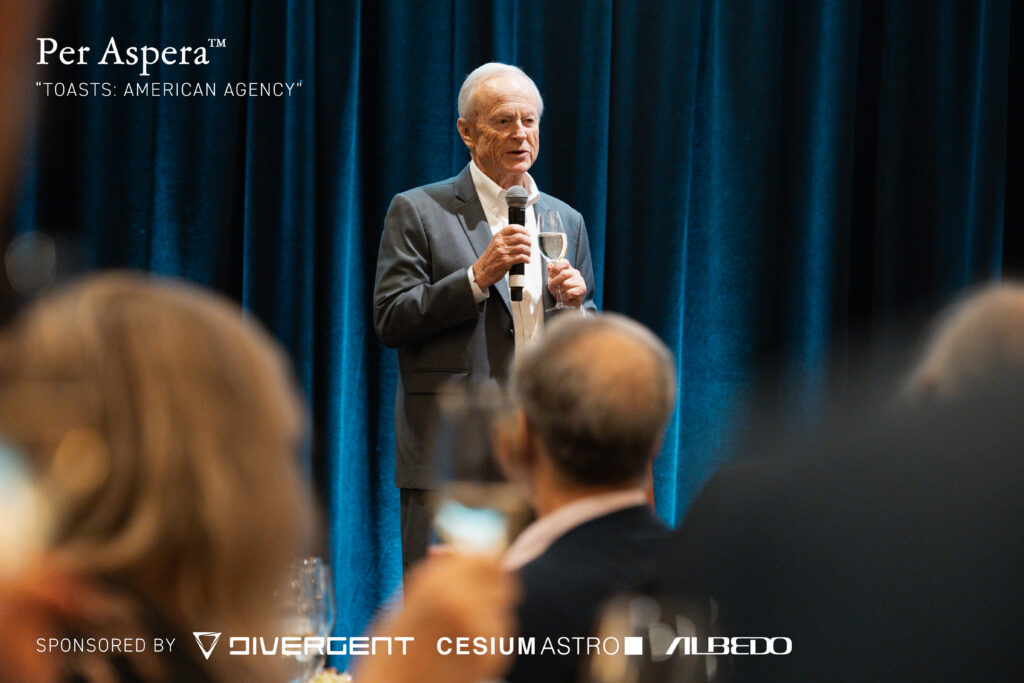
Neal Blue: All right. So this is a toast. This is a toast.
I should say a toast, really.
Who gathered here to commemorate and to dedicate yourselves to the development of entrepreneurship and individual initiative, which, indeed, are the characteristics which will preserve the republic which we hold so dear. So toast.
Ryan Duffy: Now we will call our second guest up to toast, Mr. Gilman Louie. Gilman is a distinguished technology venture capitalist and entrepreneur, among many other distinctions. He co-founded and served as the chief executive of In-Q-Tel, the United States intelligence community’s venture arm, which invests in critical technologies for the United States and also has quite the track record.
Gilman now serves as the co-founder and CEO of America’s Frontier Fund, which, by the names you might imagine, involves a lot of hard pursuits. So without further ado, Gilman, if you join me on stage, or replace me on stage.
Gilman Louie: Before I toast, I really want to toast all the parents who brought us up. I grew up in a blue-collar family. My dad was a machinist.
He volunteered for the Army Air Corps at 16 years old, learned a trade to how to build things with his hands, and was stationed in Okinawa working on B-29s in the effort to win the war against Great Depression. That greatest generation gave us the opportunity for all of us to be here. They taught us the importance of service.
My dad, as a machinist, said to me at my young age, “If you can see it in your head, you can build it. But it will require work. And it will be hard work.
But as an American, we will never be afraid of doing what’s the impossible.” The American spirit is being a pioneer to take on the greatest challenges, whether it is to go to the moon or win a war. There are many today who count America out.
Our great time has come and passed, those who say. But in every generation of America, they were told the same thing. When the Germans invaded Europe in a Japanese bomb Pearl Harbor, America was out.
When the Russians were able, the Soviet Union was able to put Sputnik over our planet in orbit, and our red stones and atlases were blowing up on the pad, we were out. When Americans couldn’t build cars that were competitive against the Japanese, we were out. And today, we’re told our time has passed.
And I will say to you that from the generations behind us who gave us this opportunity, we cannot lose this opportunity that’s in front of us. I know these are scary times. We have a lot of discourse in this country, a lot of disagreements.
But let’s not forget 1968 and 1969. In the greatest era of the America’s space program, where we put men on the moon, when everybody thought it was impossible to do it before the end of the decade. We were at war with ourselves over Vietnam, but we overcame.
Now we’re at this point where we have to pivot. The things that we got comfortable with over the last decade, from all of the benefits of the generations that came before us, is not a right. It’s an opportunity, but we have to let go of the past.
We can’t be building battleships when the world needs aircraft carriers. And today, we can’t be building aircraft carriers when we need drones. We can’t think of our departments as institutions that are built on stone, but agile enterprises that can compete with anybody else in the world.
If the United States is to lose its leadership position, it will not be because of what our adversaries do. It will be because of our willingness to let go of the things that made us great. We are all builders here in this room, whether you’re an engineer, an entrepreneur, a financer, or somebody who served in important roles in government.
We don’t just owe it to ourselves, but we owe it to the next generation. And I say it to all of us here, that the greatest product, the greatest technology we could ever build, is the dreams and the capabilities of our children. They look to us today and ask us, the generation between the greatest generation and their generation, do we have what it takes to keep this country at the forefront?
So I have a toast to the generations behind us and to the generation in front of us. May we not just succeed, but we may excel.
Ryan Duffy: Here, here. Thank you. Thank you, Gilman.
Okay, next up, I would like to welcome one of our partners, our esteemed partners, Kevin Czinger. Kevin and his son, Lucas, in the words of Dan, so you know he doesn’t use this word lightly, are revolutionizing the field of additive manufacturing from the materials all the way to the process itself. This includes automotive manufacturing, national security systems, drones, aircraft platforms, the whole gamut.
Thank you, Kevin, and I’ll hand it over to you.
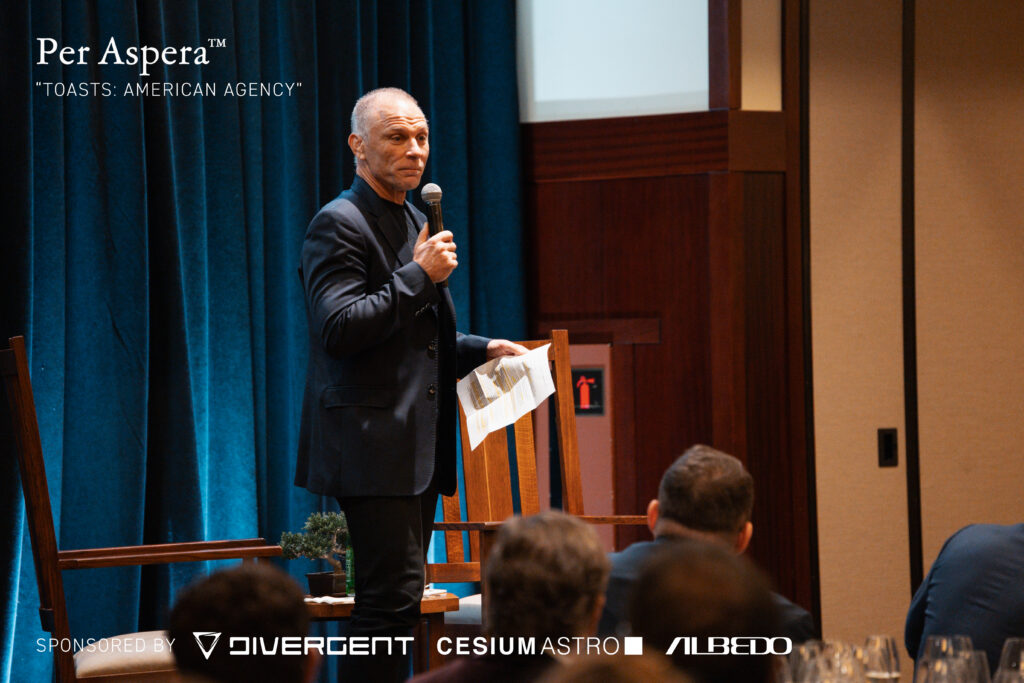
Kevin Czinger: Thanks. Hey, I am so honored and humbled to be invited by you, Dan, to speak, especially with people like Gilman and people like Neal and Lyndon here. I have a toast.
It’s actually a three-part toast, but I’ll give you a little bit of context. It’s actually a little bit of a riff off of Gilman’s toast in that it has to do with building and creating things and coming from a background where you learn to use your hands and then express what the mind is with those hands. I lived at least part of the American dream.
I grew up in Cleveland at a time when Cleveland was actually an industrial powerhouse, when people built things and took great pride in building those things. My parents were immigrants and World War II veterans that lived in that working-class community and raised me. And at the same time, the U.S. that we were being raised in was the dominant power. It was the technology and industrial leader in the world, and we put a man on the moon. I grew up in that city. I left to go to university.
I was a Division I All-American football player. I was a National Football Hall of Fame scholar-athlete. I served in the Marine Corps and then became an inventor and a founder of several technology companies.
But during that period of time, the last several decades, I’d say we witnessed our industrial base get wiped out. If you had a hardware component in your startup, Silicon Valley required that you have a section in your business plan about outsourcing its manufacturer to China, or you didn’t get funded. No offense, Gilman, but we were both there.
The result is that we lost both our overall industrial capacity and our advanced manufacturing technology edge. When it comes to manufacturing, America is not dominant. It is now the underdog.
I’d say this is now our moment of truth. Reindustrializing America is not optional. If we are going to maintain our status as the leading advanced industrial power and leading defender of Western freedom, we need to have an industrial base that is also the strongest in the world, and it is far from that today.
Today is that turning point, and unless we take today’s most advanced technologies and rapidly reindustrialize using those technologies so that we have a fully digital industrial base, we will lose that status. With that, I want to give my first toast, which is to the team of the company that was described Divergent. Like the Apollo program, we started out with a vision which was not to try to accomplish what our rivals had already done, but to do something that was a magnitude greater in performance, in cost, and in speed.
So we put together a digital engineering platform that combined artificial intelligence, additive manufacturing, advanced materials, and robotics into one system, and I’d say we’ve had the great honor to work with Neal and Lyndon’s company, among others, and have their great support. And today, we’re capable of generating the structure for and manufacturing both manned and unmanned air, land, sea, and space vehicles, and doing that with a fully digital system. And with that, I’d say cheers to my team.
We didn’t say uncle to Chinese manufacturing. Instead, we flipped the script, and to me, you know, riffing off Hugh Gilman, that’s what it’s about. Flipping the script, that’s American agency.
When you’re down, you find a way not to copy who’s beating you, but to find a way to leapfrog them. Secondly, I’d like to give a toast to my son who joined me here, Lucas Czinger, who’s also my partner in my company. I’d say he is, in my view and my experience, the best entrepreneurial operating executive that I’ve ever seen.
He was born in 1994. I’d say right on the cusp between millennial and Generation Z. You know, we, you know, the baby boomers from that greatest generation to today, we left his generation with some very big challenges, one of which is reindustrialization, which is an awesome challenge that Lucas and the team have taken on.
And, you know, I toast to their leadership and to their success, because America’s future existence depends on it. And finally, I toast to all of you out here who understand that we are at a point where America needs to regroup. We are far behind in some technologies, the most basic of which is not software, but the actual hardware that we build things with.
We are far behind, and we need to flip the script and regain the position that we once held as the leading advanced industrial power in the world. So here’s to you and the support of that. Cheers.
Ryan Duffy: You’re here. Thank you, Kevin. Best possible example you could ask for of embodying the principles that we stand for at Per Aspera as well as carrying the torch forward.
So it is now my pleasure to welcome Grace Cherashore to the stage. Grace is the executive chairwoman of Evans Hotel Corporation. She will be giving a toast on behalf of Anne Evans, who played a crucial role in developing three San Diego properties, among many other development projects, and one of those properties includes the one that we are, the very one that we are on right now.
Grace has also an illustrious career herself, among other roles having served for the Federal Reserve of San Francisco as well as chairwoman of the board for the California Chamber of Commerce. So without further ado, please welcome Grace.
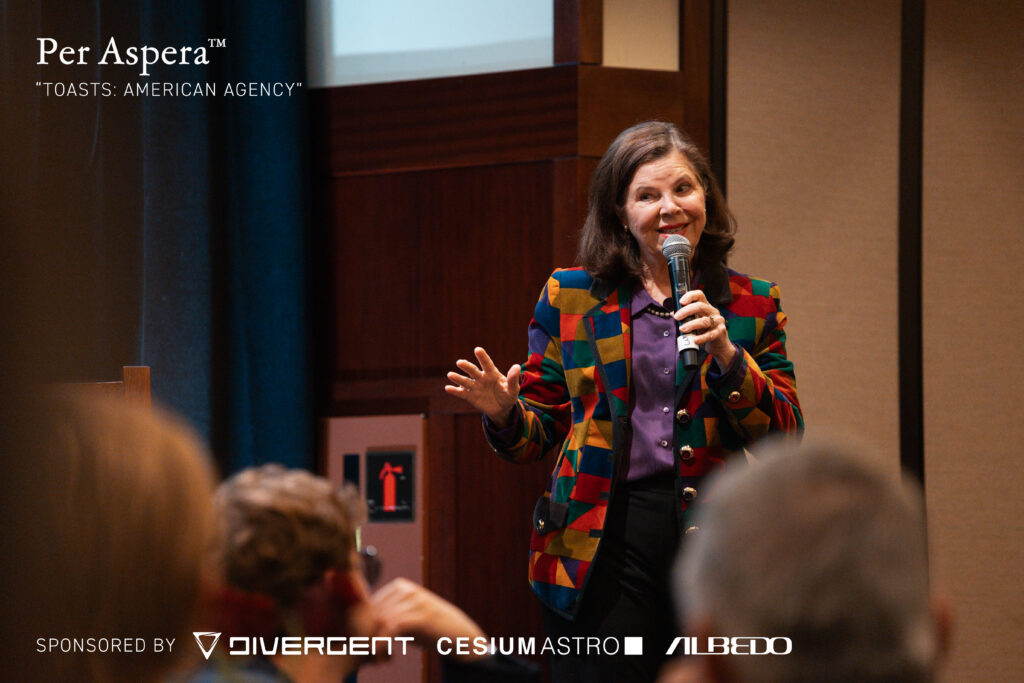
Grace Cherashore: Well, I’d like to start by toasting all of you, all of you people who are taking on truly the hard problems and things that make a tremendous difference in our world. And I want to tell you how grateful I am. So cheers to all of you.
Now, now this is time for the comedy portion of the show. And later I would love to chat with many of you, and you can speak slowly and explain a little bit more what you do to those of us in seemingly simpler businesses. But my point is that even in something simpler, such as the hospitality business, many of the same situations, seemingly insurmountable problems, exist.
And I want to talk a little bit about trying to do something really different, how hard it can be, how many roadblocks get thrown in your way, sticking with it, maybe being a little too stupid to quit, but holding on to wanting to do something in a very different way. And, well, so far, so good. Our company was started by my mother and father when my mother was 22 years old.
And they responded to an RFP from the city of San Diego to build the first hotel on Mission Bay. Now, you know, those of you who are from San Diego, you know it as the largest aquatic park in the United States. But that wasn’t what it was then.
Then it was sort of a mudflat that smelled pretty funky at low tide. And they won the RFP, and several years later they found out the reason they won was no one else bid. But they did it little by little because no one shared their vision at all.
You couldn’t get financing because it was on a city ground lease. And, well, I told you what it looked like. It wasn’t dredged yet.
So every year, summer would come, the hotels would get full, and every winter would come, and there was nothing. They hadn’t invented conventions yet, or groups, or anything such as this. So every winter they would build a few more rooms to the degree that they had money.
And this went on, and it was not easy going. They would rent the rooms in the winter, which they had decided, well, let’s put kitchens in them so that maybe we can get snowbirds, or six people from places like Cleveland to stay for the winter in early working remote, or being retired, I’m not sure. So that went on for a long time until 1984 when my father died very suddenly.
And within six hours of my father’s death, my mother and my brother, myself, my husband, we put on our suits, wiped away our tears, went to work, because we had 1,200 people coming for Easter brunch, and they were going to damn well have a happy Easter. So on we went, and none of our staff knew, and no one knew that my father had died instantaneously. We have continued that tradition here.
When we determined that there was property up here, the old Torrey Pines Inn, and become aware of it because she was involved at various boards at UCSD and at Scripps Institute of Oceanography, and it seemed to her that this mesa really, and this beautiful site, deserved something better than a very sort of plain box hotel such as is next door and a tiny little very run-down inn that was here, and that the people up here and the enterprises up here needed a bit of a place that could be a salon where they could sit by a fireplace and think outside the box, so to speak, and be taken care of, as it were. And we thought, well, since there’s a hotel there, yes, it’s in the coastal zone, but it’s zoned for a hotel. Well, you know, we’ll expand it and make it totally different.
Well, we didn’t realize that the United States Marine Corps, which was just taking over Top Gun, the air base there, would have exception to this. We are in the Seawolf Air Corridor, APZ-2, Accident Potential Zone 2, and the new group coming in was the Marines. The Navy before had been chill.
The Marines, not so much. And so at every single hearing, we had at least one three-star general show up to oppose us in the full regalia, and here it is, you know, these little women from Evans Hotels. But we just did not give up, because we knew there had not ever been an accident in the Seawolf Air Corridor, and there were already, I think it is, at least three hospitals, four other hotels, and possibly a nuclear reactor or two.
So we just couldn’t see what the harm is to making one of those hotels just a tad bit bigger, and we wouldn’t give up. So we did prevail in our little challenge. We just kept banging our head on the wall, and we were finally successful.
We were in construction when 9-11 happened. Now, you’ll all remember when 9-11 happened, travel just stopped. So you can imagine that through certain more roadblocks in front of us, such as, you know, lenders are really thinking, are you sure you’re really going to build this hotel?
You know, some of those sorts of things that happen when you’re, we ladies might say, kind of halfway pregnant, right? When you’ve got a big hole dug in the ground, and, you know, you’re a little bit built, and the lenders are saying, I don’t know, not so much. But you’ve got to keep going, because, you know, there’s only one way through it, which is to finish it, and we did.
We’ve had any number of other challenges. COVID came. Did we close down?
Not for five minutes. So what did we do? We decided we’ve got to figure out a way to be an essential service.
So my mom’s dad was a doctor, and she realized that, you know, how would a doctor who saw COVID patients, if they had, you know, a roommate or a spouse or a child that had, you know, a fragility, a health condition, how would they go home? So we signed contracts with, within a month, all of the major health care providers in San Diego County, Sharp, Scripps, UCSD, the VA, Kaiser, to provide very discounted room and meals for health care providers. And while it did not cover our costs, she said, why did you do it?
Well, for two reasons. The first reason was that we thought, hmm, how are we going to keep our team, highly trained people, specially trained people, because you didn’t know the government was going to, you know, dole out like they did. You couldn’t count on that.
That was the first reason to keep our team. And the second reason was to keep our supply chain. We have always featured local farm-to-table produce and other products.
And, for example, we always thought about the organic eggs. Well, if you’re a farmer and no one is buying your organic eggs, those chickens don’t have a lot of future, right? So we thought, you know, let’s try to keep going in some way, shape, or form to as great a degree as we could.
And we did. And our volumes were not the same, but, you know, we got through it. And so what I want to close by saying is that our mission is to be a part of this community up here to support you all that are doing things that are hard for us to even wrap our heads around, right?
That are doing things that are, you know, my friend Drew Senye solving and funding, you know, major medical discoveries or keeping our nation safe or possibly providing energy forever. And these are things that are truly important. And if we can, in a small way, support you all by just sort of being here to take care of those little necessities, that makes us very proud.
And we’re very grateful to you all. So cheers. Thank you.
Ryan Duffy: Thank you, Grace. Thank you all for having us. One, respectfully, I would just disagree.
For a lot of folks in the room, it’s just solving physics-based challenges, which can be hard. But at the end of the day, there’s an answer. Dealing with people is an entirely different beast.
Ask a lot of engineers. For our next toast, we’re going to keep the show rolling. He is also wearing cowboy boots.
He is a co-conspirator of this Per Aspera project. I’d like to welcome Jeff Crusey to the stage. Jeff is an up-and-coming space investor, deep tech investor.
To my knowledge, no one has written more checks to space startups and been actually contrarian and right early before anyone else. So without further ado.
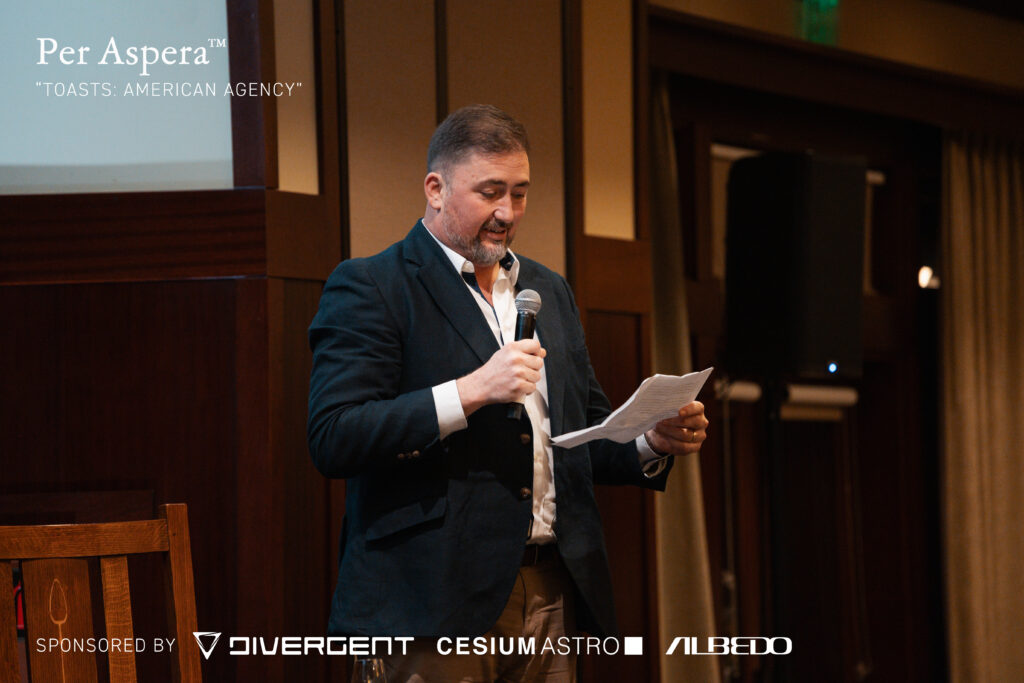
Jeff Crusey: It’s a little fun for me in my hometown of San Diego. Let me first thank Dan Golden and the incredible team at Perispera for creating a space where conversations about the essence of American agency can thrive. Dan, your career from NASA administrator to visionary behind Perispera has been a master class in agency itself.
Stepping up, taking ownership, and always striving to push boundaries. It’s a privilege to toast in your company. Now, I’ll be honest.
When I was asked to give a toast, my first thought was, this room doesn’t need inspiration. It’s probably filled with people that have launched rockets, built empires, or at least survived Thanksgiving dinner debates. But then I thought, what better opportunity to reflect on a quality that not only defines America, but also has shaped my own career, agency.
I first truly encountered the concept of American agency early in my investing career. I was asked to invest in an American solar panel manufacturing company. Sounds pretty straightforward, right?
Except at that time, adversarial nations were subsidizing industries like solar, LEDs, batteries, in what can only be described as economic warfare. The globalist mantra was loud, but it felt clear to me. If we lose our technological advantage, we are, for lack of a better term, toast.
The moment crystallized my commitment to American agency. It wasn’t just about the investment. It was about preserving a way of life, a way of thinking, that values action, autonomy, and the pursuit of greatness.
It’s why so many of us in this room do what we do. We believe that our way of life is not just worth protecting, but worth advancing. Agency is the power to act intentionally, to choose purposefully, and to shape outcomes boldly.
In American agency, it’s the unique American flair for turning vision into reality, for striving relentlessly, for overcoming obstacles, not because it’s easy, but because it’s right. But here’s where I want to challenge us, especially the investors in the room, As gatekeepers of capital, when we really should be partners in building, it’s not enough to write checks and tweet about it later. We need more technical expertise in our ranks, investors who can think from first principles, who can truly engage with founders on their level and help them accelerate. Founders have always wanted better qualified investors to stand shoulder to shoulder with them, to champion their missions and to understand the nuances of their challenges.
It’s time to rise to that call. We can’t just applaud agency and others, we must embody it ourselves. So as we celebrate American Agency tonight, let it not only be the acknowledgement of who we are and our recommitment to what we must do.
Let’s lean into the hard pursuits. Let’s own the challenge of our time. Let’s take intentional action to shape a future where America remains a guiding light, not just for ourselves, but for the world.
Here’s to American Agency. Cheers. Cheers.
Two. Three.
Ryan Duffy: Thank you. Thank you, Jeff. For our last toast or maybe our second to last toast, I’d like to call up just Jessie Frazelle to the stage.
Jesse’s the co-founder and CEO of ZOO, which is taking a first principles approach to how we design and manufacture parts and accelerate cycle times and really actually, again, in the true sense of the word, democratizing the hardware product development process, which many of you in the room could attest to is no simple thing. So, Jess, welcome up.
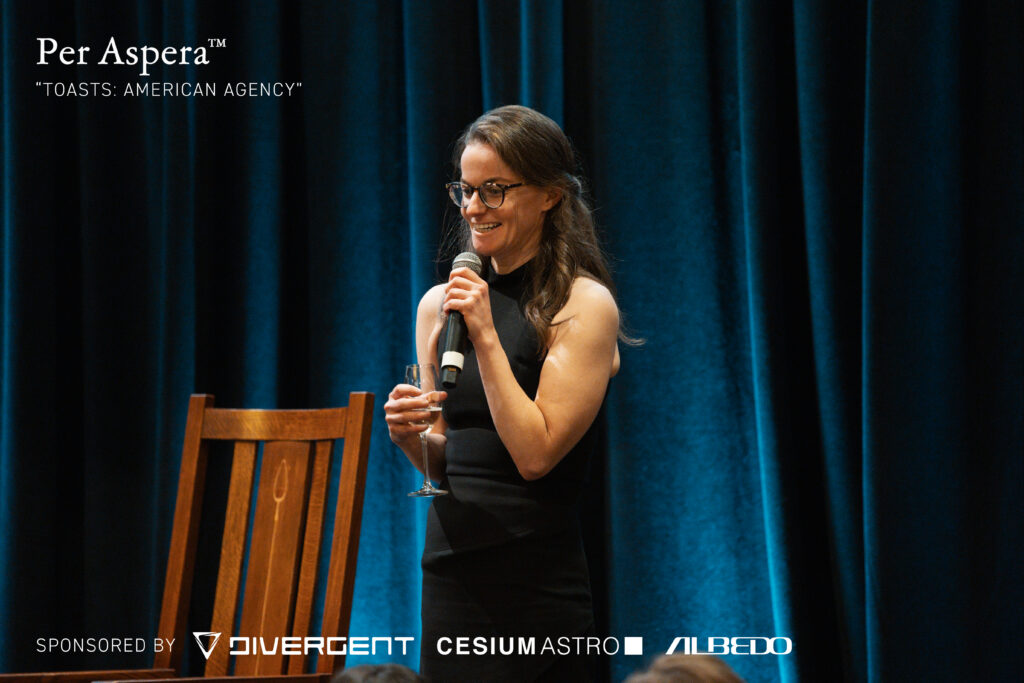
Jess Frazelle: Thank you, it’s super humbling to be up here. I think one commonality I heard from almost everyone else who’s been on stage and everyone else in the room that I’ve had the privilege of talking to is that everyone seems to be working on making the impossible possible. And my favorite quote that I thought of when I first saw that I was giving a toast, it was, first I got nervous, but then I thought of, one of my favorite quotes is from Walt Disney and he says, “It’s fun to do the impossible.”
And so, doing the impossible is hard, but everyone in this room seems to be doing it. So here’s a toast to the builders, entrepreneurs, and makers, engineers that are making the impossible possible.
Ryan Duffy: We have one last person to welcome up for a toast and it is the badass from the Bronx.
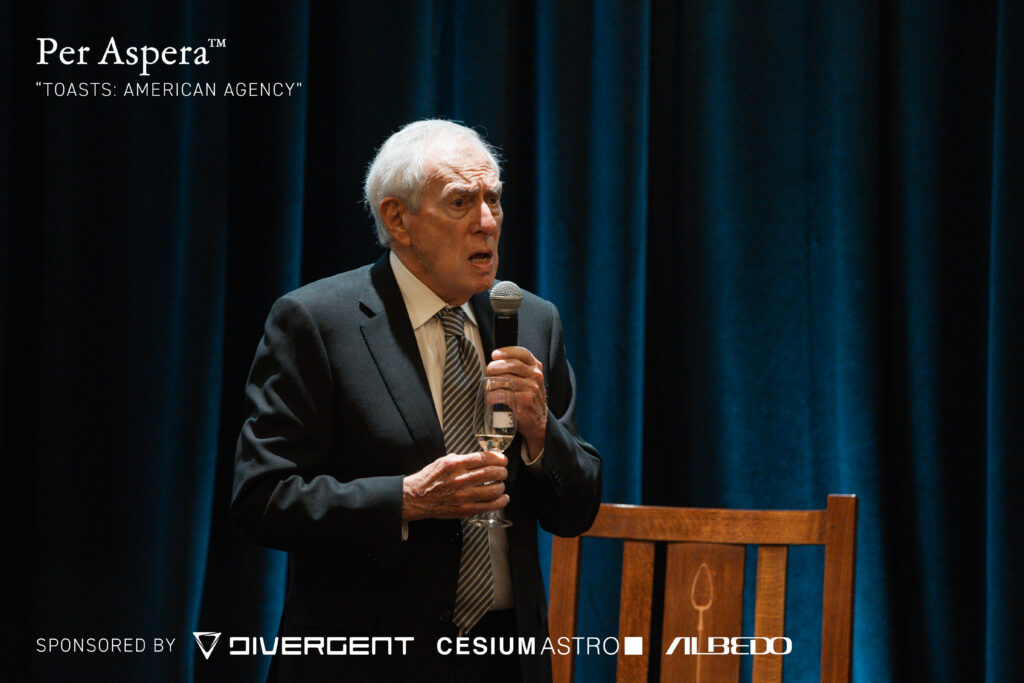
Daniel Goldin: As a country, we have a choice to make. We could choose to be an innovative leader or we could be a fast follower. America has distinguished itself by doing the hard things and thinking through the problems and led in innovation.
You could go back through our history and see how strong we’ve been. But a funny thing happened in the early ’90s. There was a sense that we could outsource the value added work to everyone around the world and America would become a fabulous manufacturing giant.
We would do the design and then we will do the marketing. We no longer will mine the minerals, we’ll no longer refine the metals, we’ll no longer make any of the plastics and all of this is gonna be outsourced and magically we could maintain our economy and we could maintain our strength so Americans could sleep well at night. Well, guess what happened?
America, and I apologize if I come on strong, but I’ve traveled to the Midwest. It’s not a pretty place. I worked, even I saw this happening in the ’90s when I was the NASA administrator, I went to meet with Morris Chang and I went early in my tenure.
For those don’t know who Morris Chang is, he came to America, he got trained and formed TSMC, Taiwan Semiconductor Manufacturing Company. We invented the semiconductors in this country and we ruled the roost into the ’90s. But then we decided, holy smokes, if we don’t do the manufacturing, if we don’t do the mining, there’s no CAPEX, wow.
And if we don’t do the manufacturing, there’s no risk and we tried that experiment and America’s near civil war. You read about civil war in America and when I saw that, that inspired me to begin to really think deep and see how can I help the country that enabled three quarters of my family to remain alive because one quarter of my family couldn’t get into America and they’re no longer with us. This is an amazing country.
So we could choose to be an innovative leader and take the risk and invest the CAPEX and support the brilliant people that have the courage to step up. Or we could support the world supply chain and that’s not gonna be a happy ending. So I had lots else to say.
I thought I would keep it focused. I thought I’d be heavy, but I wanted everyone to think about it when you go home to understand that what you are doing is the essence of the future of this country and you gotta keep doing the hard stuff and you gotta keep taking risk and you can fail. I started a semiconductor company that almost made it.
I failed. I’m still here to tell the tale. It’s okay.
You can’t succeed every time. So before I raise my glass to a toast, I just wanna point out a few people here that haven’t been identified yet that are doing incredible things. I talked about the problem that America, in spite of the fact that we have the three people here that are still holding the Guinness World Book of Records two decades later, spending a few hundred million and America spent 10 billion on hypersonics, pathetic.
But we have Sassy Dugleby. Would you stand up, Sassy? Where is she?
There she is. This young lady, I called her last night. She said, Dan, you caught me just in time.
I just put my children to bed. She and her husband have developed a single-unit, single-stage hypersonic engine that goes from no speed to Mach six. It’s not a combined cycle, which has been the basis of American hypersonics for years.
There’s another young person here. Where’s Topher? Topher Haddad.
This fellow here, he decided everyone is convenient. They like the Falcon rocket. It’s gonna take them to 550 kilometers.
It’s easy. It’s cheap. We get on an Esper ring.
Unfortunately, he did a few equations and he said, if I have an active system, the performance I get is one over R to the fourth, the distance from the spacecraft to the Earth. And if it’s a passive measurement, it’s one over R squared. So he’s operating a system, an optical system, at 285 kilometers, 275, excuse me.
And for some fraction of a few million dollars, a few tens of millions, he received a license from the US government to do 10-centimeter resolution. And this is from the most sensitive parts of the government and he’s gonna provide services no one else can. Now, it’s very complicated at that altitude.
Of course, you have to deal with coronal mass ejections and we’ve had these discussions, but they’re making a change. And then I’d like to introduce Leon Alcalay. Where are you, Leon?
There’s Leon. Leon. He decided that data centers don’t have to be on the ground.
Electricity is free and cooling is free in space. And he has a system called SOFIA. And SOFIA has the potential to get there.
There are many more people and I apologize if I couldn’t get to you, but you’ve met a number of them. And everyone here is involved in the future of the country. Don’t be afraid of failure.
Don’t be afraid of risk. And don’t put up with the nonsense of some of the people who tell you it can’t be done. It was with malice of forethought that I told my story that I took on the whole NASA establishment and I’m still standing and they didn’t get me.
So, here’s to American agency!
Big thank you to our sponsors, true leaders of the movement and the first to be convicted in Per Aspera.