On Monday
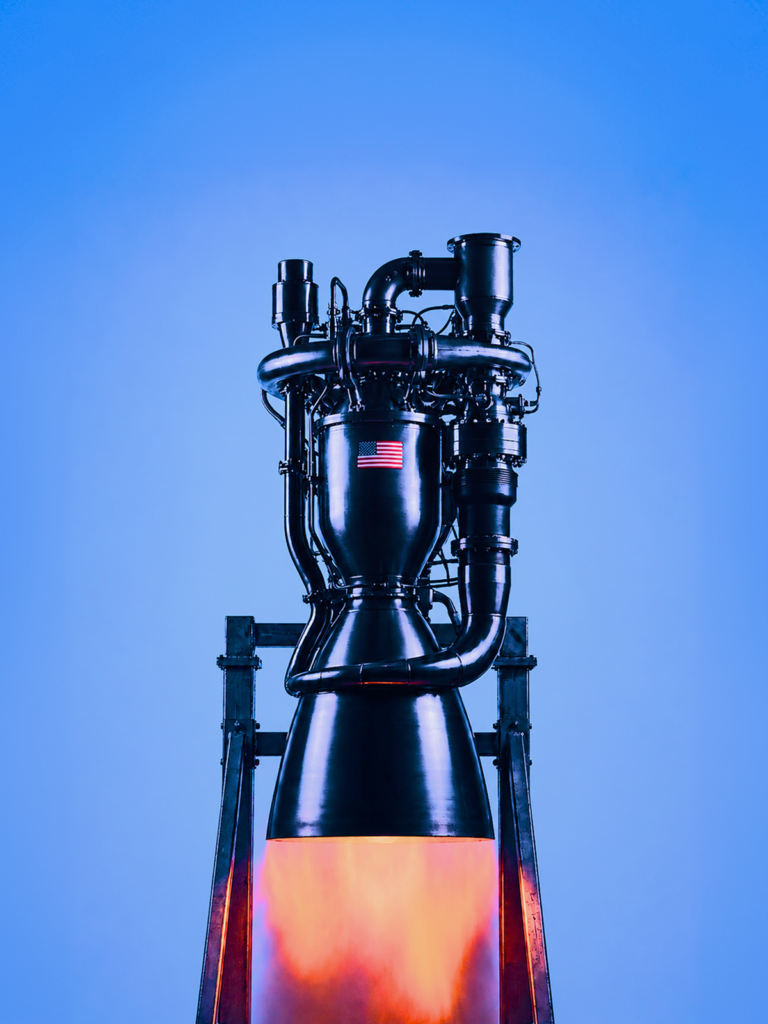
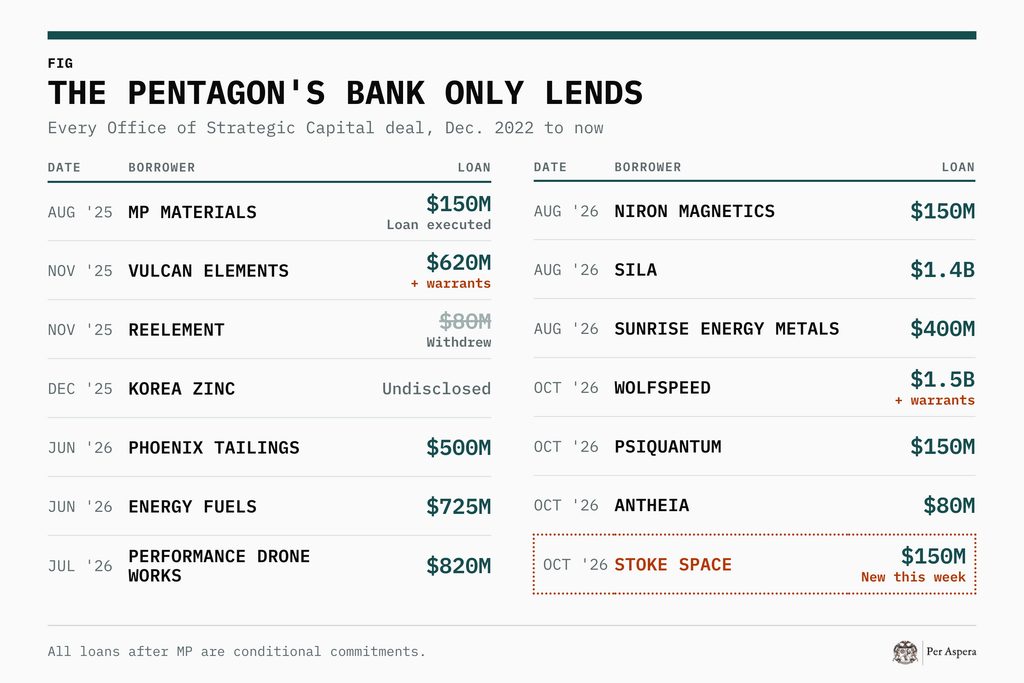
The Office of Strategic Capital (OSC), the Pentagon’s in-house lender, signed a $150M conditional loan with our friends at Stoke Space (a PA Founding Sponsor 🇺🇸) to build a second launchpad at Cape Canaveral, sized for the bigger Nova Block 2. Nine days earlier, OSC signed an $80M loan with Antheia, which brews the starting ingredients for generic drugs from sugar and engineered yeast. Two loans in ten days, ranging from launch to pharma, from an office folks commonly associate with rare earths, piqued our interest, so we combed through every deal since OSC was stood up on Dec. 1, 2022.
There are 14 deals, every one a loan, and the 12 still standing add up to $6.6B. OSC itself owns shares in nobody, which is worth emphasizing, because Washington has been doing a lot of buying in lately. A loan gets paid back with interest and leaves the cap table alone, whereas equity makes the taxpayer your co-owner.
Here’s what stands out:
- OSC spent its first two years on strategy and paperwork. Congress gave it lending authority in the FY24 NDAA and $984M of lending room in March 2024. Its first call drew 200+ applications asking for $8.9B, about 9x what it could lend.
- Then the OBBB showed up with $1.5B for the Pentagon’s credit account, enough to stand behind as much as $200B of loans (half for critical minerals). OSC’s first loan went out the door in August 2025: $150M to MP Materials for heavy rare earth separation at Mountain Pass. (This is also the only loan OSC has announced as executed; everything since is a commitment, and funds don’t move until the borrower clears its conditions.)
- Eight of the 14 are minerals and magnets: MP, Vulcan Elements, ReElement, Korea Zinc’s Tennessee smelter, Phoenix Tailings, Energy Fuels, Niron Magnetics and Sunrise Energy Metals. Since July the menu has widened: drones (Performance Drone Works, $820M), batteries (Sila, $1.4B), chips (Wolfspeed, $1.5B), quantum (PsiQuantum, $150M), medicine (Antheia), and now launch (Stoke).
- Congress hasn’t let OSC buy stock, so when it wants upside it takes warrants. Vulcan handed some over, ReElement did before it walked away from its $80M in July, and Wolfspeed’s cover up to 7.5% of the company as the loan funds. The 40% stake the USG took in the Korea Zinc JV sits next to OSC’s loans, but came through a different door.
- OSC says it committed over $8.4B in FY26 through Aug. 7, more than the deals it has named add up to. So there are more borrowers we haven’t met yet.
- And it has started lending to lenders. OSC’s new National Security Fund Finance program will lend $500M-$1B apiece to private credit funds that then make secured loans to minerals companies.
These commitments demonstrate that OSC's federal financing tools can successfully scale private capital investment in sectors vital to our economic and national security."
– Ryan Lindner, Chief Investment Officer, OSC
Our take
Factories, mines, reactors, launchpads, and the like rely on long, cheap, patient capital that doesn’t dilute the team (AKA, debt). Venture equity is a very expensive way to scale production and pour concrete.
The founders at the top of their game right now are capital-stack-maxxers, continuously optimizing their capitalization processes and calibrating the color of money to the stage of the company: equity for the risk nobody else will underwrite, debt once there’s real assets, long-term contracts, and proven cashflows in place, and government credit where there’s been a market failure and/or Washington has decided it needs the asset (as with MP Materials). Two other ready examples:
- Hadrian’s Chris Power, who as we wrote in #010, “found a way to flip the script and skillfully tap the American capital stack with purpose: using debt to build factories, preserving equity for talent, and scaling with the velocity of a software business.”
- CesiumAstro’s Shey Sabripour, whose Bee Cave, TX startup closed $185M of EXIM debt, a JPMorgan revolver, and a $270M Series C inside 18 days earlier this year (#039).
The challenge, of course, is the context-switching: staying “legible” to all three groups at once (with a cap table a VC can underwrite, collateral a bank can lend against, and a national-security case a program office can endorse). But a few of you reading this have managed just fine. And we’re optimistic that more of you are figuring it out, too!