Ownership for All Americans
In conversation with the Austin-based builder, investor and maker of community, on a lifetime of mission, the incentive structures that determine which kinds of capital will fund hard technologies, and on why America’s frontier companies belong in the public markets.
Preamble by Dan Goldin
I first met Jordan at the inaugural Texas Venture Gala, where the two of us had been booked to interview each other in a fireside chat. I was blown away by this young man, 35 at the time, who I remember thinking was going on 85.
Most people who know Jordan through the media know him as a Marine-turned-investor. That is a job description, and to me it does not do justice to the man, or the patriot, that he is. At every step of his adult life — giving up a medical school seat he had held since sophomore year at Princeton to walk into a Marine recruiting office, driving through 44 states with a friend who was his political opposite, raising the first venture fund the Pentagon ever backed, and now working to make the public markets more accessible to America’s frontier companies — he has demonstrated, highlighted and invested in the extraordinary nature of being an ordinary American.
Dan Goldin
Jordan at a glance
- U.S. Marine Corps infantry officer, 2009–2014, Captain; two combat deployments
- First deployment (2011–2012): 11th Marine Expeditionary Unit, Horn of Africa — led a helicopterborne raid force as part of a crisis-response task force.
- Second deployment (2013): Helmand Province, Afghanistan — combat advisor, trained and advised the 215 Corps of the Afghan National Army.
- General Partner at Overmatch Ventures, an early-stage VC firm he describes as “laser focused on investing in companies that can tip the scales in the US-China competition in our favor.”
- Co-Founder & Vice Chair, America’s Frontier Fund, an early-stage fund investing in frontier technologies vital to America’s future.
- Executive Chairman, Perimeter, a public-market vehicle bringing private deep-tech, defense, and space investments to public investors.
- Co-Founder, Roadrunner Venture Studios, a venture studio building frontier-tech companies from the ground up.
The Interview
Daniel Goldin: I’ve always been patriotic, and even now I’m working at 86 because I think we’re in a lot of trouble and I have a big enough ego to think I could make a difference. I sense that in you.
The thing I really love about you is how mission-driven you are. Building a business and making money is one thing, but in parallel you are very, very concerned about the next generation and how America ought to function. So could you talk about that — who from Princeton joins the Marines, for God’s sake? They go to some great graduate school or some big firm. You’re very different.
Well, from the guy who’s done more in a lifetime than I think anyone could ever hope for — that’s very high praise from Dan. So, thank you.
I grew up a nice Jewish kid in LA. My whole childhood there were two competing influences on me.
- The first is I come from a line of doctors. My grandfather was a surgeon in New York. His father was a surgeon in New York. And so since I was a little kid I was always encouraged to go be a doctor. That was the most noble profession.
- And the competing interest was I’ve always loved politics, policy, national security, and history, especially American history. As a young kid, that’s what I spent all my time reading.
On 9/11 (I think I was 14 years old), I remember my mom waking me up and saying:
We're at war.
Which is, you know, it’s a shocking thing to wake up and hear. And so my teenage years were spent with my eyes glued to the TV watching the Afghanistan invasion, the Iraq War.
My mom was a huge example for me. After 9/11, she wanted to serve the country and she tried to join the Navy. And they were like, “Lady, we don’t need you. You’re 45.”
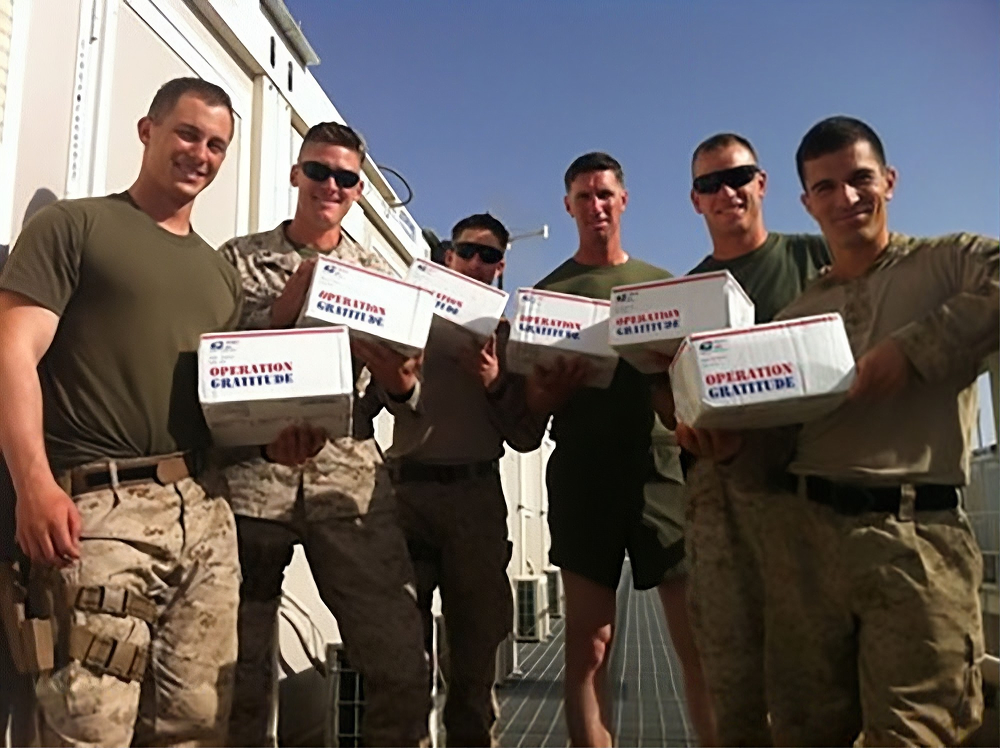
But my mom was intent on serving. She ended up volunteering at the USO in Los Angeles, as soldiers were going off to Afghanistan. Her job was to greet them, give them food, just talk to them. One of the soldiers said: “This is my third tour. I don’t think I’m going to make it home, and I have nothing to live for. My wife left me. I don’t talk to my kids. I have no one here who cares about me.” And that broke my mom’s heart.
She didn’t want any service member to go to war thinking that no one cared about them back home. So she started a nonprofit called Operation Gratitude that sent care packages to troops. She started making them by herself in our living room, then enlisted her friends to help. Soon our living room was overflowing with boxes from floor to ceiling. Eventually it grew into a massive national organization with thousands of volunteers. They’ve sent over 4 million packages to date, and it’s still going, expanding to send packages to first responders as well.


So my example was my mom. She felt that troops in harm’s way deserve the country’s gratitude. And so, with her example, I went off to college.
I thought I was going to be a doctor. I applied to Mount Sinai’s early acceptance program and I ended up getting into medical school in my sophomore year, which allowed me to study whatever I wanted.
I ended up taking a class on the Iraq War at the Woodrow Wilson School at Princeton. And through a task force, I started interviewing all these military officers coming home from war. At some point, I just had this feeling:
The country’s at war, people are going over there to fight and serve. If they’re going, why shouldn’t I?
There was no reason that I shouldn’t also step forward to do it. So senior year, I decided to give up medical school and walked into a Marine Corps recruiting office. They looked at me and said. “Can you do 20 pull-ups?” I said, “I probably could do three.” And they said, “Come back when you can do 20.”
So, I spent nine months training, got accepted to Officer Candidate School and joined the Marine Corps right after college.


Daniel Goldin: You’re out of the Marines. You were looking to be a doctor. What caused you to go for an MBA, a JD, and then get yourself to Eric Schmidt’s family office. That was a very sequential set of deterministic things.
So I had a few experiences in the Marine Corps that kind of shaped what I did next.
- The first was on my first deployment. I was on a Navy ship in the Horn of Africa, kind of between Yemen and Somalia, doing counter-piracy. And then we were going back and forth through the Strait of Hormuz — very relevant for today — basically to prove to the Iranians you couldn’t shut down the strait. That entire deployment, our battle group was shadowed by a Chinese submarine, and every morning we’d get a briefing on where the Chinese sub was. For me that was just a big moment. All of our missions are against these terrorist groups, focused on the Middle East, but China was there, and that was a sort of eye-opening moment of “there’s this bigger game going on.”
- My second deployment, in Afghanistan, I was training the Afghan army, and we were getting them ready to take over combat missions from us. My job was building trust with the Afghan soldiers. And so I’d have long conversations with them.
The thing I kept hearing over and over again was: “Well, you’re just here to steal our minerals. You just want our rare earth minerals.” I kept saying to the Afghans: “You don’t have minerals. We don’t want your minerals.” And they would insist: “No, we do. You’re here to take our minerals.”
So finally I looked into it, and it turned out they actually do have some very large lithium and rare earth deposits, and a number of Chinese firms had moved in to mine them. They had thought it was us, but it was really the Chinese. So it was another moment for me of — there’s something else going on, there’s this bigger game at play.
So for me, leaving the Marine Corps was really with this idea of “I think there’s a bigger conflict coming, there’s going to be a market-driven technological conflict. I want to focus on that.” Around then, Palantir had taken off and it was getting rolled out across the military. A number of other companies were also starting to form, and I felt that there was a technology race brewing that was very important to national security and that was the problem I wanted to work on when I got out.
That said, I didn’t know what to do. So since the GI Bill pays for four years of school, I figured I’m going to take all of it. And so that’s why I did both a law and business degree, because doing both would take four years.
One of the dirty secrets of being a student is that anyone will answer your email. Everybody wants to respond to students. And so I spent four years reaching out to everyone I thought was interesting. At one point I was working three different jobs, basically volunteering for people. And one of the people I reached out to ended up running Eric Schmidt’s family office, and he pulled me with him to stand up this whole new company for Eric.
Also, the thinking behind the JD/MBA was that Yale Law is very policy-driven, and I wanted to really understand national security policy and the grand strategy behind it. Stanford Business School was meant to give me the tech perspective, to really understand Silicon Valley. And I thought the fusion of the two would be powerful.
I think in hindsight, I learned way more on the job with Eric, and just seeing his perspective and how he approached the world.
“Union” the book
The only thing I’d add is, when I went back to school, I’d just come home from Afghanistan. This was, you know, 2015, 2016. There was lots of social tension. Trump emerged around that time. And the law school was just vicious. People were fighting all the time, lots of social protests. And I felt very frustrated coming back from serving in a combat zone overseas and then going into that type of divisive social environment.
And so my friend and I started these road trips that ultimately became foundation for a book we wrote, “Union”.

With all the social protests around us, we decided to get out on the road and see the country. And when you’re on the road, you see a different side of America. You see ordinary people who do extraordinary things, who are decent, who care about family and community and feel deeply about the country. We really wanted to tell that story, you know, about what still unites Americans despite the divided politics.
And I think a lot of that was driven, or informed, by just my experience in the military, where the Marine Corps attracts people from all different parts of America, all different backgrounds. They have nothing in common. They tease each other, they say off-color things. They may even get in fights. And then you bring them overseas and they achieve the impossible.
You give them the hardest task in the world and they achieve it. And that kind of spirit, I think, is uniquely American.
That was the story we wanted to tell. We thought we found that spirit on the road much more than you’d find it in, you know, the halls of a law school or business school.
Building Across Stages
Daniel Goldin: You’re doing early stage investing, venture, private equity growth, and you’re even worrying about IPOs and getting people to go into public markets, which we’ll talk about later. What caused you to be different than the average bear in investment, who is building a narrow tunnel for themselves?
So my early experience with Eric [Schmidt]’s office was — you know, Eric is in this incredible position where he has a huge net worth. He has a large foundation, so we were able to deploy philanthropic money. And because it’s just his own money, he could have an infinite time horizon. He didn’t have to worry about some fund life.
And it allowed us to invest in things that ordinary funds, venture funds, bigger financial institutions would never invest in, because it didn’t fit their mandate or their fund life. I found it to be incredibly powerful.
And there was a term that came up around then called “patient capital”. One of the big reasons we as a country weren’t getting more investment into deep tech or infrastructure — things that require hard capital expenditures — was because venture capital had no patience.
Because of the 10-year fund life and the need to get returns in the kind of seven-ish year range, they just would never touch that stuff. And as I was looking at it, I said, well, there are other sources of money that can. And that’s where I think Eric and other high-net-worth individuals could play this very unique role in catalyzing things that were both good for the country from a national security perspective, and could really advance the frontiers of deep tech. And this was back in like 2019, 2020, 2021, when no venture fund at scale wanted to touch these things.
So that was a huge insight for me — that the incentives behind money really mattered, and that certain kinds of investment had different incentive structures. And so the last seven years of my career have been focused on, well, how can you match different kinds of capital with the most important things we need to invest in as a country?
What I’ve tried to do is say, well, there’s this type of capital that is good for this kind of thing. Let’s stand up an institution that can do that.
And initially for me, that really started with looking at how do you build deep tech companies that are rooted in a place. You have to build real infrastructure — it’s not the SaaS model of the 2010s where you could be based anywhere. You have to build infrastructure somewhere.
And the initial source of capital that I found really interesting was state sovereign capital. You know, states have their own money, and they can use it for economic development purposes. And that gives them a slightly different incentive structure.
And so the first place we talked to is the state of New Mexico. And what we pitched them on was, well, you have the highest R&D per capita in the nation. You have three national labs that are all incredible. There’s unbelievable PhDs. You have ~$10 billion a year flowing in for R&D. And you are 42nd in the nation in startup development. That is a big opportunity. You can do a lot with that.
And so the idea of the venture studio was to say, you have the R&D, you have this incredible talent — let’s deliberately go find the research that’s ready to be commercialized, and let’s go build great companies out of it. And it’s a little-known fact that New Mexico has a sovereign fund, and it has like $80 billion in it today.
And so they gave us an investment to then create a venture studio — it was a $50 million fund to create this studio that we named Roadrunner, because that’s the state bird of New Mexico. And so that’s what got the venture studio off the ground. And I think the insight there is, company building in some sense is like being a talent agency.
You’ve got to go find the right people to build around a company, people who have all the things you need in order to succeed. You need, you know, you need a CEO who has vision and the ability to fundraise and to have great leadership and marshal the team. You need good technical talent. You need engineering talent and business development. And so you can construct that very deliberately around these deep tech companies. And that was the idea behind Roadrunner.
The sister fund to Roadrunner was called America’s Frontier Fund. And the idea for that one was, we’re entering this world where the federal government has so many strategic interests involved in our deep tech ecosystem, and that increasingly they’re going to have to put capital at risk in order to catalyze it. But the government is not an investor, and they don’t know how to do that. And so they’re going to have to work through existing investors to be able to do that.
And so America’s Frontier Fund was the very first fund to get licensed and receive investment from the Department of Defense, through the new Office of Strategic Capital. And so we very deliberately positioned that as a government partner — so, working with government to invest in their priorities. And so AFF was sort of built on this idea that government capital would have a slightly different incentive structure than a pure venture fund would. And that’s how we built AFF, to invest in early-stage deep tech companies.
And then I guess kind of the last piece of it is, at some point a lot of venture capital did become interested in deep tech and defense, and I think there’s a big story there of how the government ended up market-making, by showing their demand and saying, “We’re going to derisk, to some degree, the development of defense and deep tech, and we’re going to use our buying power to really pull capital through.” You know, all of a sudden, 2023, 2024, there’s now tons of venture capital at seed, Series A, Series B in defense and deep tech. So there’s no capital gap there anymore. And I think the capital gap shifted to the right, and so it really ended up being at the Series C, D, and E stages where deep tech companies just still require a lot of investment to build out production capability. And there are certain companies that, because of their growth rate or traction or backers, they can just raise massive amounts of capital.
And there are others that hit a wall, taking months and months to piece together their growth rounds. And it was at that point that I started looking at the public markets as an untapped opportunity for deep tech and defense, where as long as you’re disciplined and you’re able to show the market, “Here’s where we’re going,” the public markets now provide an amazing source of capital for those companies. And so I’ve been spending time looking at what does it take for a Series C, D defense or deep tech company to thrive in the public market.
And this is a long-winded answer, so I’ll finish here. But it also fits with something that I think is very important to me, which is 50% of Americans today have money in the public stock markets. That’s an incredible thing, that so many people are invested in the public markets, and venture capital is dominated by high-net-worth individuals, endowments, pension funds, and your ordinary American doesn’t get to invest in them.
And so, if so much of the growth of these companies happens in the private market, it means ordinary Americans never get to experience or invest in the great technology companies of our era. And as companies stay private longer and longer, they lose more and more of that opportunity. And so, I think there’s a moral dimension to getting companies public, because it means more Americans can invest in them.
Ryan Duffy: Yesterday I was in the belly of the beast — that is to say, I was in Palo Alto getting coffee with someone, and we were talking about how venture capital is at least somewhat mimetic. And the current meta, to a much greater extent than we’ve seen in the 21st century, is, to your point, deep tech, dual use, hardware, doing hard things again.
I just wonder, taking maybe that slightly cynical view, if you worry at all that we could see a reversal in a few years, similar to how in 2015 it was all B2B SaaS. What are your thoughts on the durability of this?
I do think there are cycles, and some of the more experienced venture investors have seen a couple of these, where deep tech was, you know, very prominent in the early ’90s and it falls out of favor, and defense is very prominent and then it falls out of favor. And so you have cycles, and I think to some degree cycles are fueled by this pattern: a sector is unpopular, but there’s some path-breakers who say, “I think there’s an opportunity here” — you know, think of Palantir as kind of your example — they then show that this is possible, all of a sudden more and more people get excited, they crowd in, that becomes a huge wave, and then it overheats, and now you have too much capital coming in, the valuations get too high, and at some point there’s a reckoning and the bubble pops, and as the tide washes out, people don’t want to invest there anymore.
So I think that cycle happens, in a recurring fashion, and I do think that’ll happen here. And I think you’re already starting to see people talk about, well, the valuations have gotten really high in defense. There’s so much capital. The defense budget’s actually not big enough to really absorb this many new companies. And so, at some point, that’s going to hit reality. And so I do think there is a natural cycle there.
I think in terms of the mimetic behavior, to some degree, you know, no investor can fuel a company on their own. Each fund is too small, the risk is too high for each company, and so you need fellow travelers — you need to invest together. And so some mimetic behavior is really just that, like “I won’t invest if I don’t think there’s other capital that’s going to come alongside me and bear the risk.” And that’s true at the start of a new cycle.
And so it takes coalition building — you’ve got to convince others that this is worth doing. And ultimately venture funds have two customers. They have founders who, you know, hopefully take their investment, but then there’s also LPs that they have to convince to give them capital. And you can’t get too far ahead of what LPs are willing to do. It took me like three years to raise AFF’s first fund because we were just too early with LPs. I can’t tell you how many people said to us, “I won’t touch defense. I won’t touch deep tech. Those are science projects. The government’s a bad buyer,” etc., etc. So it just takes time for new investment theses to catch on. And one day it does. Then all of a sudden, once all the LPs want to do it, everybody else says, “Okay, now this is the area that I want to invest in.
So that mimetic behavior is a function of the incentives, and just the dynamics of how investment works and how you have to raise capital, as much as it is, you know, cynical — that people like doing what other people do.
So all that is to say, I do think the risk going forward is that we do see a collapse in defense investment, just given how much capital there is right now. And I think the way to ensure that doesn’t happen is, one, investors just need to talk about staying disciplined and really try to coach companies — “You don’t want to take too much money too soon. You don’t want too high of a valuation too soon. It really hurts you down the road.” I also think the government has a big role to play here in just making sure that the demand pull and demand signals are accurate for industry. And ultimately, you know, the government alone is not enough — we need big commercial demand pull, and I personally think there’s really only two today.
There’s the space economy, which feels a little further out, but I do think there’s a big growing demand pull into space. And it’s AI and the data center buildout for it, which creates demand pull for energy and compute, and all kinds of innovation across deep tech in order to meet that sort of exponential demand for energy and compute.
Overmatch
Daniel Goldin: Could you talk about Overmatch? And then once you’ve defined it, I want to ask how having this plethora of different investment vehicles lets you evaluate companies differently from someone who sits in one smokestack. And the corollary — how do you figure out that a company is worth backing?
So Overmatch is my current [investment] firm, and it kind of brings together everything I love and everything I’ve done to date. There are six of us on the team, and we all came together around a shared mission and passion for American innovation and making sure that we lead this next era.
Overmatch is laser-focused on investing in companies that we think can tip the scales in the US-China competition in our favor. So we like to back founders taking very big swings across deep tech, defense, and space.
We’ll do everything from building our own companies — so we have a build program where, you know, we have hunches, we go find great talent, and then we launch new companies ourselves — all the way through to IPO. And we’ll also invest across the entire stack.
And I think that our focus on new builds all the way to IPOs comes from our belief that building companies makes us better investors — and that there’s an incredible amount we can learn from understanding how the public market values companies. And it does shape, to some degree, what you look to invest in at the early stage. You have all these crossover lessons that make you better at each stage if you can do the full spectrum.
You might take more risk on a given company because you know, here are the things I need to do to get it ready to actually go public. We’ve done a few things most venture funds would never touch, and they’ve worked out incredibly well for us, just for that reason. And then on the other side, understanding what’s happening at the frontier can inform your public investing. And so it just has this incredible advantage, I think, of informing both sides.
And so it’s really fun that Overmatch brings together everything I’ve done to date in my career, and I get to do it with partners who are just exceptional, both as humans and as builders and investors and patriots. They are world-class.
Joy Shin: What are some of the things that you’ve done that other funds just wouldn’t have done, and it worked out?
We invested very early in a company called Principal Mineral. It’s one of our favorite companies and largest investments at Overmatch. When it was founded, Principal Mineral wanted to focus on the “industrial midstream” for critical materials and rare earths at a time when most venture funds would shy away from that sector. The team was exceptional—Adam Johnson, who came out of MP Materials, and Wes Spurlock, who was one of the founders of the Office of Strategic Capital.
My partner Evan believed in them when they had just a deck and an idea. He believed in them as founders, and he thought the area was extremely important for the country, so he made an initial seed investment. Very quickly, the company made a series of acquisitions to create a huge critical materials and minerals platform, that in two years has gone from zero to nearly half a billion in revenue.
And I think that kind of strategy — acquisition-led, backing operators — is usually more of a PE thing. And yet Evan saw the potential for a huge venture-scale outcome, because of how talented the team was and the kind of single points of failure they were focused on. And Adam and Wes saw something that no one else saw, which was that the US has to secure these single points of failure in order to truly reindustrialize. And so that’s an example of something that, because of our understanding of the whole stack, we felt much more comfortable doing.
Joy Shin: Why did they take VC equity versus a cheaper cost of capital, debt, for this particular strategy? Like, what was the benefit to them?
Ultimately, they were starting from scratch. So we had to initially capitalize the team and the platform, and then as you do each acquisition, it unlocks the ability to use other forms of cheaper capital. But you’ve got to get over that first hurdle.
Ryan Duffy: You see the term “valley of death,” which means a million different things in this world. One way I’ve seen it deployed: past a few hundred million in valuation, you’re too big for anyone to want to acquire you. So you have to go for broke. It’s zero or hero — you have to IPO.
And speaking from the point of view of companies like ours, like Array Labs, that incentivizes you to go beyond the main thing and try to become a neoprime, something bigger, so you’re large enough to be sustainable.
Is that a real issue, or overplayed? And if it’s real, does any of what we’ve discussed help?
I think it’s much less of an issue than it was a few years ago. And the thing that’s really changed is the government has been able to pull capital across the stack in a way that didn’t exist before.
So if you go back five years, you had venture funds willing to take this risk at the early stages — seed to Series B — and the rounds weren’t so big that these funds couldn’t invest. So you could get through those early stages, and then you hit Series B and all of a sudden it’s really hard, because the growth-stage investors in defense and deep tech weren’t there. They just didn’t exist. Or if they were there, there were only a couple of them, so they’re going to pick their bets and everybody else really struggles to raise. What I saw happening was you’d have a great company, but they’d spend 9 to 12 months trying to piece together all these small checks, because no one could write the big, you know, $50 million checks into the space.
I think what’s happened now is twofold. Some of the firms just became huge. Andreessen Horowitz, Thrive, Lux, General Catalyst — they got so big, they have so much capital, they can now fill in at that growth stage and really take firms across it.
And then the second thing is, as the government started creating new programs like OSC or the Ex-Im Bank, or just increasing allocation to buy specific capability, that led a lot of other firms to say, “This is actually interesting to us.” And so Blackstone, BlackRock, JPMorgan, Goldman — all of them start moving into the space, saying, “This is now interesting, we’ll start allocating here.” And so the full stack is now kind of built out.
It doesn’t change the fact that for certain companies it’s still very hard. And what can happen is, to keep raising larger and larger private rounds, you have to tell a bigger and bigger story of growth. Because ultimately every round you have to tell a story of how you’re going to at least double or triple the returns in a couple of years. And so the storytelling element of how you get there is really important.
But for some companies, that’s not healthy. It’s not healthy to constantly have to tell a bigger and bigger growth story. And so the question becomes, well, what do you do with those companies? To me, one answer is the public market. I think the public markets don’t necessarily need the same hyper-growth story. They just need a good, fair valuation and predictability about how you’re going to grow.
The other question is, are there other models going forward that can be attractive for some of those companies? And that’s where things like a holding company model, or strategic M&A, become really interesting, as companies look for ways of meeting that next phase in a different model.
One of the beliefs I have is that strategic M&A is success. For some companies, that is a great outcome. It shouldn’t be viewed as a lesser outcome. It is a great outcome. And I think increasingly, more and more options are going to emerge there. You know, 10, 20 years ago, when your only option was getting acquired by a prime, that maybe felt like a loss. But going forward, there’s going to be a lot of interesting options in that strategic M&A bucket.
Joy Shin: As a builder, and then also as an investor across the spectrum, what is your current philosophy on “build fast and break things quickly” with hardware? And then how does that align to getting to the public markets sooner than later?
That’s a great question. So I’m a Marine, and one of our sayings is…
Slow is smooth, smooth is fast.

And I definitely believe that when it comes to building hard tech, getting things wrong early can be very painful later. So I think you should go slow enough that things are smooth, and that can lead you to go faster later.
The flip side is, we do look for teams that have just an amazing violence of action when it comes to building companies. Like, they move the ball so fast down the field, and get really aggressive when they feel like they’ve started nailing the pieces.
So, you know, we’re investors in Saronic. We’ve been in Saronic since the seed round, and we went to visit their facility the other day. You go to the factory and it’s full. It’s humming, and there are 10 boats getting pumped out the line.



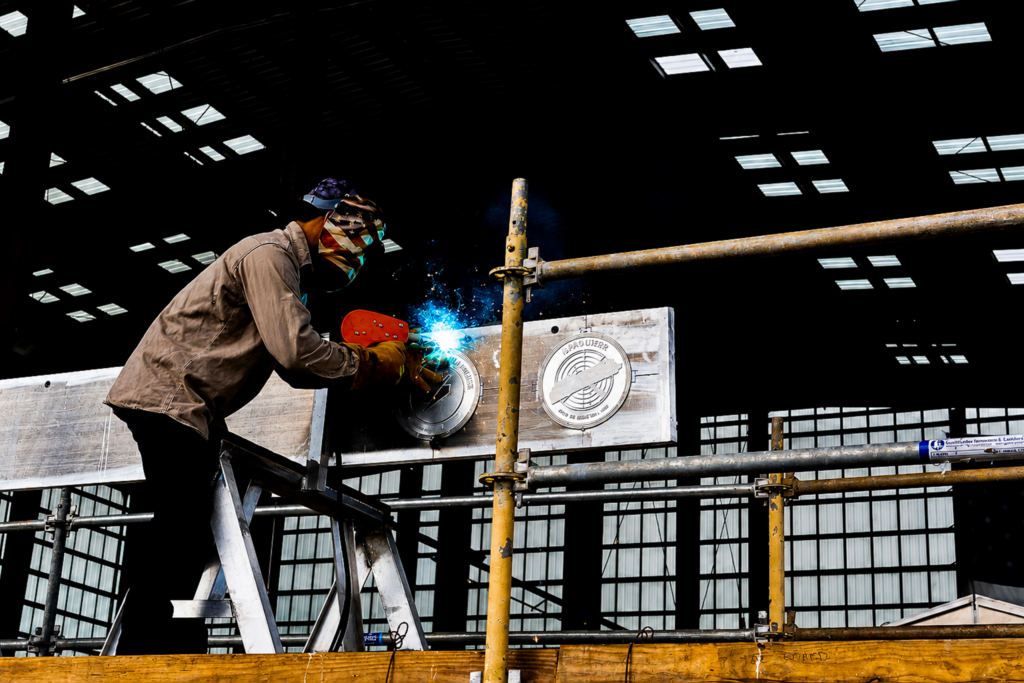


And to see that pace — that’s what we want to see. We want to see people moving so fast. That company’s only a couple of years old, and they’re operating like they’ve been around a long time.
And I think certain companies have a choice of, well, how cautious do we want to be in getting this design right before we go to the next iteration. And there’s sort of an art there. I think Dan probably knows more about this than anybody.
When you do have the pieces in place, that violence of action is so important. It just creates belief – you build belief in your team, in investors and in the market when you're moving that fast, with that aggression, and you're doing it right. That's what we want to see.
Joy Shin: I love that phrase, “violence of action.” That might even be the title of all of this.
I think Dan is the originator of “violence of action.”
Joy Shin: Maybe even violence in action.
Spotting Talent
Daniel Goldin: How do you spot talented people to invest in? And how do you spot the people you want on your team?
So on the investment side, there’s a couple things that I like to look for.
- The first is founder-market fit, that, you know, the person is the best person to tackle that market.
And I’ll give an example, not from the investment world. When I was working for Eric [Schmidt], we started looking at the criminal justice system and the recidivism rate. And, you know, there’s this concept that I think Dan probably agrees with — you can’t solve what you can’t measure. Until you measure outcomes, it’s really hard to fix anything.
So there were two different groups both trying to solve the criminal justice data problem. One was a researcher in Florida who had started a nonprofit. She was using essentially the equivalent of FOIA requests to get states to give her data, and the turnaround time was like years. And once she had it, it was a moment in time.
On the other side was a woman out of Google, a computer engineer, very brilliant, who just had a personal passion for this. In her evenings she was coding systems that would go in and work with state data systems — which are, you know, built on COBOL, very old — and figuring out how to pull real-time data out of each state, to create dashboards of here’s what’s actually happening.
For me, this was a huge lightbulb moment that she had the better founder-market fit. When you want real-time data, having a computer engineer who really understands data systems is just going to be infinitely better. We ultimately gave her a huge grant and said, “Quit your job, go do this full-time.” Her company is called Recidiviz, and the impact she’s had in a couple of years has been staggering.
So founder-market fit is so important, because the person needs the right skills to win in that market. - The second thing I look for is storytelling. I think storytelling ability is really, really important. Ultimately you have to convince people to join your team. You have to convince investors to give you money. You have to convince government to partner with you. And if you can’t storytell, you’re not going to be able to achieve those. And you can get by maybe the first couple rounds with just pure technical brilliance or having found a great market niche that no one else saw. But ultimately, to get all the way, you’ve got to have just a rockstar storyteller. And that’s something that can get improved and trained.
- Which leads to the third thing, which is coachability. I think having founders that are coachable, having teammates that are coachable, is really important, because no one is a wholly formed individual, and you have to grow, and the phases of a company look different. And so you want someone who can get through each of those phases and keep growing all the way through.
- And then lastly, does this this person have an indomitable spirit?
No matter what happens, will this person just keep going? Will they break down every wall to win?
I think that competitive, indomitable spirit is the X factor that I think makes all the difference at the end. When you see it, there’s really no single thing you can point to but you just feel it when you’re with that person. Building a company is really hard. So having that spirit, I think, is ultimately what really matters.
In terms of who I want to partner with, or who I want to team with, I think there are a couple things that really matter:
- The first is a shared mission. I think I’ve always looked for people where, at the end of the day, we believe so deeply in the same mission that we can work through everything else. If you have that shared mission, that’s the foundation of trust.
- The second is people who give you energy. You might not always know initially, but over time you can tell — when I spend time with this person, do I always leave feeling more energized? I told Dan this the other day. Every time I get off the phone with Dan, I have more energy. He makes me feel good, like I want to go do more. And we all have people where you leave the call and you just feel drained. So having partners who give you energy matters. My current partner, Evan, is the best in the world at this. He’s so fun and irreverent, and it makes every call fun. When you’re doing hard things, having fun is superpower.
- And lastly, I look for people who are super spiky. They’re so good at something, better than I could ever be, and I get to learn from them. I get to watch them do some really cool, important thing better than I ever could. I feel that way all the time with my other teammates Morgan and Aabid and Blake. That’s what you want in a team, I think — a bunch of people who are very spiky, where everyone feels like everyone else is smarter or better than they are. Because ultimately that creates a very high-quality, incredible team.
Public Markets
Daniel Goldin: Let me go into the last subject here, and that’s public markets. I grew up in a different era. The companies I dealt with in the defense business when I was at TRW in the ’60s and ’70s, and even into the ’80s, were publicly traded. They weren’t multi-billion-dollar mammoth companies. Their objective was not to become a unicorn, which I think is one of the worst things that’s happened to us: “I got to be a unicorn before I go public.”
A lot has changed in the public markets since then, and none of it makes them comfortable for high-tech companies, especially defense. What that does is put the burden on the US taxpayer to fund the risk that businesses ought to be taking.
Can you talk to us about this, because it’s my passion project.
Definitely. Well, it is for me too — a huge, huge passion of mine. I do think it’s just healthier and better for the country when everybody, the ordinary American, gets to invest in the future of their defense, their space industry, their manufacturing base. You know, when you own something, you feel concerned about it. When you don’t own it, you don’t care. And so I think having more ownership of our innovation economy is good for America.
And I think some of the divide we feel between, you know, a large part of the country and the tech world can in some ways be boiled down to that — that it feels like only a small number of people benefit from the tech world, both at the companies and as investors. And so having broad ownership, I think, is a potential solution there. And how exciting for young kids. If you saw, Gwynne Shotwell donated $325 million of stock to young Americans through the Invest America accounts. It’s incredible.
So it’s getting distributed to all these Americans in low-income neighborhoods — as long as they open this Invest America account, they’ll get a little bit of SpaceX stock. And I think the idea that a kid could own a little piece of one of America’s great companies can change their mentality growing up, change what they decide to do. So I think it’s very important.
If you go back to the 1980s, 90s, companies went public very early. They’d do maybe a couple million dollars of private capital, and then they went public. Apple, Google, Amazon — all these companies went public pretty early. And it was really only in the mid-2000s that it starts getting pushed later and later.
And I have two observations of it. I don’t know if there’s a causal link, but two observations.
- Discipline. I think it’s no surprise that the most successful companies today are the ones that went public very early. A lot of their growth was achieved in the public market, because as a public company you develop discipline. You have to be disciplined about your forecasts. You get laser-focused on your business model, on making sure you’re not just good at growth, you’re good at generating free cash flow. And so you end up with companies like Amazon, Nvidia, Apple, Google — they developed that discipline over decades.
And I think a lot of companies today that stay private longer and longer and longer are, to some degree, not going public because their business model isn’t ready yet. They haven’t figured out how to generate real free cash flow. They’re still in this growth-at-all-costs mentality, and there’s something there where they don’t want the scrutiny of the public market yet. So I think there’s a discipline that gets built in the public markets. - Incentives. The flip side is, it’s also no surprise that between 2000 and today venture capital went from a small cottage industry — about ~$10 billion a year — to ~$500 billion or more a year in the US. And the impact of that is companies stay private longer, because that money needs to go somewhere. Venture capitalists have an incentive to keep companies private longer so they can keep putting money in. Otherwise, where are they going to put their money? And so as some of these companies hit breakout status, you see larger and larger rounds coming in from private capital, because they need to deploy it.
So when you put those two observations together: I think we’re handicapping some companies by delaying when they go public, where they could develop that discipline. And I think it’s taking so much of that growth out of the public market and into the hands of private investors.
To some degree, I think there will be a sense that the public market gives you more financing options. It’s cheaper. If you’re a founder, and you own shares in your public company, you can start increasing your ownership over time through your management incentive plan. There are many reasons why companies might in the future decide to go public earlier. And we’re even starting to see that a little bit with, Anthropic, OpenAI, choosing to go public a little sooner.
I think the final note I’d say about it is there’s certainly an element of the compliance burden pushing companies away from the public markets. It’s become more expensive to be a public company, given the amount of compliance you have to go through.
- The banks have made it more expensive to go public.
- And to Dan’s point about the government having a role to play here, I think the government can do two things:
- They can try to drop the cost of compliance without necessarily dropping standards, but make it so that it is not as burdensome to go public as it currently is. I think that helps.
- And the second is to give public companies privilege for contracts. So if the Department of War were, for instance, to say, “You know, we give more credit to public companies,” it would create an incentive for a lot of companies to go public.
There is heightened scrutiny of public companies. They’re subject to more disclosures, more filings, earnings reports. But there’s more transparency, and more Americans get to invest. And so I think the government should see it as a compelling interest to drive companies into the public market.
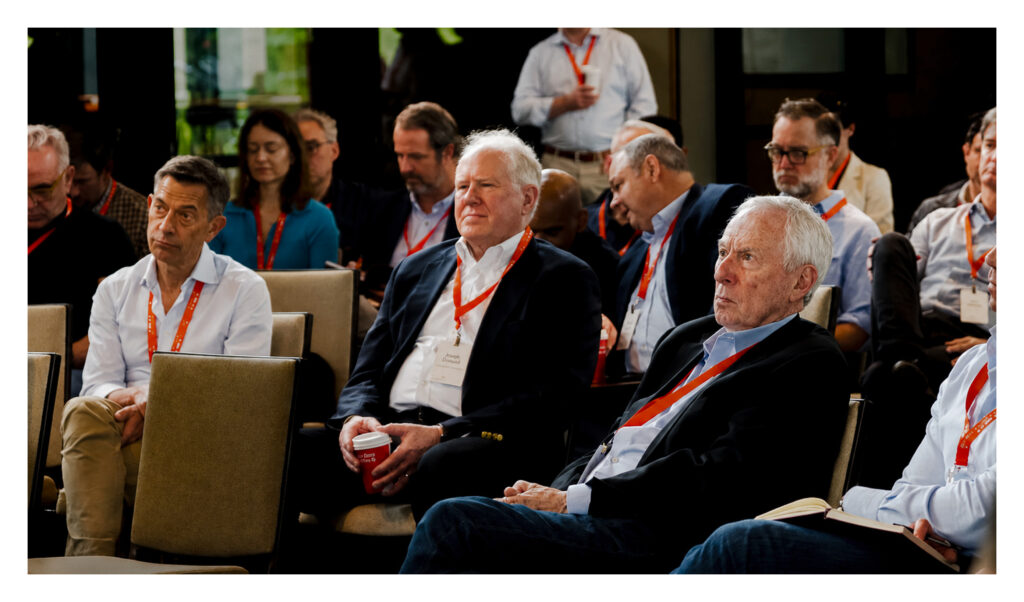
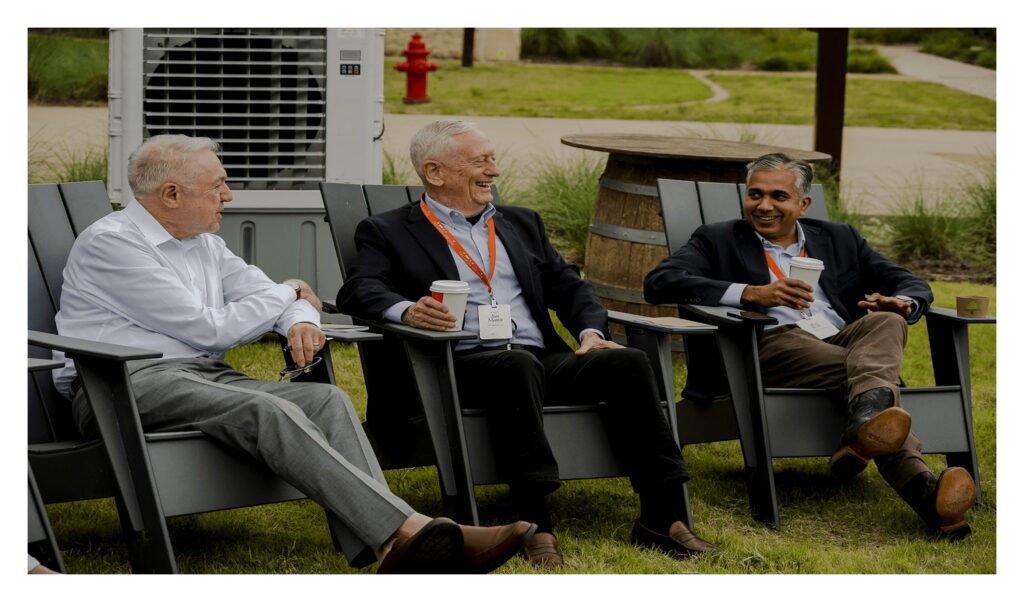
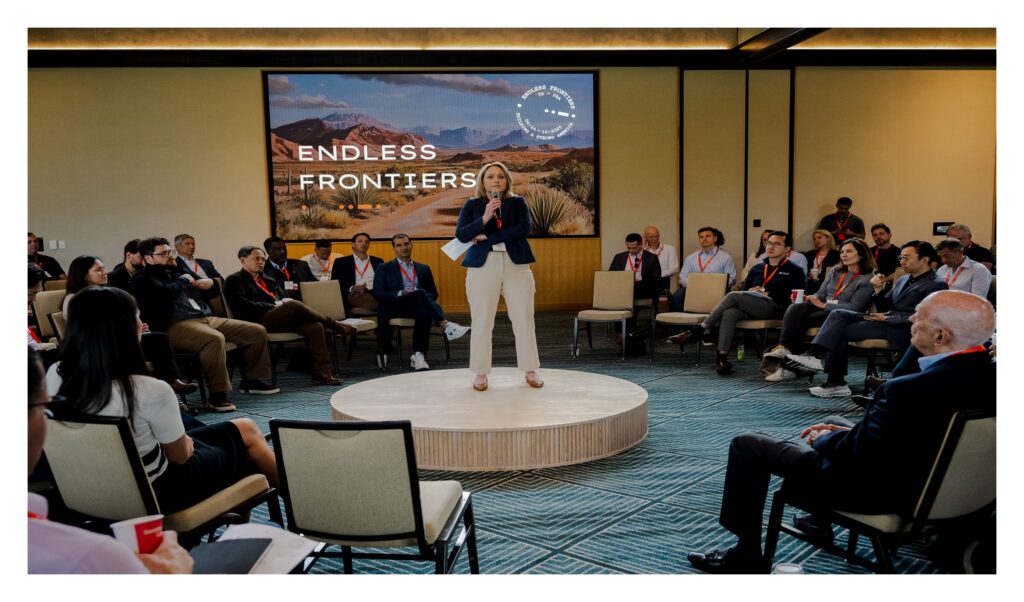
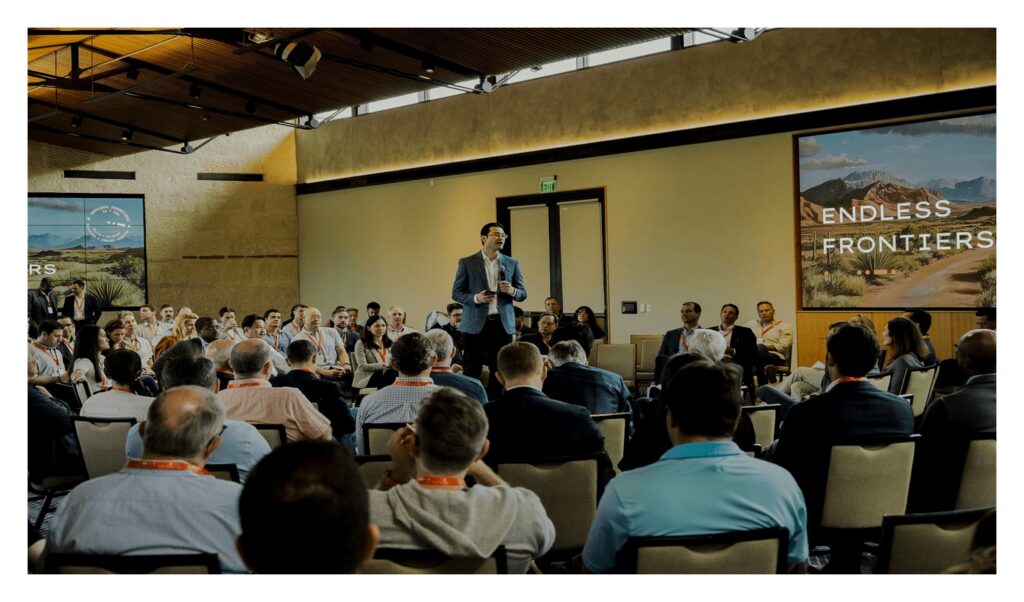
Daniel Goldin: Love it. I think it would be wonderful at Endless Frontiers next April to have a session on this and invite the New York Stock Exchange and NASDAQ.
It’s a great idea.
Daniel Goldin: And again, the government has to play a role. One of the things that I think is important is to get the appropriate person from this Administration — they’ve got to fix the barriers to the public marketplace. It has got to be dealt with on a bipartisan basis, and it may even be worthwhile to invite someone from the finance committee in the Senate, Democrat and Republican. I think Endless Frontiers could do a great service for the whole national security community if we made some progress here.
I would love that. It matters that the compliance burden’s too high. My plan for Endless Frontiers next year is to try to bring some of the staffers. And the whole goal there, Dan, is to try to start building a bipartisan consensus quietly around some of these things.
Daniel Goldin: You know the beauty of it? It aligns with Republican and Democrat principles. Americans could own defense companies! It’s not Republican or Democrat. It’s the right thing for the country. We have taken a little too much of your time.
Exactly. This was so fun. Thank you for letting me do this.




Endless Frontiers — bipartisan, invite-only annual retreat (with Council on Foreign Relations and four Texas universities) focused on renewing American strength and competitiveness with China.
Overmatch Ventures — early-stage venture firm investing in deep-tech, defense, and space companies from pre-seed through Series A.
America’s Frontier Fund — early-stage venture capital fund investing in frontier technologies, first to be licensed to receive capital directly from the U.S. Department of Defense’s Office of Strategic Capital.
Roadrunner — venture studio backed by New Mexico’s ~$80 billion sovereign wealth fund to commercialize research from the state’s national labs.
Jordan Blashek is General Partner of Overmatch Ventures.
Ryan Duffy is our Editor in Chief of Per Aspera.
Dan Goldin is our own Honcho of Per Aspera.
Joy Shin is a Co-founder of Per Aspera.