Where History Pulled the Trigger
For a town few could place on a map, Bastrop, Texas has long had a habit of being present at the creation. According to local legend, a son of Bastrop fired the first shot of the Texas Revolution; another was the first to fall, and three were signers of the Texas Declaration of Independence. The gas station from 1974’s The Texas Chain Saw Massacre still stands just outside town, these days serving tourists brisket.
Despite the lore, and its moniker as “Most Historic Small Town in Texas,” Bastrop has become a place of new industrial beginnings. Situated ~25 mi from Austin-Bergstrom International, it has fast consolidated into the densest cluster of Elon Inc, with tunnel-boring robots, North America’s largest PCB facility, giga-scale EV manufacturing just over the county line, and a rising company town called Snailbrook. (90 miles northeast, in Grimes County, SpaceX and Tesla aim to achieve the impossible with the $55B Terafab project.)
New neighbor
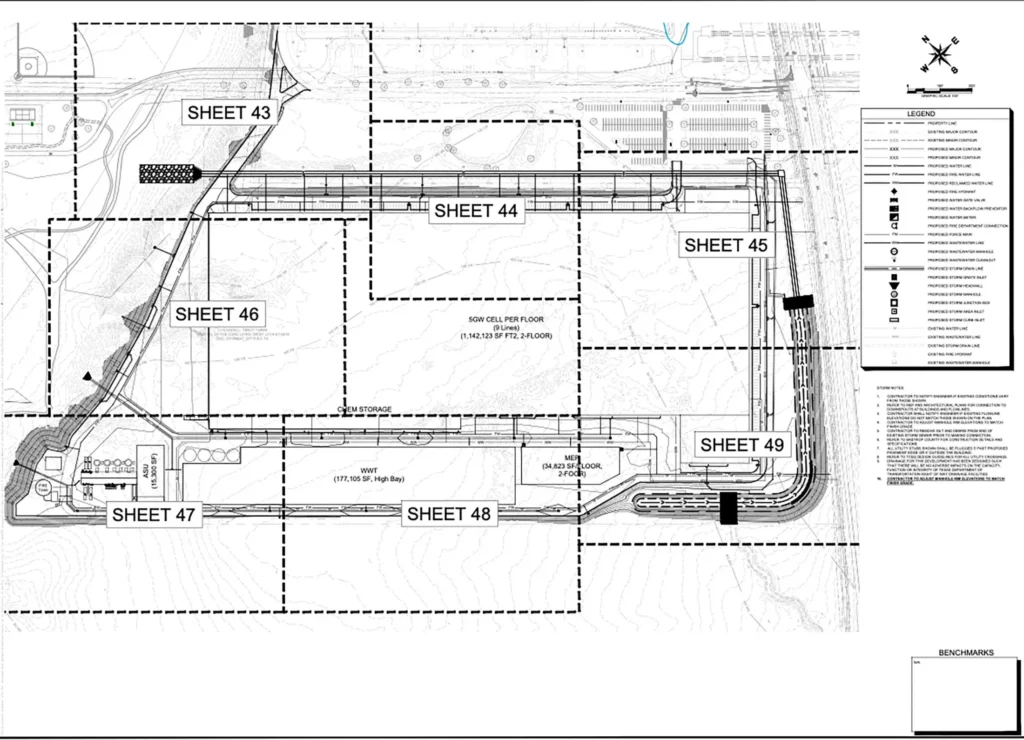
The latest addition to the Bastrop Mega-Complex is a ~2M sq ft solar cell factory, co-located with the Starlink campus, per recent county paperwork spotted by Bloomberg. The permit application details a two-story beast, with a pair of 1M sq ft fabrication decks dedicated entirely to space-grade silicon. Each floor is engineered to crank out 5 GW at full tilt, yielding a total touted capacity of 10 GW a year. SpaceX is targeting initial production lines this year.
A quick aside/prediction… SpaceX will bypass the ERCOT grid interconnection queue for this facility, relying instead on massive on-site generation and heavy battery buffering.
They’re going for it (!)
ICYMI… As Jeff and Ryan have previously discussed, SpaceX is internalizing solar production because:
- Vertical integration runs in its veins
- China’s tightening grip on the cell supply chain
- A legacy, low-volume oligopolistic vendor base simply cannot supply the raw wattage required for Starlink and future space datacenters.
To pull this off, SpaceX had to break the fundamental design canon of aerospace engineering: using gallium arsenide (GaAs) for solar arrays. SpaceX swapped GaAs for silicon years ago when designing the Starlink constellation, recognizing that, among other things, the legacy material is a unit-economic dead end for megaconstellations.
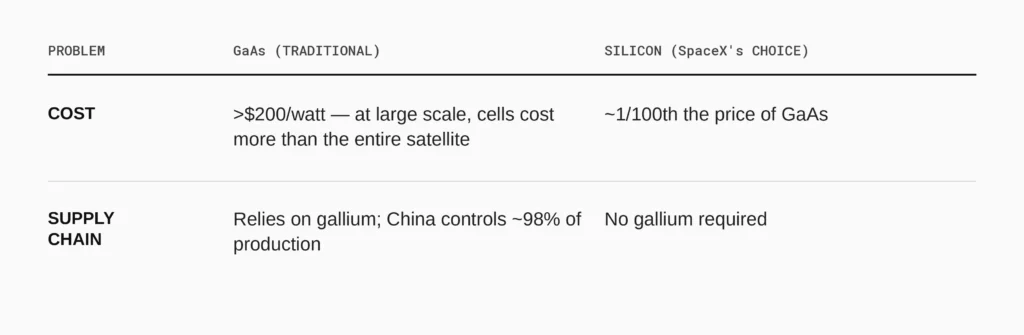
This is a big deal in our eyes because it 1) singularly represents a massive, orders-of-magnitude step-up in global space solar cell capacity, and 2) proves that SpaceX is entirely serious about the endgame (take the dang datacenter and put it in space).
There’s a bigger story here — on the existing technology, physics, geopolitics, and unit economics of space power — that explains why SpaceX is plowing a chunk of its upcoming IPO proceeds into this new factory. For the definitive read on SpaceX’s gigawatts-in-space ambitions, the reshoring (and scaleup) of space solar manufacturing, and the perovskite endgame, dive into Space Power from PA № 043 (10 weeks ago).