The case for asteroid mining
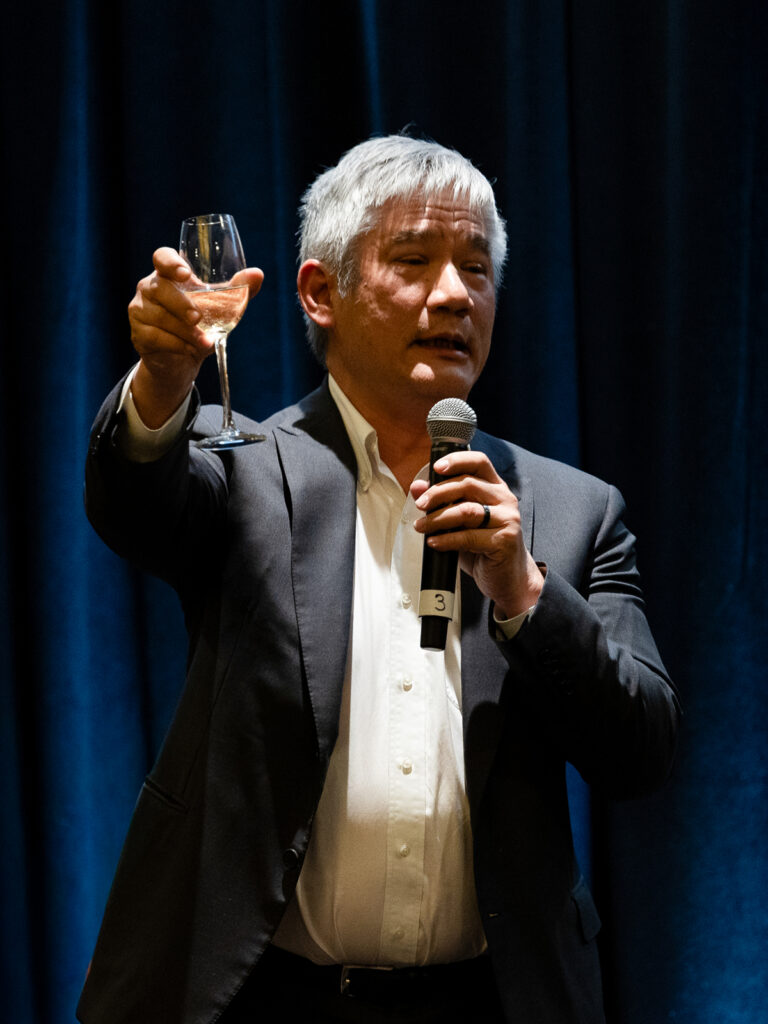
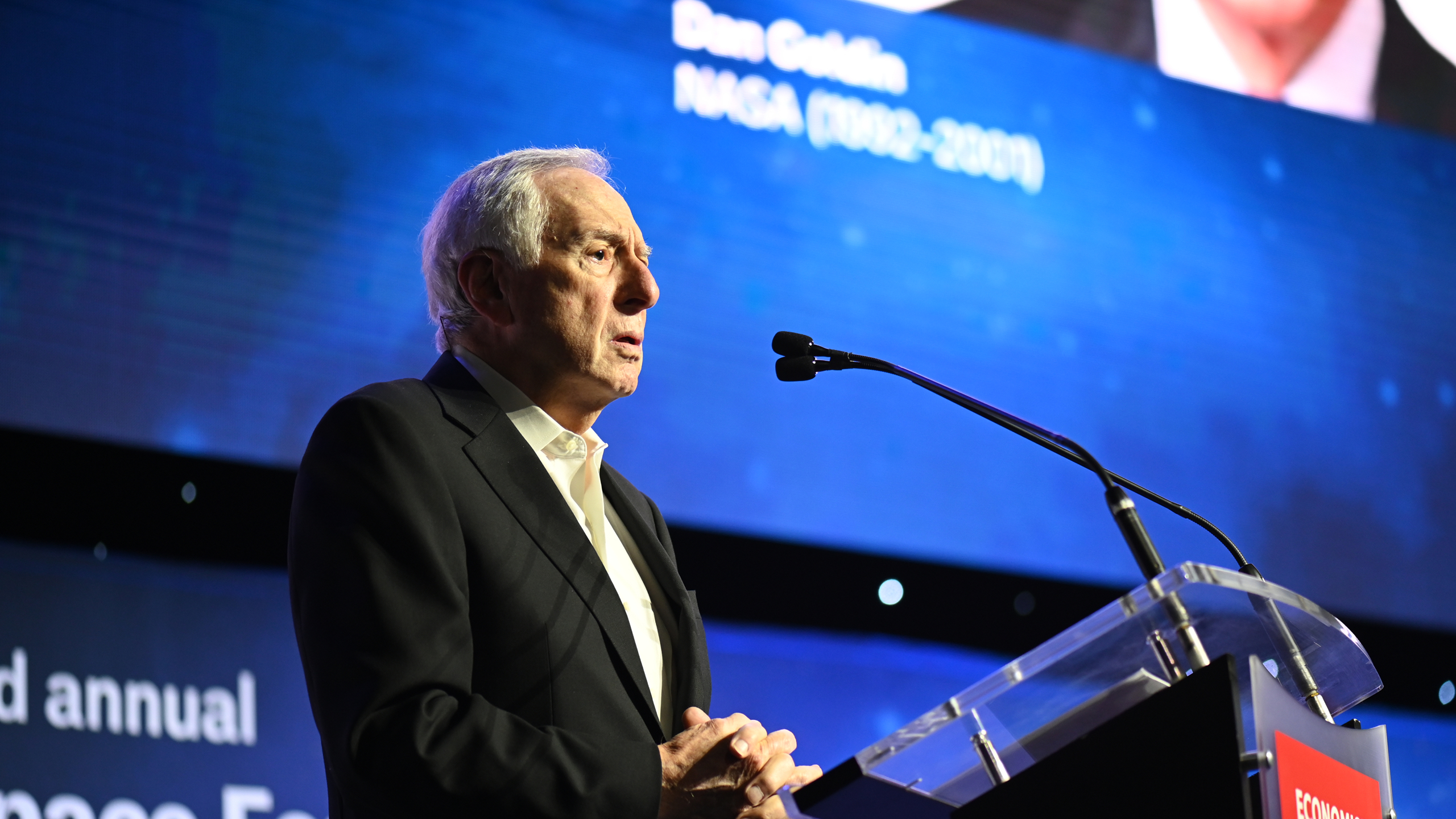
In November 2025, Dan Goldin took the stage at The Economist’s Space Economy Summit to make the case for asteroid mining. His full speech below.
Oh, hello. It’s nice coming back down to Florida and being near Kennedy Space Center. It is an amazing place.
NASA continues to be an amazing organization. And I want to talk today about leaving Earth orbit. I’m bored by the space program.
We’re locked in Earth orbit. I remember when I went through my confirmation process, I took the position that I wanted to darken the skies with small satellites. And I wanted a lot of them to be commercial.
And I wanted to get NASA out of Earth orbit. We succeeded to an unbelievable level, but we’re still locked in Earth orbit. If you take a look at the whole commercial industry in space, it’s hundreds of billions of dollars.
It’s all about communications. It’s all about services. There’s been the promise of products from space.
I haven’t seen doodly squat from space. It’s — we are now in 2025 and we’re locked in Earth orbit and we’re in love with communications and we can’t do anything beyond communications to call. And it’s not — that’s not a commercial business.
It’s a single-note band. So today I want to talk about two areas that I think are ripe for exploitation. One: mining the asteroids.
And I’ll make a financial case for that. My inspiration for this is Matt Galick at Astroforge. If you don’t know about — I have nothing to do with the company.
But if you don’t know about that company, go talk to Matt. He’s here. He’s an amazing guy.
Be prepared for four-letter words, and they’re not pleasant, but he’s a good man. The second area I want to talk about is about why the space — one of the reasons the space station got built. And — and that is to take advantage of the absence of gravity.
Now, why do you want to do that? Because when you have the absence of gravity with little jitter, there’s no convection — you know, the thermal currents — and there’s no sedimentation. And without convection and sedimentation, you could make perfect crystals. And there have been, I think, 300 experiments on the space station on semiconductors.
Can’t remember the name of the company. I’m sure you could all find it. But they’re now talking about building six-inch, sub-two-nanometer wafers for gallium arsenide, which is — and the performance is transformational because you now have a perfect crystal.
The other area that I want to — will be talking about is making pharmaceuticals. There’s Varda, many other companies are doing that, but it’s going slow as molasses because everyone wants to get the instant money and do things. So we keep doing more and more and more in communications, except there are less and less and less communication companies.
And in space, I see two of them right now. I don’t see 10 dozen. So let me dig into what I want to talk about.
And I also want to give it a little bit more background to give context. On October 4th, 1967, I was sitting in Physics 101 when my professor came in and he said, “There’s a Russian satellite looking at you.” We were shocked when the Russians put a satellite into low Earth orbit.
And America had been in a kind of a nice place, but we weren’t doing aggressive things. And from that point in time, the whole American industry changed. And I want to say now that American industry really needs to change because we spent all our time making fabulous manufacturing companies and we have no supply chain, especially for space.
And if you take a look at the time to go build things, it becomes very difficult. So let me talk about the platinum group materials: platinum, palladium, rhodium, iridium, osmium, and ruthenium.
And if you take the average, it’s about $50,000 a kilogram. That makes for a very, very nice return. And if you think heavy machinery, $24.2 billion a year.
All of it comes from mines. There’s one big mine in South Africa. There’s somewhat of a mine in Russia and somewhat of a mine in the U.S. It’s deep and it’s expensive.
But now when you have something at $50,000 a kilogram, you can get good returns and I’ll go through those numbers. But then there’s something else that’s quite interesting. You look at the price of gold.
Well, we produce about $120 billion a year of gold and $20 billion a year of silver. And guess what? The asteroids are full of these materials. But I want to tell a little story so you understand why we want to go to asteroids.
Because when our solar system got formed, there was a big gas cloud and there was a supernova that went off. It sent a shockwave and this cloud of metallic particles and gases went into compression. It flattened and, due to the conservation of momentum, it started spinning in this flattened mode and things started to accumulate. The heavy metals went to the inside where it was very hot and it formed Mercury, Venus, Earth, and Mars. And all the gases went out to form the other planets.
And in the process, there were planets being formed and they broke apart and they made the asteroid belt. So as the Earth cooled, all the heavy elements — it was still molten — they went down to the core, and that’s why we have a molten core that has all the platinum group materials. The molten core has gold and it has silver and it has iron.
But guess what? Those unformed planets in the near-Earth asteroid belt — those unformed planets have exactly the same stuff and it’s there in abundance. And I think there’s 700 quadrillion dollars worth of gold on one of the asteroids whose name doesn’t escape me now. So while we’re building better and better communication satellites, there’s this unbelievable opportunity for companies to go do things.
So let me walk you through the finances here. If I could bring back a thousand kilograms of platinum group materials at $50,000 a kilogram, that’s $50 million. And then if I could build a system — I need to get a thousand kilograms.
So NASA has developed these deployable return vehicles which you could carry rather lightly and you could bring it back. And I don’t have all the details of what Matt’s doing, but if you could build a spacecraft for $6 million and I could bring back $50 million, I get a pretty damn good return. And those are the kind of numbers that are going to drive us to leave Earth orbit and go out to the asteroids.
The other good news about the asteroids is it’s less energy to get there than to the moon because if you go to the moon, you escape Earth’s gravitational field, but you have to fall back into the gravitational field of the moon, and that takes extra energy. So getting there is not expensive. And something on the order of $6, $7 million for a spacecraft — a couple of hundred kilogram spacecraft — and that could bring back, I don’t know, $30 to $50 million worth of platinum group materials.
And if we could get to these other places to get the gold, that’s in the future. But that’s a very nice business and it will solve a lot of social problems here on Earth, especially for the supply chain for the United States. We will become the supplier of platinum group materials.
The other area that I like to talk about is microgravity research. I remember when I got to NASA, I was asked by President Bush to go fix Space Station Freedom. They had spent by that point in time — I think $17 billion — and all they had to show for it were bushel baskets of parts.
There wasn’t one working system. And I had to go talk to the Congress and convince them that we needed to get a space system up where we could learn to work in space, where we could show that we could solve the health problems for astronauts — be responsible that we could handle the zero gravity, that we could handle the radiation. And it’s been up there.
It went up, by the way, November 2nd of 2000. I promised it would go up by the end of the 20th century. And on November 2nd, 2000, Bill Shepard — one of the most amazing people I’ve met in my life — he went up with two Russians and they commissioned the International Space Station.
November 2nd, 2000. Well, guess what? It was supposed to last a quarter of a century. And on Sunday, Mike Fink — Colonel Mike Fink — sent me a LinkedIn from the space station.
A few days ago on Sunday, he said, “Dan, we finally made it — 25 years.” That’s amazing. That’s amazing.
And it has to do with a commitment to excellence. And by the way, the members of the Congress didn’t understand that we needed to get people into orbit to get off planet Earth. It’s time.
And I remember June of ’92 — it was 2.15 to 2.15 on the floor of the house. And John Lewis of Georgia, who’s no longer with us, he came out of the elevator. And Jeff Lawrence, who was the head of legislative affairs, said to me, “Dan, go get him.” So I jumped in front of him and he was grumpy.
And I said, “Mr. Lewis, the space program for America and the world depends on you.” This was — this was ’93. And at that point, we had already committed to bring the Russians in.
And he laughed at me. I said, “How are you going to vote?” And he said, “I ain’t going to tell you.” I said, “Could I give you a speech?” He said, “Have at it. I’m not going to show any facial motion.”
And Jeff Lawrence was standing at the entrance to the house and he was literally biting his nails. I thought blood was going to come out of his fingers.
It was — it was unbelievable. He went on to the floor of the house — to 16 to 2.15. And I’m so proud of the Americans, the Russians, the Canadians, and the Japanese. We work together.
And the other thing that — that space — and the other thing that space station did is I was a weapons builder for the 25 years before. I got went to NASA. I built weapons to help bring down the Soviet Union.
And then on June 6th in ’92, President Bush asked me to meet with the president of Russia, Boris Yeltsin. And I sat in Blair House and we talked about how the Russians and the Americans were going to work together.
And with all the stress in the world, this is the power of space. With all the damn stress in the world and all the politics, that space station has operated flawlessly. Not one scratch to one person.
And there have been hundreds of people up there. But you know what? It’s time for the space station to come down — at three billion dollars a year, it’s done its job.
It’s 25 years old. And it needs to come down because we need to let the commercial industry start doing low Earth orbit. NASA and America and our partners — we need to go to the stars.
And this has to happen. And it needs to be a commercial activity. Now, the space agency has incredible technologies and that’s their job — to help the commercial industry.
But this has to be done with venture and private equity capital. There are a number of companies — their names are not all coming back to me now — but you ought to think about it.
Now, let’s talk about microgravity. On microgravity, there’s been amazing results. We have semiconductors.
We have pharma. And even it looks like we could make fiber optic cable because without sedimentation and without convection, you could get a much better optical transmission. So there are a whole series of products and there are a number of companies in this domain.
And then I just met yesterday a group called the Spaceplane Company. What they’re talking about doing is taking the X-37B, which is a national security platform, and they’re going to convert it into a laboratory that goes up and comes down. And when you come down with that vehicle, there’s no g-force.
It just eases in and kisses the runway. And it is a much more quiet in terms of microgravity vibrations in orbit. That platform can do an amazing amount of things.
But there’s a reticence to invest in this. I just advise the folks in this room: go take a look at the kind of things that happened on the space station and understand — is America going to try and replicate what they’re doing in Taiwan? I don’t think there’s a chance in hell. But America does best when it really reaches out and does the wild and crazy things.
So I really do believe that the International Space Station has set the stage and we’re ready to go start mining. I want to close by talking about the past and then going into the future. I was a student in engineering, October 4th, 1957.
Oh, I talked about that. I’m sorry about that. And the fact of the matter is, we decided at that point that we’re going to change.
And in 1961, President Kennedy said, “We’re going to the moon and we’re going to land in ’69.” Eight years. Eight years.
In 1955, Russia exploded a one-megaton bomb, and the man who was to become my mentor when I became an executive at TRW — Dr. Simon Rameau — two days later got a call from President Eisenhower. And he said, “Si, I want an intercontinental ballistic missile. And I want it in eight years.”
In that eight-year period, Simon Rameau — who had the Rameau-Woodridge Corporation — worked with General Bernard Schriever, who was in the Air Force. In that eight-year period, they produced the Delta, the Atlas, the Titan launch vehicle. They produced the Minuteman and they had it deployed in the heartland of America with hundreds of missiles.
And the Air Force doesn’t get credit. The semiconductors that powered Apollo to the moon came from the ballistic missile program. And guess what? Eight years.
So here’s my challenge. I’m 85. I’m going to be 93.
I want to see America work with its international partners and get the hell out of Earth orbit and start getting the riches from the asteroids. We could get to the moon, but we need to become a space-faring society. And we’re not going to do it by making billions of dollars in communications.
So America, the world — I’ve thrown out my challenge. I’ll be here eight more years and I’m going to watch and see if you do it. Thank you very much.
Dan Goldin is Cofounder & Chairman of Per Aspera.