Your humble editor here. We’re trying on a more off-the-cuff essay for size and mixing things up a bit. Hope you like it!
In April, yours truly finally went to Taiwan, after half a decade of theorycrafting from afar and surely very original thoughts about “concentration risk with Chinese characteristics.” (Here’s the full confession from that trip.) Being there drove home just how central Taiwan is to how American technology gets made, even as the United States works to bring more leading-edge logic production back home. Stats rarely make a great story, but the sheer scale of TSMC’s foreign direct investment (FDI) tells it well:
- 2022: Planned US investment taps $40B
- 2024: The commitment rose to $65B
- March 2025: TSMC announced an expansion to $165B
- July 2026: Another $100B is tacked on, bringing total planned investment to $265B (!)
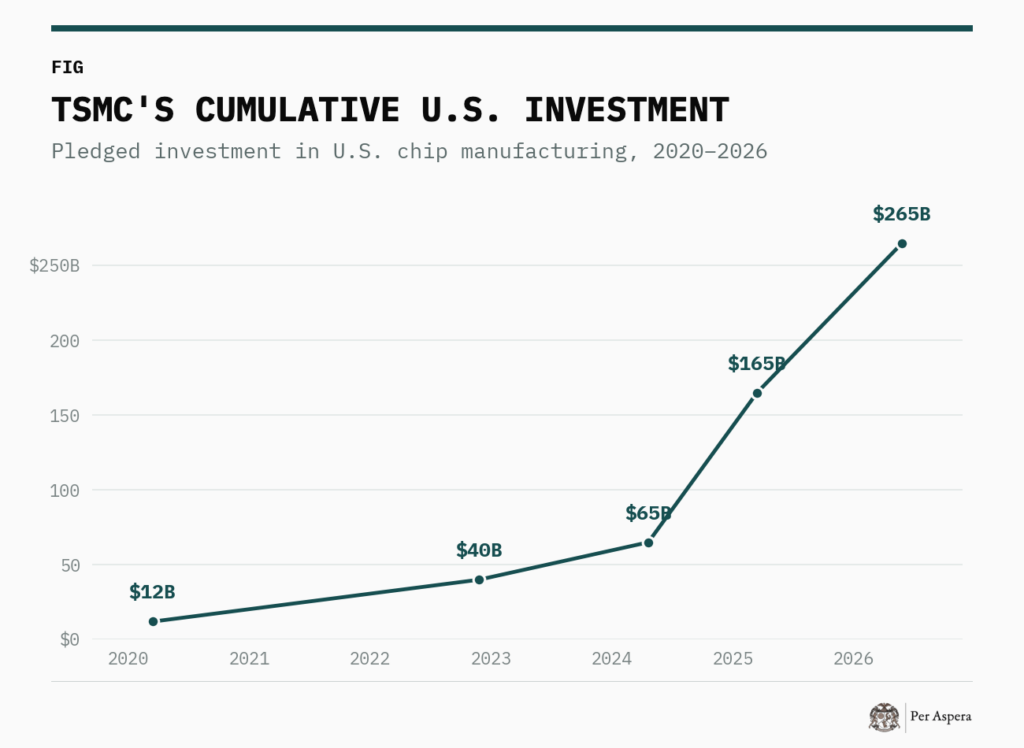
That last tranche is meant to add four more advanced fabs in Arizona, bringing TSMC’s planned American footprint to 12 manufacturing and packaging facilities. But pledges are pledges (and planned investments are “planned” until actualized). As of last Friday, Taiwan’s economic ministry had approved $44B of TSMC’s U.S. investment since 2020, with $20B of it this July. Back home, meanwhile, TSMC runs 19 fabs and packaging plants, with 13 more under construction.
The “dependency” is actually only accelerating. Our goods deficit with Taiwan has gone from $30.2B (2020) → $47.8B (2022) → $73.8B (2024) → $146.6B (2025), nearly doubling in a single year as imports jumped 73% to $201.4B. This year is running hotter still, at $127.8B through July, up ~81% on the same stretch last year.
If anything here deserves an indictment, it’s not our current industrial policy but the last three decades of strategic amnesia. And these trendlines are pretty easy to explain. There’s an all-consuming AI supercycle taking place, if you hadn’t noticed, and demand for leading-edge inference is about as inelastic as it gets. Most of those chips are still made in Taiwan. When Chairman C.C. Wei announced TSMC’s latest $100B American capex boost in July, he pinned it on “the strong multi-year demand from our leading U.S. customers.” Planned investment, meanwhile, is spent over years on some of the most capital-intensive megaprojects ever attempted. And even after a fab comes online, it takes time to ramp up, and longer still to build out surrounding suppliers, packaging capacity, and so on.
Our take: Put AI demand next to the time it takes to stand up the most complex machine humanity has ever built, and it’s no surprise the first curve is much steeper. This gap shows up as the trade deficit. It’s also a good chance for us to practice what we preach and resist the siren song of “The Press Release Economy.” Celebrate the announcements, pledges, and planned commitments, by all means. And then: trust, but verify.