
We once built satellites to survive nuclear war. Now we’re moving almost everything, commercial and military alike, into the one orbit a single warhead could completely destabilize.
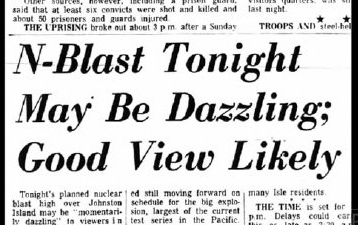
The view was as good as advertised. At nine seconds past eleven on the night of July 8, 1962, a flash lit the sky southwest of Honolulu, and for the next three minutes, one reporter wrote, the moon hung “in a sky partly blood-red and partly pink.” On the hotel rooftops, where “rainbow bomb” parties were under way, the guests got what they came for. The glow was visible as far away as New Zealand.
Then the streetlights went out: about 300 of them, across Oahu, all at once. Burglar alarms began to ring. A telephone company’s microwave link went dead.
The cause was 900 miles away and 250 miles up. The United States had just set off a 1.4-megaton hydrogen bomb in space, a hundred times the size of the one dropped on Hiroshima, in a test called Starfish Prime. The pulse that reached Honolulu was so much stronger than predicted that it drove the test’s own instruments off the scale.
Two months earlier a reporter had asked President Kennedy about exploding an H-bomb in space. “Van Allen says it is not going to affect the belt,” JFK said, and the room laughed.
The blast did, in fact, affect the belt, pumping it full of high-energy electrons, some of which lingered for years. “This result contravened all our predictions,” the chairman of the Atomic Energy Commission wrote afterward. Of the 21 satellites in orbit or about to be that summer, eight would be crippled or killed, among them Britain’s first, a Soviet one, and Telstar.
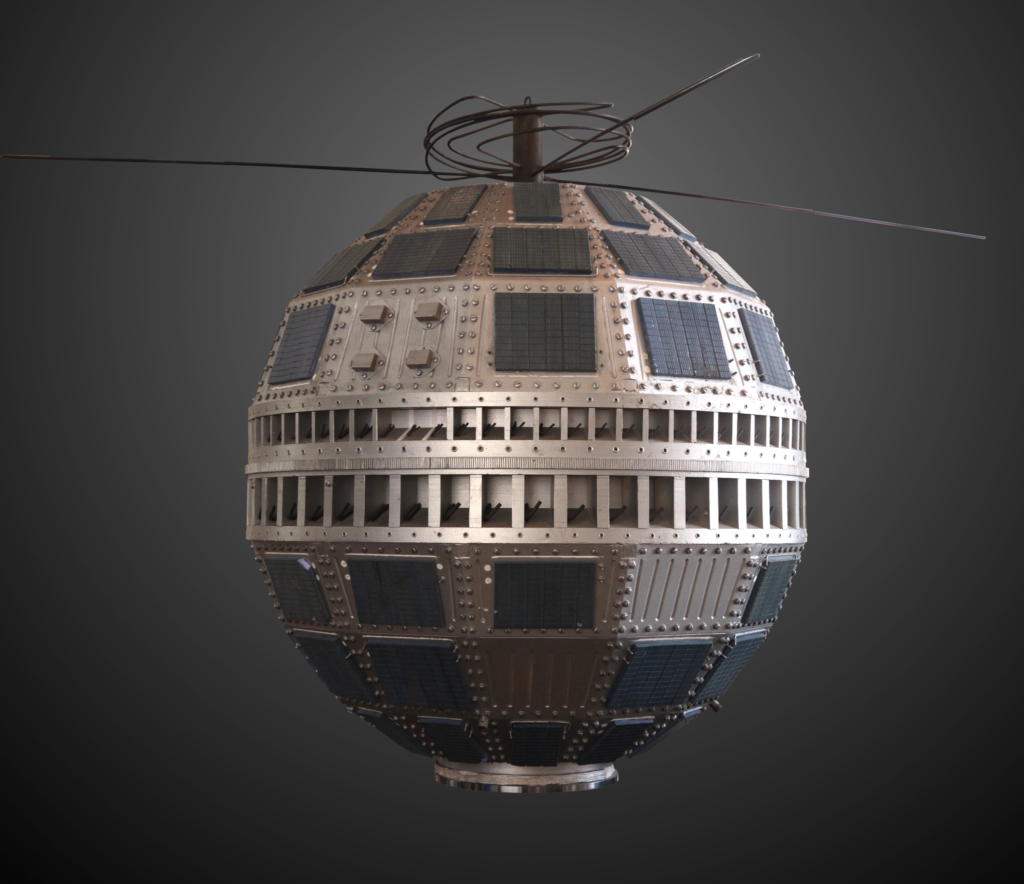
AT&T had spent $50M on Telstar, the first satellite a private company ever paid for. It launched the day after Starfish Prime, flew straight into the belt we had just made, relayed a Phillies-Cub game to Europe, and was already failing when the Tornados took “Telstar” to No. 1 on the Billboard Hot 100 that December.
Three months later the Soviets took their turn. On Oct. 22, the same day Kennedy went on TV to tell the nation about missiles in Cuba, the Soviets set off 300 kilotons 180 miles above Kazakhstan, blowing every fuse on a 570-kilometer telephone line and damaging about 1,000 kilometers of buried power cable.
By Christmas, both superpowers knew what one bomb in space could do.
All it would take is one.
In 1962 there were 21 satellites in space. Today there are nearly 17,000, and 94% of them are in low Earth orbit:
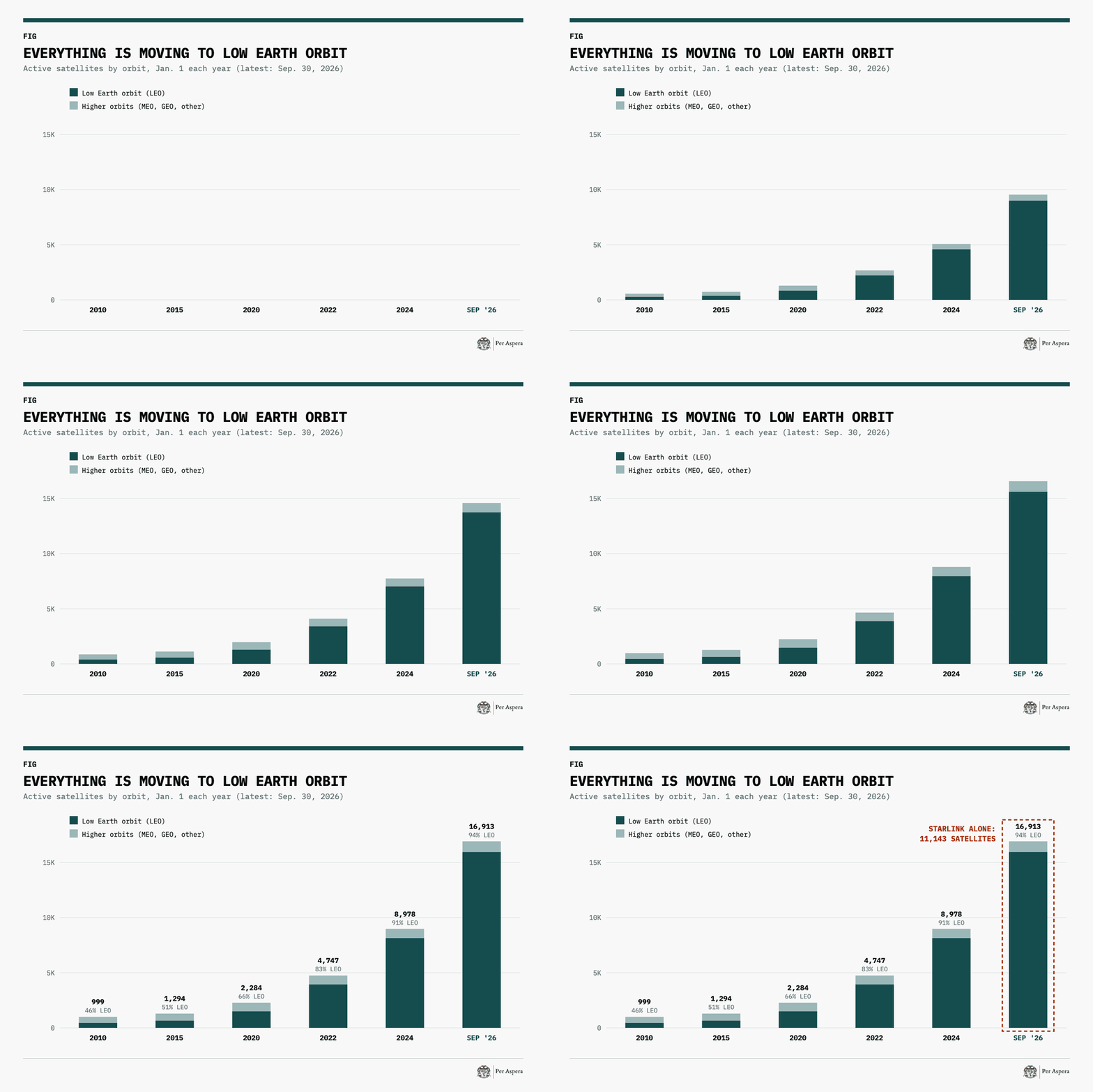
Sources: Jonathan McDowell, Jonathan’s Space Report, active satellite data (Sep. 30, 2026). Chart: Per Aspera.
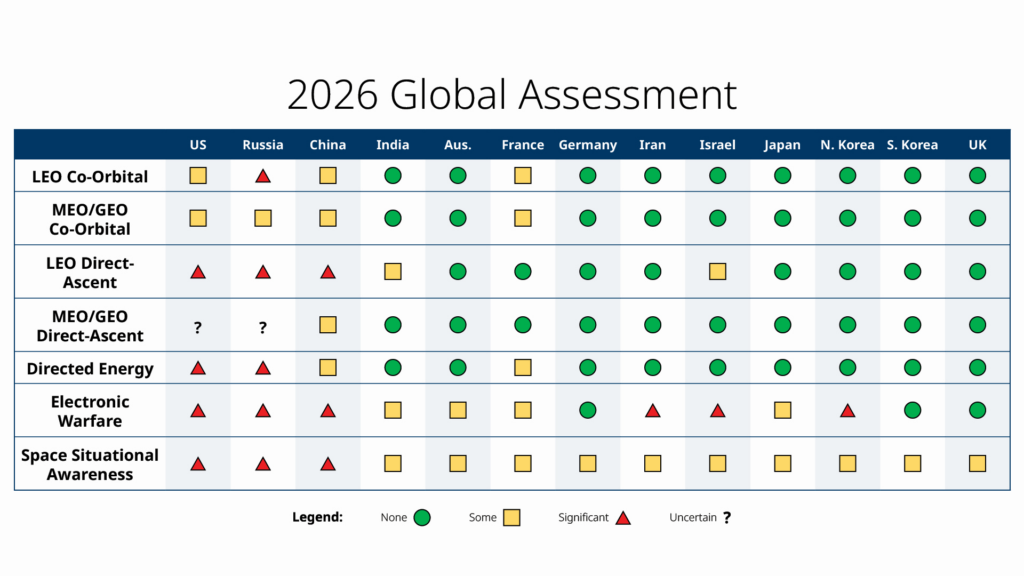
Last month, Air Force Secretary Troy Meink announced that America “has on-orbit space control weapons,” the first time an official in stars and stripes has said so out loud. This prompted a considerable news cycle of alarmism, breathlessness, and outrage over what should have been a nothingburger. Anyone paying attention to the news knows that we have weapons in orbit, as do the Chinese, the Russians, and others:
Sec. Meink went on to describe the next chapter of orbital defense: space-based interceptors, a Space Data Network, and a system to track aircraft from orbit, all built as what he called “proliferated constellations,” which is Pentagon-ese for swarms of small satellites flying low. The Space Force has requested $71.3B for 2027, up from $40.1B this year, which was itself up about 40% from the year before. The force is studying a fivefold increase in its fleet to meet our critical national security needs.
The government worked out long ago what a single nuclear weapon would do to these critical LEO assets. In 2001 the Defense Threat Reduction Agency studied a small bomb, 10 to 20 kilotons, about the size of Hiroshima, set off between 125 and 300 kilometers up. It found that the blast “could disable — in weeks to months — all LEO satellites not specifically hardened to withstand radiation generated by that explosion.” The belts would be charged for six months to two years, so anything unhardened launched as a replacement would suffer the same fate Telstar did. The Pentagon stood by that assessment in 2024, and recent studies by RAND and the American Foreign Policy Council reached similar conclusions.
All it would take is one.
We knew how to build for this
I spent 25 years at TRW working on national security space programs. In July I wrote here about one of them: Milstar, the communications system my team at TRW helped build in support of Lockheed and the Air Force.
Milstar’s job was to guarantee that the President could talk to his forces should nuclear weapons go off in the atmosphere or in space. Everything in the design followed from that requirement. We put the satellites in geostationary orbit, 22,300 miles up, where there is vast room and it is hard for a single weapon to do real damage. We shielded and hardened them against prompt dose and electromagnetic pulse. We gave them extremely high frequency links that resist jamming and the interference a nuclear blast creates. And we designed them to keep running for up to six months with no ground control at all, in case the control centers were gone.
We knew how to do this. We built it. It works. The first Milstar retired this year after three decades on station.
The Pentagon understands the priority and still pays this kind of survivability premium where it matters most. Last year Boeing won $2.8B to build Evolved Strategic SATCOM, the latest nuclear-survivable successor to Milstar, in the same high orbit, with first delivery in 2031.
Though POTUS’s line to the bombers and subs will remain radiation-hardened, nearly everything else is headed the other way.
The case for low orbit, and its one exception
The Space Force has a good reason to go low. A handful of large, exquisite satellites makes a handful of large, exquisite targets, and China and Russia have missiles and co-orbital weapons built to hunt them.
Here lies the beauty of distributed, proliferated systems: put up hundreds or thousands of cheap satellites and an enemy cannot shoot them down faster than you can replace them. Against “conventional” anti-satellite weapons, the cost asymmetry runs brutally against the attacker.
A nuclear detonation is the one exception, because it irradiates the entire orbit at once.
The people building the low-orbit constellations made a reasonable trade. Asked in 2024 about a Russian nuclear anti-satellite weapon, the director of the Space Development Agency said, “We are not planning on making sure that all of our satellites are extremely resilient to such an attack,” and noted that at 1,000 kilometers the agency’s satellites are already “more hardened than most.”
Why aren’t space operators taking this more seriously? Put on a game theorist’s hat and the answer is simple: using such a weapon sounds like suicide! Any spacefaring power that did so would kill its own satellites along with ours. So, we assume that deterrence will prevail under the age-old logic of MAD, mutually assured destruction, which holds as long as everyone has the same amount to lose.
We need to ask ourselves: does everyone have the same amount to lose? And what about a rogue actor with very little or nothing up there at all?
Russia operates about 200 satellites, in every orbit combined, to America’s 10,000-plus. In March the Director of National Intelligence reported that Russia “is developing a new satellite meant to carry a nuclear weapon as an antisatellite capability,” and Space Command ran its first wargame built around a WMD on orbit. Analysts at FPRI, working from Russian military writings, concluded in August that Moscow “could choose to simply ‘take LEO off the board,'” knowing the act “would also harm Russian satellites.” As for rogue actors, North Korea has an estimated 60 warheads and one satellite.
The actor with the least in orbit has the least reason to hold back.
What about the company doing most of the flying? SpaceX operates about two of every three active satellites. It has won $6.45B in Space Force contracts for an aircraft-tracking constellation and the military’s low-orbit communications backbone. Like the Pentagon, the company has staked no small part of its future on low Earth orbit.
When SpaceX IPO’d in June, its prospectus warned investors about anti-satellite weapons, solar storms, and other risk factors they’d certainly never seen in an S-1 before.
And the commercial gold rush is just getting started. Just last week, Google launched its first AI chips into orbit. Starcloud has already flown an off-the-shelf Nvidia datacenter accelerator with no rad hardening. Last year, me and Ryan Duffy wrote a long beast of a piece here on what it takes to compute in space. Radiation was among the hardest problems, and that was before anyone added a bomb into the mix.
The blast also points down
A weapon that would clear out LEO would, sadly, also drive an electromagnetic pulse into whatever sits beneath it. The congressional EMP Commission has described this pulse in three parts:
- The first wave hits in billionths of a second, too fast for any surge protector, and fries unshielded electronics, including the precious controls that guard our power grid.
- The second is no worse than lightning, which the grid shrugs off daily. But it lands an instant after the first has knocked out those defenses, and walks through the open door.
- The third is slower, bending Earth’s magnetic field and driving hundreds to thousands of amps down long transmission lines into the transformers at either end.
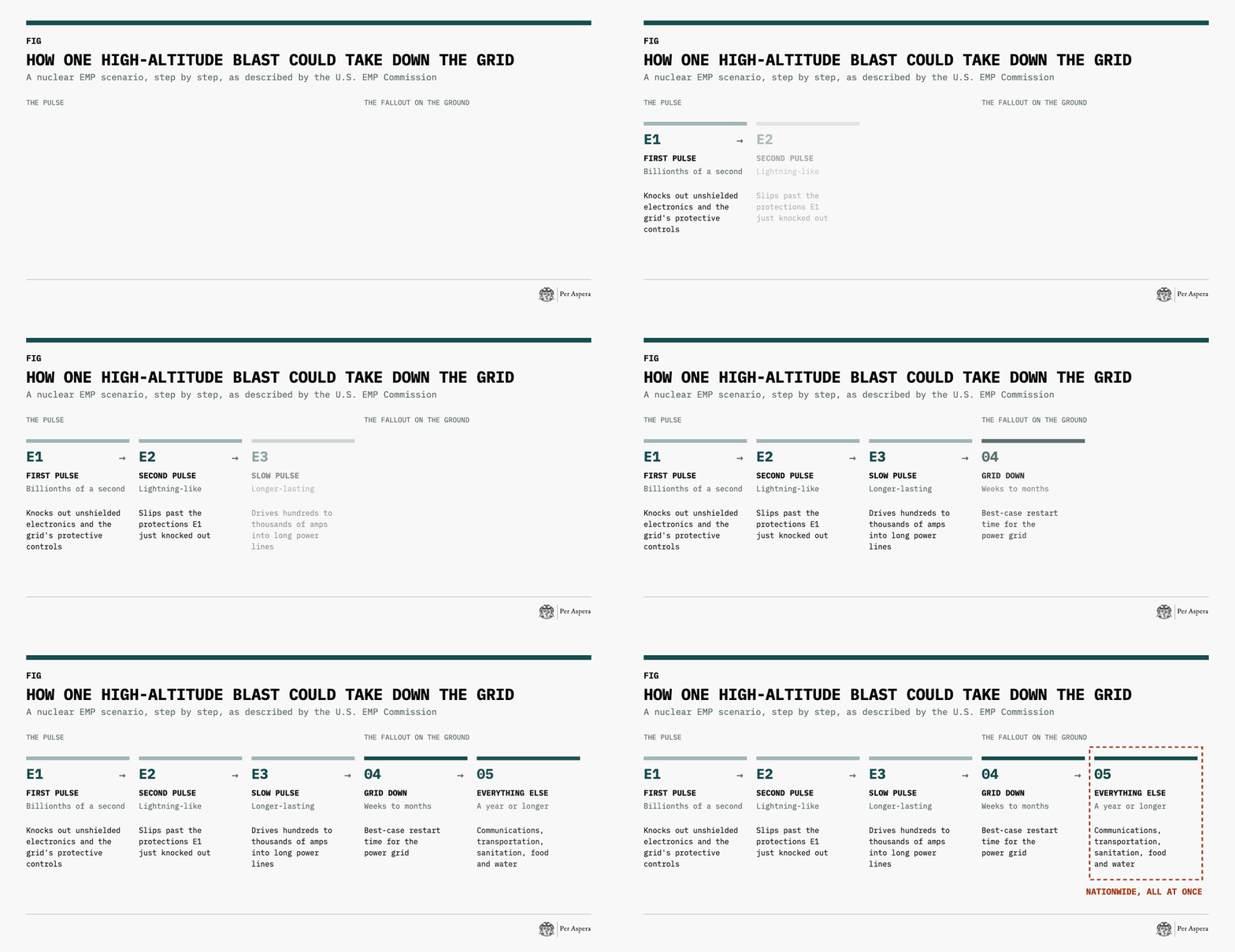
Sources: EMP Commission Executive Reports (2004, 2017); Critical National Infrastructures Report (2008). Chart: Per Aspera.
My former colleague, Jim Woolsey, who ran the CIA under President Clinton, devoted a good part of his distinguished career to calling attention to the danger of EMP. He co-wrote the Air Force’s 2018 task force report on the threat. The EMP Commission, whose work he championed, concluded that a blackout after an attack “could plausibly last a year or longer” and could bring “the death of a large fraction of the American people” through starvation, disease, and societal collapse. The commission closed in 2017 when its funding ran out. Woolsey died this July.
Some of the popular pictures are exaggerated. When the commission ran 37 cars through simulated pulses, three stalled, and all three restarted. The grid is where the real danger sits. As we’ve highlighted repeatedly in our work, large power transformers now take 30 to 36 months to deliver, and more than 80% of the ones America installs are imported. In August the White House declared a national emergency over the country’s dependence on foreign bulk-power equipment.
We have never addressed how to build commercial electronics and power systems that can withstand an EMP, because it has always been judged too expensive. Meanwhile the list of countries that could deliver an EMP attack keeps growing, including ones who, relatively speaking, have nothing to lose.
Build for the worst day
I’ve thought about this a lot. It’s not my intention to revive the old pants-on-fire debate over prompt dose or EMP, nor call for a big national program. Good defense, like good offense, has a balance to it. With that in mind, here are five things I would advocate for:
- DIVERSIFY: Keep low Earth orbit. It is too valuable for communications, sensing, science, defense, and commerce to abandon. But the country that depends on a single orbital regime for its national security, essential commercial services like weather forecasting, disaster management, warning and monitoring, communications, software updates, and critical national infrastructure has accepted a deep strategic vulnerability by default. Milstar, GPS and others have proved that GEO and MEO works. We need multiple orbits, multiple providers, and multiple paths.
- SHIELD & HARDEN: Design some portion of mission-critical spacecraft for survival, including modest radiation hardening, shielding, redundant electronics, autonomous recovery, and the ability to operate in degraded conditions. Then buy them that way. The objective should be a national capability that survives attack. Toward this end we do not need to requalify every part or redesign every satellite. Optimal shielding, combined with smarter electrical design and selective radiation hardening of electrical components can get most satellites through the pumped radiation belts for roughly 10 to 30 percent more in cost and 3-5 percent more in mass, by my estimate. Surviving a distant burst will cost more, and operating through a nearby one, as the President’s satellites must, costs several times a commercial build. Most of what we fly only needs the first level. Not everything will make it. Enough will.
- PREPARE: The same goes for the ground, and the ground is the cheaper problem. Hardening the grid, water system, hospitals, and electronics in other critical infrastructure would run $8 to $25 billion a year over roughly two presidential terms, by our back-of-the-napkin estimates. Well under a tenth of a percent of GDP, would add roughly a few hundred dollars to a car and less than half a percent to an electric bill, and as an added bonus, would provide protection against severe solar storms and lightning.
- BACKSTOP: Keep ground-based and airborne alternatives alive for every service the country cannot live without, and exercise them, rather than assuming that every critical service must pass through a satellite.
- NEGOTIATE: We have done this before. After the tests of 1962, when the United States and the Soviet Union each damaged their own hardware, the two governments looked at the results and decided this was foolish. The following year they banned nuclear tests in space, and four years after that the Outer Space Treaty banned nuclear weapons in orbit. That bargain has frayed; in 2024 Russia vetoed a UN Security Council resolution reaffirming it. It is time to start negotiating again. Keeping nuclear weapons out of low Earth orbit is in the interest of the United States, it is in the interest of China, which is building large constellations of its own, and it is in Russia’s interest too. Whether one or two smaller countries sign on matters less than whether the major space powers do. It may have long odds, but it’s worth a shot.
The House has asked the Space Force for a briefing by March 1 on what a nuclear detonation does to satellites in low orbit. This seems like a fine question to be taken up by Project Meridian, Secretary Hegseth’s new 120-day study of future warfare, led by Elon Musk, Palmer Luckey, and Newt Gingrich.
We’ve built for the worst day before. But in LEO, we keep building for peacetime and hoping war never comes. Pray that it never does, but build as though it will.