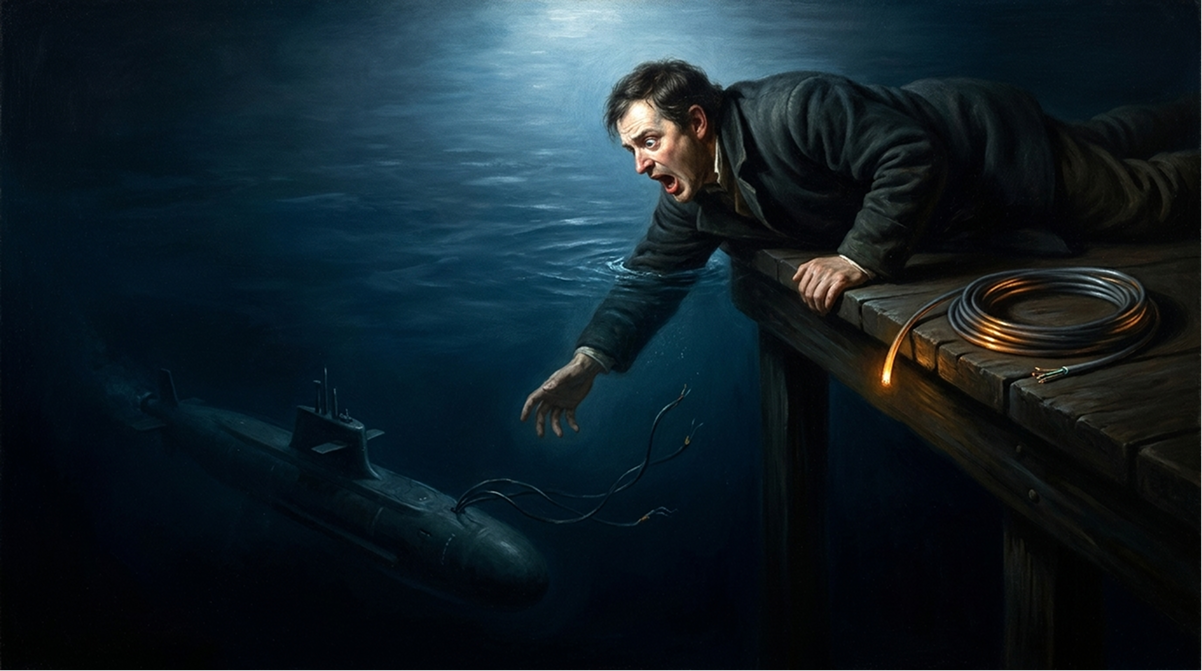
The Unsolved Problem of Subsea Communications
This March, the Defense Innovation Unit and the Navy picked Anduril’s Dive-XL for a program called CAMP. It imposes hard requirements for systems that are already hard enough to build, in a place that’s already hostile enough as it is: cross 1,000+ nautical miles without surfacing, operate below 200 m, hold a course where GPS can’t reach, and set payloads down on the sea floor. Anduril is now spinning up a line at Quonset Point, Rhode Island to turn out dozens of these things a year.
There’s one requirement that the Navy and DIU conspicuously left out, and we can’t fault them, as it’s an issue that nobody has been able to solve. Once a system like Dive-XL…. dives, you can’t really reach it.
This is the harder half of a problem we’ve spent the better part of two centuries working from the other end.
Then & Now

The first transatlantic telegraph took ~16.5 hours to cross, and the cable that carried it burned out within a few weeks. But the core idea lived on: a signal-carrying core that we armored, buried, and landed at shore stations.
We’ve perfected the pipe (it’s a great pipe sir), evolving from copper and Morse, to copper + coaxial for analog telephony, to glass fiber carrying light (not unlike the shift currently underway in datacenters). Today, a single modern fiber pair can push ~200 TB/s across an ocean.
Beyond any reasonable doubt, we’ve mastered the fixed link: the thing bolted to the bottom, or tethered to a ship. But in our 165 years as a seabed cable-laying species, we’ve been fundamentally unable to solve high‑bandwidth, stealthy wireless at depth.
The moving link has eluded us.
Not for lack of trying, but due to the tricky physics of it all. Anyone who sets out to solve underwater comms is navigating a tough trade space, and headed headlong into a three-way trap:
- Saltwater swallows radio. Only the very lowest frequencies make it to a submarine at depth, in one direction, at a few hundreds bits per second, from megawatt shore stations the size of small towns.
- Sound carries, but it crawls along (~1,500 m/s) and tops out in the kilobits (e.g., 1992 dial-up speeds on a good day) if you want real range. Therein lies the challenge: optimize for range, and you’ll sacrifice bandwidth.
- Light is fast — with blue-green lasers able to push gigabits — but the beam dies past ~200 m and demands a marksman’s aim between two moving platforms in a messy medium. (I’d bet somewhere, right now, an ex Starlinker is working on this — if that’s you, get in touch)
If you’re the United States Navy, you’re also facing an operational trap: talking at all is a tell, because the two ways to get real bandwidth will blow your cover:
- Surface and your mast, periscope, or buoy is in view of RF and satellites.
- Transmit sound and you are… transmitting sound… by definition, announcing yourself to the ASW ears that are built to hear exactly that.
Fire and forget
So, stealth and connectivity are in direct tension. The depth and silence a dual-use platform so desperately seeks is precisely what’s cutting it off from Command and Control (C2). We work around these constraints by taking C2 out of the loop and turning to autonomy. But the comms challenge means that today’s undersea autonomy is largely “fire-and-forget”: you program the mission, launch, and hope, because you cannot retask in real time.
And don’t get me wrong — we need more AUVs (autonomous underwater vehicles) — and by goodness, is industry rising to the call for more autonomous, attritable, agile, FBC surface and subsurface vessels. Catch me in a pub, and I could probably rattle off at least two dozen startups (plus the bigco programs) building these systems, just from the top of my head. There’s enough work to go around for these craft builders: ISR, mine countermeasures, ASW, seabed surveying, payload/strike, etc.
But there’s still that one stubborn problem: you can build the robot, but you can’t talk to it in real time once it’s in the deep.
A Blue-Ocean Opportunity
I do not submerge you with nautical knowledge simply because it’s the latest obtuse obsession of mine, or a nice-to-have science project, but because the ocean is one of the least appreciated, most critical strategic domains of our time.
Conservatively, 95%+ of intercontinental data goes through subsea infrastructure, and a large share of cross-border oil and gas moves through seabed pipelines and offshore infrastructure. All of that is installed and maintained by a shockingly small fleet — on the order of sixty‑odd large, specialized cable‑laying and repair ships, many of them closer to retirement than launch. In a world where the incremental hull, craft, and vessel leaving a shipyard — whether ours or an adversary’s — wants to be autonomous, which way do you think the scales are tipping: toward attackers or defenders?
Indeed, down in the deep, as you’ve probably seen, cables are being cut and pipelines are blowing up. There’s plenty more ‘plausibly deniable’ activity down there that doesn’t make the front page news. (Look no further than my editor Ryan’s dispatch from Taiwan). Russia has an entire naval unit — the secretive, deep-sea GUGI, with assets purpose-built to tap or cut undersea infrastructure.
My call to action (or request for startups, if you will) is for the right team to attack this and build the missing piece. Right now every undersea vehicle (besides exquisite subs) is autonomous by necessity, not by choice. Persistent comms would give us more control, help the West defend its seabed infrastructure, and give the team who cracks it a huge mission and big ($$$) market.
Get in touch if you’ve got a company, product, a plan, or even concepts of a plan in this dept! To going where the signal doesn’t yet reach. 🥂